Indian Stream
Fly fishing in New Hampshire · Intermediate · Best seasons: Summer, Fall
Target Species
Brook Trout
About This Water
Pittsburg brook trout stream. Historic disputed territory with wild fish.
Fishing Recommendations
Welcome to the Great North Woods. As a guide in northern New Hampshire, I consider Indian Stream to be one of the crown jewels of the Pittsburg area. While the Connecticut River gets the most press, Indian Stream offers a more intimate, rugged, and "wild" experience for those seeking the quintessential Eastern Brook Trout.
Here is your comprehensive guide to fly fishing Indian Stream.
🎣 Location Overview
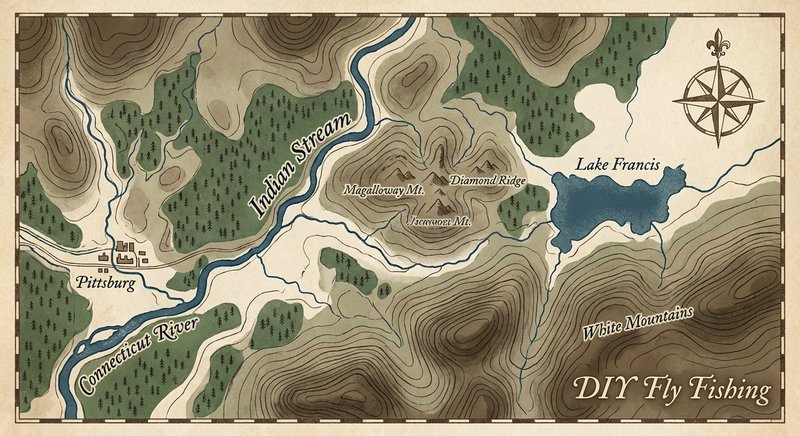
Indian Stream is a major tributary of the Connecticut River, flowing south from the Canadian border into Lake Francis. It is a classic New England freestone stream characterized by its remote feel, crystalline water, and a diverse mix of "pocket water," deep ledge pools, and gravelly runs.
What makes it special is the connectivity. Because it flows into the Connecticut River system, it benefits from "run-up" fish—large Brookies and Landlocked Salmon that move into the stream to escape summer heat or to spawn in the fall. It feels like a wilderness experience, where you are more likely to see a moose than another angler.
🐟 Target Species & Behavior
The primary draw is the Brook Trout.
- Wild vs. Stocked: The stream holds a healthy population of wild, native "salter-style" brookies in its upper reaches, while the lower sections are supplemented with high-quality stocked fish.
- Behavior: These fish are opportunistic but spook easily. In the fast pocket water, they strike aggressively because they have seconds to decide before the food is gone. In the larger, slower pools, they become highly selective and demand stealth.
- Diet: Their diet consists mainly of caddisflies, small stoneflies, and mayflies (Blue Winged Olives and Hendricksons). In the summer, they become highly focused on terrestrials (ants and beetles).
📅 Best Times to Fish
Summer (Late June – August)
- Window: Early morning and the "magic hour" before dark.
- Conditions: Water levels can drop; look for highly oxygenated water—riffles and the heads of pools. This is the prime time for dry fly fishing.
Fall (September – October 15th)
- Window: All day, particularly overcast afternoons.
- Conditions: This is the most exciting time. Large "Lake Run" Brookies and Landlocked Salmon move up from Lake Francis. The fish are in their brilliant spawning colors, and the aggressive "pre-spawn" bite is on.
🪰 Recommended Flies & Techniques
Top Fly Patterns
- Dry Flies:
- Royal Wulff or Royal Coachman (Sizes 12-16): The white wings are easy to see in broken water.
- Elk Hair Caddis (Tan or Olive, Sizes 14-18).
- Foam Beetle or Cinnamon Ant (Sizes 16-18): Vital for summer afternoons.
- Nymphs:
- Pheasant Tail (Flashback) (Sizes 14-18): Mimics almost any mayfly.
- Prince Nymph (Sizes 12-16): Great for the deeper, darker holes.
- Zebra Midge (Size 20): Crucial when the water is low and clear.
- Streamers:
- Woolly Bugger (Olive or Black, Sizes 8-10): Swing these through deep pools.
- Muddler Minnow: Excellent for mimicking sculpins or even grasshoppers.
Presentation Tips
- Dry-Dropper: This is the "bread and butter" on Indian Stream. Hang a small Pheasant Tail 18 inches below a buoyant Stimulator or Elk Hair Caddis.
- Stealth: The water is exceptionally clear. Wear drab clothing, keep a low profile, and try to avoid wading deeply; many fish hold right against the bank.
💡 Pro Tips & Local Knowledge
- The "Dead Water": There are sections of Indian Stream referred to as the "Dead Water." These are slower, deeper stretches. While they look fishless during the heat of the day, they hold the largest fish in the stream. Fish these at dusk with a large dry fly or a stripped streamer.
- Go North: Many anglers stay near the mouth. If you want wilder, smaller fish and total solitude, take the logging roads further north toward the border. The stream narrows, but the "gems" are more frequent.
- The "Pocket Water" Game: Don't spend too much time on one pool. If a fish is going to strike in a pocket, it will usually do so on the first three drifts. Cover water to find the active fish.
⚠️ Important Information
- Access: Access is primarily via Indian Stream Road, a gravel logging road. It is generally well-maintained, but a vehicle with decent clearance is recommended. Pull completely off the road when parking to allow logging trucks to pass.
- Regulations:
- NH Fish and Game regulations apply. Much of the stream has specific rules regarding "General Law" vs. "Fly Fishing Only" or "Catch and Release" depending on the time of year and specific section. Always check the current NH Freshwater Fishing Digest before your trip.
- Note: The season for most NH rivers ends October 15th.
- Safety: You are in bear and moose country. Carry a whistle, let someone know where you are going (cell service is non-existent), and be mindful of the "Pittsburg weather"—it can drop 30 degrees in an hour.
Guide’s Final Word: Indian Stream isn't about trophy sizes every cast; it’s about the beauty of the fish and the wildness of the setting. Bring a 3-weight or 4-weight rod, a box of classic dries, and your sense of adventure. Tight lines!
Bug Hatches & Matching Flies
| Hatch | Type | Peak months | Time of day | Hook sizes | Matching flies |
|---|---|---|---|---|---|
| Blue Winged Olive Baetis | mayfly | May, September, October | Afternoon | #18-22 | RS2 #18-22, Parachute BWO #18-20, Pheasant Tail #18-20 |
| Hendrickson Ephemerella subvaria | mayfly | May | Afternoon | #12-14 | Red Quill #12-14, Hendrickson Emerger #12-14, Hendrickson Nymph #12-14 |
| Grannom Caddis Brachycentrus | caddis | May | Late Morning/Afternoon | #14-16 | Peacock Caddis #14-16, LaFontaine's Deep Sparkle Pupa #14-16, Elk Hair Caddis (Dark) #14-16 |
| March Brown Maccaffertium vicarium | mayfly | June | Afternoon | #10-12 | March Brown Dry #10-12, Gold Ribbed Hare's Ear #10-12, March Brown Wet #10-12 |
| Pale Evening Dun (Sulphurs) Ephemerella invaria | mayfly | June, July | Evening | #14-18 | Sulphur Parachute #14-18, Sulphur Emerger #16-18, Pheasant Tail #16-18 |
| Golden Stonefly Acroneuria | stonefly | June, July | Evening/Night | #8-12 | Stimulator (Yellow) #8-12, Pat's Rubber Legs #8-12, Golden Stone Nymph #10-12 |
| Light Cahill Stenacron interpunctatum | mayfly | July, August | Evening | #12-14 | Light Cahill #12-14, Cahill Wet #14, Cream Variant #12-14 |
| Trico Tricorythodes | mayfly | August, September | Morning | #22-26 | Trico Spinner #22-24, Trico Drowned Spinner #22-24, Griffith's Gnat #22-24 |
| Giant Black Stonefly Pteronarcys dorsata | stonefly | May, June | Evening | #4-8 | Kaufmann Stone #4-8, Girdle Bug #6-10, Black Stimulator #8 |
| Terrestrials Formicidae / Gryllidae | terrestrial | July, August, September | All Day | #12-18 | Chernobyl Ant #10-14, Black Foam Ant #14-18, Beetle #14-16 |