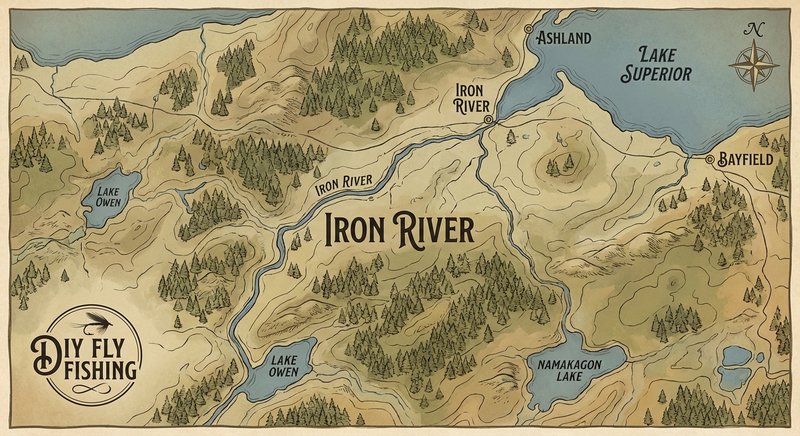
Iron River
Fly fishing in Wisconsin · Intermediate · Best seasons: Spring, Summer, Fall
Target Species
Steelhead, Brook Trout, Brown Trout
About This Water
Lake Superior tributary with steelhead and brook trout. Northern Wisconsin wilderness.
Fishing Recommendations
The Iron River in Bayfield County, Wisconsin, is one of the "South Shore’s" best-kept secrets. While its neighbor to the west, the Bois Brule, garners most of the international fame, the Iron River offers a more intimate, rugged, and often less-crowded experience. It is a diverse system that transitions from a classic spring-fed brook trout stream in its upper reaches to a powerful Lake Superior tributary in its lower sections.
🎣 Location Overview
The Iron River is a quintessential Lake Superior tributary characterized by its "dual personality."
- The Upper River: Above the town of Iron River, the water is cold, clear, and spring-fed. It flows through sandy pine barrens and alder thickets, providing some of the best resident brook trout habitat in the region.
- The Lower River: As it moves toward Lake Superior, the river gains volume and carves through red clay banks and sandstone. This section is the playground for "adfluvial" (lake-run) species.
What makes it special is the solitude. While the Brule might have an angler every 100 yards during the steelhead run, the Iron River allows for a "get lost in the woods" feel. The river is notorious for its heavy woody debris—fallen cedars and log jams—which creates world-class overhead cover for trophy fish.
🐟 Target Species & Behavior
Steelhead (Lake Superior Strain)
These are "spring runners" primarily, though some "loopers" (shorter-run fish) can appear. They are incredibly hardy and known for explosive leaps.
- Behavior: They hold in deep "guts" (the deepest part of a bend) during cold snaps and move into gravelly riffles to spawn as the water hits 42–45°F.
Brook Trout (Resident)
The native gems of the system. In the upper stretches, they are opportunistic but wary.
- Behavior: They hug the undercut banks and stay deep within "tag alder" sweepers. They feed heavily on caddis, mayflies, and small minnows.
Brown Trout (Resident & Lake-Run)
- Resident Browns: Found in the middle reaches. They are nocturnal hunters and very wary of overhead shadows.
- Lake-Run Browns: These monsters enter the river in late summer and fall. They are aggressive and territorial, often holding in the same deep pools as steelhead.
📅 Best Times to Fish
Spring (Late March – May)
- Prime Window: Mid-April is usually the "sweet spot" for Steelhead.
- Conditions: Look for "the drop and the clear"—after a spring thaw, when the water level is receding and the color changes from muddy chocolate to a "tannic tea" clarity.
Summer (June – August)
- Prime Window: Late June and July for the Hexagenia limbata (Hex) hatch.
- Time of Day: Late evening and into the night. This is when the largest resident Brown Trout come out to play. Daytime is excellent for Brookies on terrestrial patterns (hoppers/ants).
Fall (September – November)
- Prime Window: October.
- Conditions: The run of Lake-run Browns and Coho Salmon begins. This is arguably the best time for a "mixed bag" day. The fall colors in Bayfield County are an added bonus.
🪰 Recommended Flies & Techniques
For Steelhead (Lower River)
- Flies: Glo-bugs (Oregon Cheese, Roe color), Egg-Sucking Leeches (Purple/Black), and Beadhead Stonefly nymphs (Size 6-10).
- Technique: Indicator Nymphing. Use enough split shot to get the fly to the "tick" the bottom. A "dead drift" is mandatory.
For Resident Brook & Brown Trout (Upper River)
- Dries: Elk Hair Caddis (Size 14-16), Royal Wulff, and Parachute Adams. For the Hex hatch, use a Size 4-6 Hex Parachute.
- Streamers: Black or Olive Wooly Buggers. For big browns, try a "Sex Dungeon" or similar articulated pattern near log jams.
- Technique: Stealth Casting. The water is clear; use 5x or 6x tippet for brookies and stay low to the bank to avoid being "spooked."
💡 Pro Tips & Local Knowledge
- The "Orienta" Area: The area near the old Orienta Dam site (now removed) is a hotspot for lake-run fish. The removal of the dam has changed the river's morphology, creating new gravel runs that fish are still adapting to—explore these "new" stretches!
- Wood is Good: On the Iron, if you aren't losing a few flies to submerged logs, you aren't fishing where the big fish are. Cast tight to the "sticks."
- The "South Shore Swing": While nymphing is most productive, swinging a large intruder-style fly on a light Spey rod or switch rod in the lower river can be incredibly rewarding for steelhead during a warm spring afternoon.
- Tannic Vision: The water often has a tea-colored stain. Use flies with a bit of "flash" or high-contrast colors (chartreuse, hot pink, or solid black) to help fish track the fly.
⚠️ Important Information
Access Information
- Hwy 2 Bridge: A common access point for the lower river.
- County Hwy A: Provides several access points to the middle and upper reaches.
- Public Lands: Much of the upper river flows through Bayfield County Forest and state lands, but always respect "Posted" signs on private property.
Regulations & Permits
- License: A Wisconsin Fishing License AND an Inland Trout Stamp are required.
- Great Lakes Salmon/Trout Stamp: Required if you are fishing the lower sections for lake-run species.
- Special Seasons: The Iron River has specific "extended" seasons for Lake Superior tributaries. Generally, the season for the lower river (downstream from Hwy 2) opens earlier and stays open later than the inland trout season. Check the current WDNR Guide to Trout Fishing Regulations for "Category" colors.
Safety Considerations
- Red Clay: When wet, the clay banks of the Iron River become "greased lightning." Wear studded wading boots and use a wading staff.
- Bears & Bugs: This is black bear country—keep your snacks sealed. In June and July, the "Black Flies" and mosquitoes can be brutal; bring high-quality repellent or a head net.
Bug Hatches & Matching Flies
| Hatch | Type | Peak months | Time of day | Hook sizes | Matching flies |
|---|---|---|---|---|---|
| Blue-winged Olive Baetis / Pseudocloeon | mayfly | April, May, September, October | Midday | #18-22 | BWO Sparkle Dun #18-22, Pheasant Tail Nymph #18-20, RS2 #20-22 |
| Hendrickson Ephemerella subvaria | mayfly | May | Afternoon | #12-14 | Hendrickson Dark #12-14, Red Quill #12-14, Hare's Ear Nymph #12-14 |
| Grannom Caddis Brachycentrus | caddis | May | All day | #14-16 | Elk Hair Caddis (Olive) #14-16, Peacock Caddis Larva #14-16, Deep Sparkle Pupa #14-16 |
| Sulphur Ephemerella dorothea | mayfly | June | Evening | #16-18 | Sulphur Parachute #16-18, Sulphur Emerger #16-18, Mercer's Trigger Murphy #16 |
| Brown Drake Ephemera simulans | mayfly | June | Late Evening | #10-12 | Brown Drake Spinner #10-12, Brown Drake Cripple #10-12 |
| Hex Hexagenia limbata | mayfly | June, July | Night | #4-8 | Hexagenia Spinner #6-8, Wiggle Hex Nymph #6-8, Robert's Yellow Drake #8 |
| Trico Tricorythodes | mayfly | July, August, September | Morning | #20-24 | Trico Spinner (Female) #20-24, Griffith's Gnat #20-22 |
| Hopper/Ant/Beetle Formicidae / Coleoptera | terrestrial | July, August, September | Afternoon | #8-16 | Dave's Hopper #8-12, Black Foam Ant #14-18, Chernobyl Ant #8-12 |