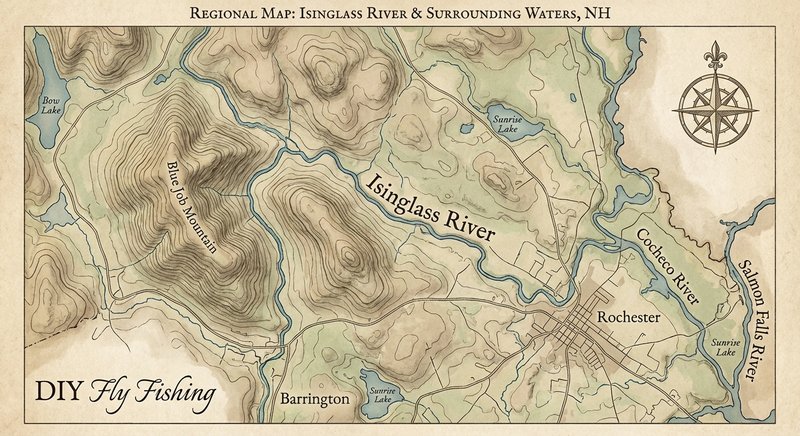
Isinglass River
Fly fishing in New Hampshire · Intermediate · Best seasons: Spring, Summer, Fall
Target Species
Brook Trout
About This Water
Strafford County stream with wild brook trout. Technical small stream.
Fishing Recommendations
Tight lines! As a guide who has spent plenty of time navigating the technical pocket water of New England, I can tell you that the Isinglass River is one of the Seacoast region’s most underrated gems. It is a quintessential New Hampshire river: boulder-strewn, moody, and full of character.
Here is your comprehensive guide to fly fishing the Isinglass for Brook Trout.
🎣 Location Overview
The Isinglass River flows roughly 15 miles from Bow Lake in Strafford down to its confluence with the Cocheco River in Rochester. It is a classic "pool-and-drop" river characterized by granite boulders, sandy runs, and dense overhanging canopy.
What makes it special is its accessibility paired with its rugged feel. While it’s close to the Seacoast population centers, many stretches feel remarkably remote. The water is generally tea-colored (tannic) due to the surrounding wetlands, which means stealth and high-contrast flies are your best friends. It is a river that rewards technical casting and a "short game" approach.
🐟 Target Species & Behavior
The primary draw here is the Brook Trout.
- Stocked vs. Wild: The NH Fish & Game department stocks the Isinglass heavily with Brookies (and some Browns). However, the upper reaches and cooler tributaries hold wild, native "salters" or resident Brookies that are smaller but exceptionally vibrant.
- Holding Patterns: Because of the boulder-heavy nature of the river, these fish love to sit in the "cushion" right in front of large rocks or in the soft bubbles just behind them.
- Feeding: Isinglass Brookies are opportunistic. They aren't usually picky about specific hatches, but they are very wary of overhead shadows due to heavy predation from herons and kingfishers.
📅 Best Times to Fish
Spring (Late April – June)
- Conditions: This is the prime window. The water levels are high, and the stocking trucks have made their rounds.
- Window: Mid-day is best until the water warms up.
- Note: Watch out for "black fly season" in May—bring a head net!
Summer (July – August)
- Conditions: The Isinglass can get low and warm. During a hot drought, please carry a thermometer; if the water hits 68°F, stop fishing to protect the trout.
- Window: "Dawn patrol" or the last hour of light. Look for shaded stretches and areas where cold springs enter the main stem.
Fall (September – October)
- Conditions: My favorite time. The Brookies are in their spawning colors (vibrant oranges and reds) and become aggressive.
- Window: Afternoon sun helps wake up the bugs and the fish.
🪰 Recommended Flies & Techniques
Top Fly Patterns
- Dry Flies:
- Royal Wulff (#12-14): Great visibility in the tannic water.
- Elk Hair Caddis (#14-16): The river has heavy caddis activity.
- Stimulators (Orange or Yellow): Perfect for the "skating" technique.
- Nymphs:
- Pheasant Tail (#14-18): A staple for the Mayfly larvae.
- Bead-head Hare's Ear: The extra weight helps in the plunges.
- Zebra Midge (#18-20): Effective during low summer flows.
- Streamers:
- Black or Olive Woolly Bugger (#8-10): The gold standard for the Isinglass. Strip them through the deeper holes near the bridges.
Techniques & Presentation
- Tight-Line Nymphing: Because the river is so rocky, traditional indicator fishing often results in constant tangles. Using a "Euro" or tight-line style allows you to probe the pockets behind boulders effectively.
- The "Dap": In the brushy sections, you often won't have room for a backcast. Simply poking your rod through the bushes and dropping a dry fly (dapping) on the surface is a local secret.
💡 Pro Tips & Local Knowledge
- Focus on the Conservation Land: The Isinglass River Adventure Park and the Waste Management/Locke Falls areas offer great public access and well-maintained trails. The further you walk from the parking lots, the better the fishing gets.
- Check the USGS Gauge: The Isinglass doesn't have its own gauge, but you can monitor the Cocheco River at Rochester gauge. If the Cocheco is spiking after a rain, the Isinglass will be chocolate milk.
- The "Shadow" Rule: On the Isinglass, if your shadow falls across a pool, the Brookies will vanish. Always approach from downstream and stay low.
- Small Stream Stealth: Treat this like a small mountain stream. Use a 7'6" or 8' 3-weight or 4-weight rod. A 9-foot rod is often too cumbersome for the overhanging branches.
⚠️ Important Information
- Access: Key access points include the bridge on Route 126 in Strafford, Hale Farm Road, and the Gonic Trails area in Rochester.
- Regulations: The Isinglass is generally managed under general NH fishing regulations, but always check the NH Fish & Game Freshwater Digest for any mid-season changes or specific "Fly Fishing Only" designations (though most of the Isinglass is open to all tackle).
- Wading Safety: The rocks in the Isinglass are notoriously "greasy." Felt soles (where legal) or studded wading boots and a wading staff are highly recommended.
- Ticks: This area of NH is high-density for ticks. Wear long sleeves and use Permethrin-treated clothing.
Guide’s Final Word: The Isinglass isn't about catching 20-inch monsters; it's about the beauty of the woods, the technicality of the cast, and the jewel-like colors of a wild New Hampshire Brook Trout. Enjoy the solitude!
Bug Hatches & Matching Flies
| Hatch | Type | Peak months | Time of day | Hook sizes | Matching flies |
|---|---|---|---|---|---|
| Blue Winged Olive Baetis spp. | mayfly | April, May, September, October | Midday | #18-22 | BWO Sparkle Dun #18-20, Pheasant Tail #18-22, RS2 #20-22 |
| Hendrickson Ephemerella subvaria | mayfly | May | Afternoon | #12-14 | Red Quill #12-14, Hendrickson Nymph #12-14, Hendrickson Emerger #14 |
| Grannom Caddis Brachycentrus | caddis | May | Morning/Afternoon | #14-16 | Elk Hair Caddis (Olive) #14-16, Pupa-X #14-16, Peeping Caddis #14 |
| Sulfur Ephemerella invaria | mayfly | June, July | Evening | #14-18 | Sulfur Parachute #14-18, Sulfur Emerger #16-18, Frenchie #16 |
| Light Cahill Stenonema/Stenacron | mayfly | June, July | Evening | #12-14 | Light Cahill #12-14, Hare's Ear (Light) #12-14 |
| Slate Drake Isonychia bicolor | mayfly | July, August, September | Afternoon/Evening | #10-12 | Isonychia Parachute #10-12, Prince Nymph #10-12, Iso Nymph #10-12 |
| Cinnamon Caddis Hydropsyche | caddis | June, July, August | Evening | #14-18 | Elk Hair Caddis (Tan) #14-18, Cinnamon Soft Hackle #14-16, Holy Grail #16 |
| Terrestrials (Ants/Beetles) Formicidae/Coleoptera | terrestrial | July, August, September | All Day | #12-18 | Black Foam Ant #14-18, Cinnamon Ant #14-16, Japanese Beetle #12-14 |