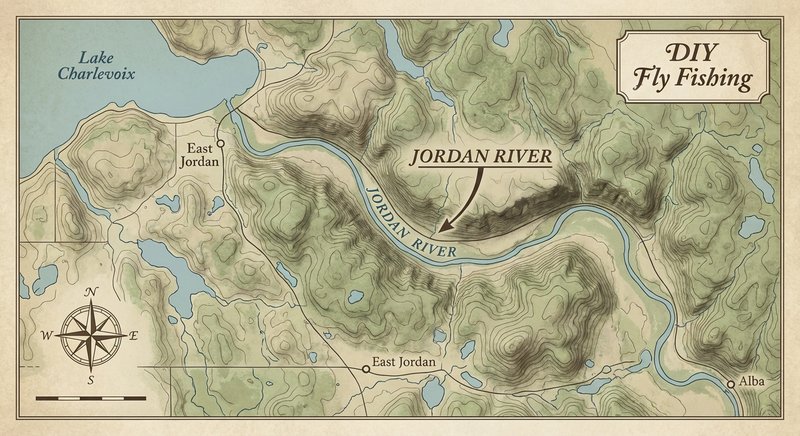
Jordan River
Fly fishing in Michigan · Beginner · Best seasons: Spring, Summer, Fall
Target Species
Brook Trout, Brown Trout
About This Water
First Michigan river designated as a Natural River. Wild brook trout in pristine setting.
Fishing Recommendations
The Jordan River in Northwest Lower Michigan is a crown jewel of the Midwest. As Michigan’s first designated "Wild and Scenic River," it offers some of the most pristine, cold-water fly fishing in the state. Flowing through a deep, glacial valley, the Jordan is a spring-fed masterpiece characterized by its crystal-clear water, lush cedar swamps, and an abundance of "woody debris" that provides perfect cover for wild trout.
🎣 Location Overview
The Jordan River is a relatively short but powerful system that flows roughly 25 miles before emptying into Lake Charlevoix at East Jordan. What makes it special is its thermal stability. Because it is heavily fed by groundwater springs, the river stays cold even during the heat of July, making it a reliable refuge for trout when other regional rivers (like the Manistee or Boardman) might get too warm.
The river is generally divided into two personalities:
- The Upper River: Above Graves Crossing. It is smaller, tighter, and dominated by wild Brook Trout.
- The Lower River: Below Graves Crossing toward Webster Bridge. The river widens, deepens, and becomes the domain of larger, more selective Brown Trout.
🐟 Target Species & Behavior
Brook Trout (Native)
The Jordan is arguably one of the best Brook Trout streams in the Lower Peninsula. These fish are vibrant, aggressive, and wild.
- Behavior: They hold in the "soft" water—behind logs, in small eddies, and right against the bank.
- Feeding: They are opportunistic. In the upper sections, they will often rise to a well-placed dry fly even if a hatch isn't occurring.
Brown Trout (Wild)
The Browns in the Jordan are notoriously wary. While there are many smaller fish, the "monsters" are nocturnal or low-light hunters.
- Behavior: They live deep within the sunken cedar logs. To catch a trophy Brown here, you must be willing to put your fly into "the kitchen"—the tightest, brushiest spots imaginable.
- Feeding: They focus on heavy hatches (Hex, Drakes) or high-protein meals like sculpins and crayfish.
📅 Best Times to Fish
Spring (Late April – June)
- Conditions: High water early on, but as May progresses, the "Superbowl" of Michigan fly fishing begins.
- Highlights: The Hendrickson hatch (May) and the Sulphurs (early June). This is the best time for high-volume dry fly action.
Summer (Late June – August)
- Conditions: This is the time for the "Michigan Night Games."
- Highlights: The Hexagenia Limbata (Hex) hatch usually hits the Jordan in late June or early July. It is a massive mayfly that brings the largest Browns to the surface at dusk and into the night. Daytime fishing remains excellent with terrestrials (grasshoppers and ants).
Fall (September – October)
- Conditions: Crisp mornings and changing colors.
- Highlights: Brook Trout are in their spectacular spawning colors. Large Brown Trout become aggressive and territorial. This is Streamer Season.
🪰 Recommended Flies & Techniques
Dry Flies
- Hatch Specific: Robert’s Yellow Drake (a Michigan staple), Adams (Parachute or Traditional), Standard Hex (Size 4-6), and Light Cahills.
- Attractors: Royal Wulff or Au Sable Wulff.
- Terrestrials: Chernobyl Ants, Dave’s Hopper, and foam beetles.
Nymphs
- Patterns: Pheasant Tail (14-18), Prince Nymph, and Gold-Ribbed Hare’s Ear.
- Technique: Use a "dry-dropper" rig in the upper river to cover both bases without spooking fish with a heavy indicator.
Streamers
- Patterns: Sculpzilla, Galloup’s Dungeon (in smaller sizes), and the classic Muddler Minnow.
- Colors: Black, Olive, or "White/Tan" to mimic juvenile trout or sculpins.
💡 Pro Tips & Local Knowledge
- "The Jordan Reach": The river is full of "sweepers" (fallen trees). You cannot always make a traditional overhead cast. Master the roll cast and the bow-and-arrow cast. If you aren't losing a few flies to the cedars, you aren't fishing close enough to the fish.
- Graves Crossing: This is the most popular access point. To find solitude, head to the Jordan River Valley Road and look for the small, unmarked pull-offs. The hike down to the river can be steep, but the fishing is often untouched.
- Wading Safety: The Jordan has a deceptive bottom. While much of it is firm sand or gravel, there are "silt pockets" or "suck holes" near log jams that can go from 6 inches to 3 feet deep instantly. Wade slowly and use a staff.
- Stealth is Key: The water is gin-clear. Wear earthy tones (camo, olive, tan) and avoid "lining" the fish. Long, fine leaders (9-12ft, 5x or 6x) are often necessary for the Browns.
⚠️ Important Information
- Regulations: Much of the Jordan is Type 1 Water (Check the current Michigan DNR Fishing Guide for specific boundary dates). Typically, the season opens the last Saturday in April and closes September 30th.
- Access: The Jordan River Valley is a state-owned forest. Access is plentiful via public land, but much of it requires a 4WD vehicle, especially after rain.
- Cell Service: Expect zero cell service in the heart of the valley. Download your maps for offline use before heading in.
- Conservation: This is a fragile ecosystem. Practice Catch and Release—especially for the native Brook Trout—to ensure this "Wild and Scenic" gem stays that way for the next generation.
Guide’s Final Word: The Jordan isn't a river where you go to catch 50 fish a day; it's a river where you go to disappear into the cedars and hunt for some of the most beautiful wild trout in North America. Slow down, watch the water, and respect the wood.
Bug Hatches & Matching Flies
| Hatch | Type | Peak months | Time of day | Hook sizes | Matching flies |
|---|---|---|---|---|---|
| Blue-Winged Olive Baetis spp. | mayfly | April, May, September, October | Midday | #18-22 | BWO Sparkle Dun #18-20, Pheasant Tail Nymph #18-22, RS2 #20-22 |
| Hendrickson Ephemerella subvaria | mayfly | May | Afternoon | #12-14 | Hendrickson Dark #12-14, Red Quill #12-14, Hendrickson Wet Fly #12-14 |
| American Grannom Brachycentrus | caddis | May | All Day | #14-16 | Peacock Caddis #14-16, Holy Grail Caddis #14-16, Elk Hair Caddis (Dark) #14-16 |
| Sulphur Ephemerella invaria/dorothea | mayfly | June | Evening | #14-18 | Sulphur Parachute #16-18, Sulphur Emerger #14-18, Mercer's Poxyback Sulphur #16-18 |
| Brown Drake Ephemera simulans | mayfly | June | Late Evening | #8-12 | Brown Drake Spinner #10-12, Brown Drake Cripple #10-12, Hare's Ear Nymph #8-12 |
| Hex Hexagenia limbata | mayfly | June, July | Night | #4-8 | Hex Dun #4-6, Hex Spinner (Spent) #4-6, Wiggle Hex Nymph #6-8 |
| Trico Tricorythodes spp. | mayfly | July, August, September | Morning | #22-26 | Trico Spinner #22-24, Trico Parachute #22-24, Zebra Midge #22-24 |
| Terrestrials Formicidae / Gryllidae | terrestrial | July, August, September | All Day | #8-16 | Chernobyl Ant #8-12, Black Foam Beetle #14-16, Cinnamon Ant #14-18 |