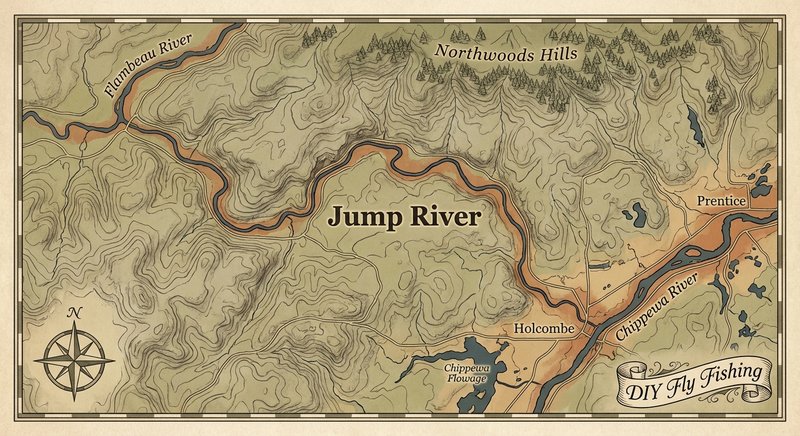
Jump River
Fly fishing in Wisconsin · Beginner · Best seasons: Summer, Fall
Target Species
Brook Trout, Smallmouth Bass
About This Water
Northern Wisconsin stream with trout and smallmouth bass. Remote wilderness waters.
Fishing Recommendations
The Jump River in North-Central Wisconsin is one of the state’s best-kept secrets. It is a rugged, "big woods" river that offers a classic Northwoods experience without the crowds of the Driftless Area or the Brule. Flowing through Taylor, Price, and Rusk counties, it transitions from a cold-water trout fishery in its upper forks to a world-class smallmouth bass and musky river in its lower reaches.
As your guide, here is the breakdown for tackling the Jump River.
🎣 Location Overview
The Jump River is defined by its rocky, boulder-strewn bed and its tea-colored, tannic water. It is a "flashy" river, meaning it rises and falls quickly with rainfall.
What makes it special is the transition zone. The North and South Forks are primary targets for wild Brook Trout, characterized by tighter corridors and colder spring-fed inflows. As these forks merge near the village of Jump River, the water warms slightly and the river widens, transforming into a premier Smallmouth Bass fishery. Anglers love it because it feels prehistoric; you are more likely to see a black bear or a bald eagle than another fly fisherman.
🐟 Target Species & Behavior
Brook Trout (Upper Forks)
- Behavior: These are wild, opportunistic fish. Due to the tannic water, they are often dark and vibrantly colored.
- Holding Zones: Look for "pockets" behind large granite boulders and deep undercut banks where cold springs enter the main stem.
- Feeding: They rely heavily on terrestrial insects in the summer and small forage fish/crayfish.
Smallmouth Bass (Main Stem)
- Behavior: The "Bronzeback" here are aggressive and lean. They use the heavy current to their advantage.
- Holding Zones: In the Jump, Smallmouth love the "seams" where fast water meets slow water. They also stack up in the deep pools below the river's many rocky rapids.
- Feeding: Their diet is dominated by crayfish and hellgrammites (dobsonfly larvae), as well as dace and shiners.
📅 Best Times to Fish
Summer (June – August)
- Smallmouth: This is the prime window. Low, clear water allows for sight casting and topwater action.
- Brook Trout: Focus on the early morning or late evening. In July and August, look for "thermal refuges"—areas where colder tributaries flow into the forks.
- Time of Day: For Smallmouth, the "Golden Hour" (last two hours of light) provides legendary topwater action.
Fall (September – October)
- The Transition: As water temperatures drop, Smallmouth become incredibly aggressive, bulking up for winter. This is the time for trophy fish.
- Brook Trout: The colors of the Brookies in late September are world-class as they prepare to spawn.
- Conditions: Overcast days are your best friend in the fall; the fish feel safer moving out of deep cover to hunt.
🪰 Recommended Flies & Techniques
For Smallmouth Bass
- Topwater: BoogleBugs or Sneaky Petes in frog or white (Size 4). Pop them rhythmically near boulder gardens.
- Subsurface: Clouser Minnows (Chartreuse/White) and Game Changers.
- The "Secret Weapon": Near Nuff Crayfish or any lead-eyed crayfish pattern hopped along the bottom.
For Brook Trout
- Dry Flies: Royal Wulff, Elk Hair Caddis, and Stimulators (Size 12-16). These fish aren't usually picky, but they want a high-floating fly they can see in the dark water.
- Terrestrials: Chernobyl Ants or Hopper patterns in late summer.
- Streamers: Black Wooly Buggers (Size 8-10) represent the leeches and baitfish common in the tannic water.
Techniques
- The "Jump" Cast: Because of the boulders, use a high-sticking technique to keep your line out of the "clashing" currents that cause drag.
- Swing the Riffles: For Smallmouth, swinging a streamer through a fast riffle into a pool is deadly.
💡 Pro Tips & Local Knowledge
- The "Confluence" Strategy: The area where the North and South Forks meet is a biological hotspot. Spend time here to find a mix of species.
- Wading Caution: The Jump River is notoriously slippery. The rocks are rounded and often covered in a fine silt. Studded wading boots and a staff are non-negotiable.
- Watch the Gauge: Use the USGS gauge at Sheldon, WI. If the river is spiking after a heavy rain, the water turns to "chocolate milk" and fishing becomes nearly impossible. You want a stable or falling trend.
- Streamer Colors: In the tannic "tea" water, black, purple, and gold silhouettes show up much better than natural olives or browns.
⚠️ Important Information
Access
- Public Lands: Much of the upper forks run through the Chequamegon-Nicolet National Forest, providing excellent public access.
- Road Crossings: Most bridge crossings are traditional access points. Always respect private property boundaries, which are common in the lower sections.
Regulations
- Trout: Check the WI DNR Trout Tool, as specific sections of the forks may have different size/bag limits (Category colors).
- Smallmouth: Generally, the Jump follows the Northern Zone bass regulations. Catch and release is highly encouraged to maintain the quality of the fishery.
- License: A valid Wisconsin Fishing License and an Inland Trout Stamp are required.
Safety
- This is a remote area with limited cell service. Always let someone know your "float plan" or where you intend to park.
- Bring bear spray or at least be "bear aware," as the Taylor County woods are prime habitat.
Bug Hatches & Matching Flies
| Hatch | Type | Peak months | Time of day | Hook sizes | Matching flies |
|---|---|---|---|---|---|
| Hexagenia Hexagenia limbata | mayfly | June, July | Dusk/Night | #6-10 | Hex Parasol #6-8, Wiggle Nymph #8-10 |
| Brown Drake Ephemera simulans | mayfly | June | Evening | #10-12 | Brown Drake Cripple #10-12, Hairwing Drake #10-12 |
| White Mayfly Ephoron leukon | mayfly | August | Dusk | #12-14 | White Wulff #12-14, Snowshoe Emerger #14 |
| Golden Stonefly Acroneuria lycorias | stonefly | June, July | Morning/Evening | #6-10 | Pat's Rubber Leg #6-10, Golden Rogue Stone #8-10 |
| Grannom Caddis Brachycentrus | caddis | May | Afternoon | #14-16 | Peacock Caddis #14-16, Holy Grail #14-16 |
| Slate Drake Isonychia bicolor | mayfly | July, August, September | Afternoon | #10-12 | Iso Parachute #10-12, Prince Nymph #10-12 |
| Trico Tricorythodes | mayfly | July, August | Morning | #20-24 | Trico Spinner #20-22, Sunken Trico #22-24 |
| Grasshopper Orthoptera | terrestrial | August, September | Mid-day | #6-12 | Morrish Hopper #8-12, Dave's Hopper #10-12 |