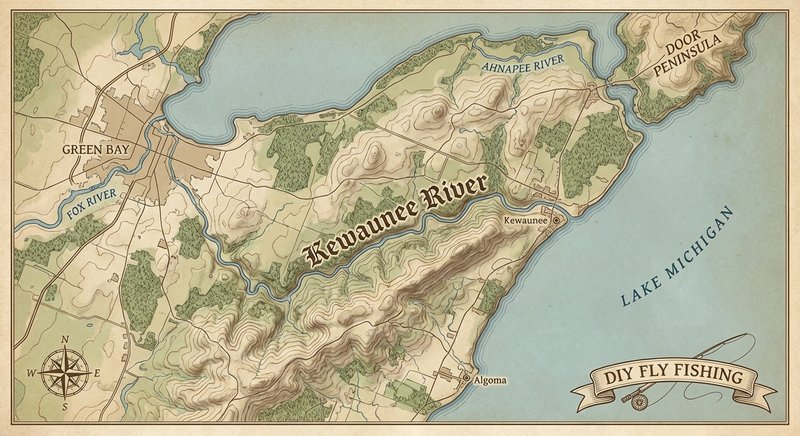
Kewaunee River
Fly fishing in Wisconsin · Intermediate · Best seasons: Spring, Fall
Target Species
Steelhead, Chinook Salmon
About This Water
Lake Michigan tributary with excellent steelhead runs. Popular spring fishery.
Fishing Recommendations
Welcome to the "Trout Coast" of Wisconsin. As your guide, I can tell you that the Kewaunee River is one of the premier Lake Michigan tributaries. It is a legendary destination, primarily because it hosts the C.D. Besadny Anadromous Fish Facility, which serves as a major collection point for eggs and a focal point for massive migrations of salmonids.
Here is your comprehensive guide to fly fishing the Kewaunee.
🎣 Location Overview
The Kewaunee River is a classic Great Lakes "spawning" river. It winds through the rolling farmland of Kewaunee County before emptying into Lake Michigan. What makes it special is its diversity of water; you’ll find everything from slow, deep "frog water" near the mouth to classic riffles, runs, and gravel bars further upstream.
Anglers love the Kewaunee because it is a high-volume river. Unlike smaller creeks, the Kewaunee can hold a massive amount of fish without feeling quite as "stacked" as other tributaries. When the run is on, the sheer density of fish moving past the Besadny facility is a spectacle of nature.
🐟 Target Species & Behavior
Steelhead (Rainbow Trout)
- Behavior: In the Spring, they are focused on spawning. They move onto gravel riffles to "bed up" but hold in the deeper "seams" and "tailouts" just below the gravel when resting. In the Fall, they follow the Chinook salmon to gorge on loose eggs.
- Feeding: They aren't "feeding" in the traditional sense, but they maintain a predatory instinct and a high metabolic interest in protein (eggs and nymphs).
Chinook Salmon (King Salmon)
- Behavior: These are the heavyweights of the fall. They enter the river to spawn and eventually die. They are most aggressive when they first enter from the lake (silver). Once they turn dark, they become more territorial and defensive of their redds (nests).
- Feeding: Kings rarely "eat" once in the river, but they will strike out of aggression or instinct.
📅 Best Times to Fish
- Spring Steelhead: March through early May. The "Push" usually happens when the ice breaks and the water hits 40–42°F. Peak spawning is typically mid-April.
- Fall Chinook: September through late October. The first big rains in September usually draw the Kings in.
- Fall Steelhead: October through December. These fish follow the salmon. This is often the best "quality" fishing, as the fish are chrome-bright and incredibly strong.
- Prime Conditions: Look for a "falling barometer" and water that is "dropping and clearing" after a rain event. Visibility of 12–24 inches is the "sweet spot" for fly anglers.
🪰 Recommended Flies & Techniques
Top Fly Patterns
- Eggs: Glo-bugs, Estaz Eggs, and Beads (8mm and 10mm) in Oregon Cheese, Mottled Orange, and Clown colors.
- Nymphs: Giant Stoneflies (Size 6-10) in black or gold, Prince Nymphs, and "Sucker Spawn."
- Streamers: Egg-Sucking Leeches (purple or black), Woolly Buggers, and large intruders for fresh-run fish.
Effective Techniques
- Indicator Nymphing: This is the bread and butter. Use a high-vis indicator and enough split shot to get your fly within 2 inches of the bottom. Your drift must be natural and at the same speed as the bubbles on the surface.
- Swinging Streamers: Highly effective in the lower river for fresh fish. Use a Skagit or Scandi line with a sink tip to swing leeches across the current.
- The "Chuck and Duck": Used primarily in deep, fast water near the Besadny facility where traditional fly lines struggle to sink fast enough.
💡 Pro Tips & Local Knowledge
- The Besadny Factor: The area immediately downstream of the Besadny Fish Facility is the most popular spot. While crowded, it holds the highest concentration of fish. If you want solitude, hike a half-mile downstream or explore the stretches near Footbridge Road.
- The "Walking Speed" Drift: If your fly is moving faster than the current at the bottom, Steelhead will ignore it. Use un-weighted flies and put your weight (split shot) 12–18 inches above the fly to allow for a more natural "tumble."
- Size Matters: In low, clear water, drop your leader size to 8lb or even 6lb fluorocarbon and use smaller beads (6mm). In murky water, go big and bright.
- Watch the Gravel: Do not walk on the "redds" (light-colored circles of clean gravel). Those are nests. Not only is it bad for the fishery, but it’s a quick way to get yelled at by local sticks.
⚠️ Important Information
- Access:
- C.D. Besadny Fish Facility: Excellent public access and parking.
- Footbridge Road: Good access to middle-river runs.
- County Highway F: Provides access to several public spots.
- Regulations:
- A Wisconsin Fishing License AND a Great Lakes Salmon/Trout Stamp are mandatory.
- Hook Gaps: Wisconsin has specific rules on hook size (gap cannot exceed 1/2 inch) in many tributary areas to prevent snagging.
- Night Closures: Most of the river is closed to fishing at night during the fall run. Always check the current WI DNR Trout Regulations before heading out.
- Safety: The Kewaunee can be slippery. Studded wading boots and a wading staff are highly recommended, especially near the rocky stretches of the Besadny facility.
Guide’s Final Word: The Kewaunee is a "reward" river. It can be cold, wet, and crowded, but when you hook into a 15-pound Steelhead that thinks it's still in Lake Michigan, you'll understand why we keep coming back. Tight lines!
Bug Hatches & Matching Flies
| Hatch | Type | Peak months | Time of day | Hook sizes | Matching flies |
|---|---|---|---|---|---|
| Blue-winged Olive Baetis tricaudatus | mayfly | April, May, September, October | Mid-day | #18-22 | RS2 #18-22, Parachute BWO #18-20, Pheasant Tail #18-22 |
| Midges Chironomidae | midge | February, March, April | Late Morning/Afternoon | #20-26 | Zebra Midge #18-22, Griffith's Gnat #20-24, Top Secret Midge #20-22 |
| Hendrickson Ephemerella subvaria | mayfly | May | Afternoon | #12-14 | Red Quill #12-14, Hendrickson Nymph #12-14, Hare's Ear #12-14 |
| Cinnamon Caddis Hydropsyche | caddis | June, July | Evening | #14-16 | Elk Hair Caddis #14-16, LaFontaine Sparkle Pupa #14-16, Caddis Larva #14-18 |
| Sulfur Ephemerella invaria | mayfly | June | Evening | #14-16 | Sulfur Parachute #14-16, Sulfur Emerger #16, Frenchie #14-16 |
| Little Black Stonefly Capniidae | stonefly | March, April | Mid-day | #14-18 | Prince Nymph #14-18, Black Stone #16-18, Copper John (Black) #16-18 |
| Light Cahill Stenacron interpunctatum | mayfly | June, July | Evening | #12-14 | Light Cahill #12-14, Gold Ribbed Hare's Ear #12-14 |
| Tricos Tricorythodes | mayfly | August, September | Morning | #22-26 | Trico Spinner #22-26, Trico Sunken Spinner #22-24 |
| Terrestrials Formicidae/Orthoptera | terrestrial | July, August, September | Mid-day | #10-16 | Black Foam Ant #14-18, Dave's Hopper #10-12, Beetle #14-16 |