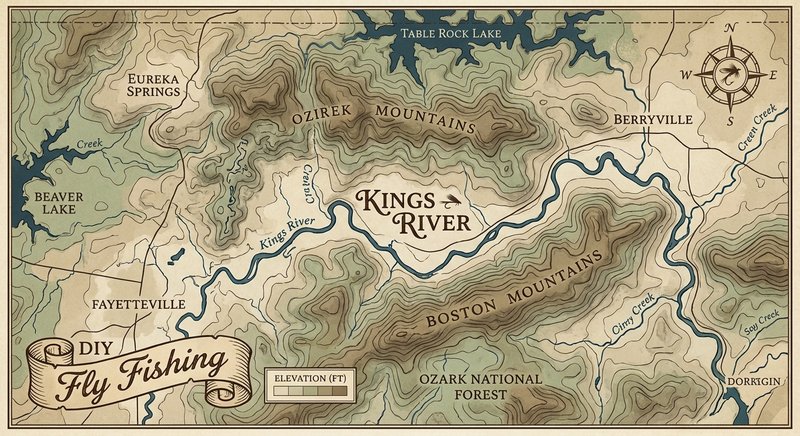
Kings River
Fly fishing in Arkansas · Intermediate · Best seasons: Spring, Summer, Fall
Target Species
Smallmouth Bass, Rainbow Trout
About This Water
Scenic Ozark stream with smallmouth bass and some trout. Float fishing opportunities.
Fishing Recommendations
The Kings River in the Arkansas Ozarks is a hidden gem of the South. Unlike the tailwaters of the White or North Fork, the Kings is a free-flowing, undammed river, meaning its character changes with the rain and the seasons. It is widely considered one of the premier Smallmouth Bass destinations in the United States, offering a "Wild West" feel with towering limestone bluffs and crystal-clear water.
🎣 Location Overview
The Kings River flows north out of the Boston Mountains, carving through the Ozark plateau before emptying into Table Rock Lake. What makes it special is its pristine, undeveloped nature. Large sections are designated as "Natural Areas," meaning you won't see many docks or houses—just eagles, kingfishers, and deep turquoise pools.
The water is characterized by a "pool and drop" structure: long, slow stretches of deep water separated by quick, rocky riffles and "shoals." The clarity is exceptional, often allowing for sight-fishing, which is a rare treat for bass anglers.
🐟 Target Species & Behavior
Smallmouth Bass (The Main Attraction)
The Kings River Smallmouth is a world-class fighter. Because they live in moving water, they are lean and incredibly strong.
- Behavior: They hold in the "seams" where fast water meets slow water. During midday, they retreat under limestone ledges or into deep root balls.
- Feeding: Their diet is 70% crawfish. The rest consists of hellgrammites, sculpins, and shiners.
Rainbow Trout
Note: The Kings is primarily a warm-water fishery. However, Rainbows are found in the colder, spring-fed tributaries and the lower sections near the confluence with Table Rock Lake.
- Behavior: They are much more light-sensitive than the bass. Look for them in the deeper, oxygenated bubbles at the base of riffles.
- Feeding: They focus on midges, sowbugs, and small terrestrial insects.
📅 Best Times to Fish
Optimal Seasons
- Spring (April – June): This is the gold standard. Water levels are usually high enough for easy floating, and the bass are aggressive pre- and post-spawn.
- Summer (July – August): Great for topwater action early and late in the day. However, water can get low, requiring "drag over" spots if you are in a boat.
- Fall (September – November): The "Smallie" bite picks up again as they gorge before winter. The foliage on the bluffs is spectacular.
Best Times of Day
- Low Light Windows: The first two hours of light and the last hour before dark are the "magic hours" for topwater poppers.
- Midday: Switch to sub-surface streamers or "craw" patterns as the sun hits the water.
🪰 Recommended Flies & Techniques
For Smallmouth Bass
- Topwater: Murdich Minnows, BoogleBugs (Poppers), and Sneaky Petes. Use a "pop-and-pause" retrieve near the banks.
- Streamers: Clouser Minnows (Chartreuse/White), Game Changers, and Near Nuff Craws. These should be bounced along the bottom to mimic fleeing crawfish.
- Nymphing: Hellgrammite patterns or Pat’s Rubber Legs. Use a heavy fluorocarbon leader (10-12lb) to prevent break-offs on rocks.
For Rainbow Trout
- Dries: Parachute Adams (16-20), Elk Hair Caddis.
- Nymphs: Zebra Midges (Black/Silver), Pheasant Tails, and Sowbugs. The Ozark trout love a sowbug.
Presentation Tips
- The "Shadow Cast": Cast your fly into the shadows of the bluffs. Smallmouth use these "cool spots" as ambush points.
- The Swing: When fishing riffles, let your streamer swing across the current at the tail-out. This often triggers a reflex strike from a waiting bass.
💡 Pro Tips & Local Knowledge
- The "Rockley" Stretch: The section from Rockhouse to Trigger Gap is arguably the most productive stretch for fly anglers. It offers a perfect mix of deep holes and fast runs.
- Go Small to Go Big: If the water is ultra-clear and the bass are "spooky," drop your leader size and use smaller, natural-colored streamers (olive or tan) rather than bright attractors.
- The "Ozark Twitch": When using a popper, don't overwork it. Cast it, let the rings disappear, then give it one tiny twitch. Many of the biggest Kings River Smallies hit while the fly is sitting perfectly still.
- Wade vs. Float: While you can wade near public access points, a canoe or weighted kayak is the best way to see the river. It allows you to cover the "dead water" pools to reach the prime shoals.
⚠️ Important Information
- Access: Key access points include Marble, Marshall Ford, Rockhouse, and Trigger Gap. Note that some access points require a shuttle; local outfitters like Kings River Outfitters provide excellent shuttle services.
- Regulations: Arkansas Game and Fish Commission (AGFC) manages the Kings as a "Quality Smallmouth Stream." There are specific length limits (usually 14 inches) and daily limits. Catch and release is highly encouraged to maintain the trophy quality of the river.
- Safety: The Kings is a "flashy" river. If heavy rain hits the headwaters in the mountains, the river can rise several feet in a matter of hours. Always check the USGS Gauge at Berryville before heading out.
- Permits: An Arkansas Fishing License with a Trout Permit (if targeting trout) is required. You can purchase these via the AGFC mobile app.
Bug Hatches & Matching Flies
| Hatch | Type | Peak months | Time of day | Hook sizes | Matching flies |
|---|---|---|---|---|---|
| White Fly Ephoron leukon | mayfly | August, September | Evening/Dusk | #12-14 | White Wulff #12-14, Snowshoe White Fly #14, White Sparkle Dun #14 |
| Hellgrammite (Dobsonfly) Corydalus cornutus | stonefly | May, June, July | All Day | #2-8 | Murray's Hellgrammite #4-8, Near Nuff Hellgrammite #6-10, Pat's Rubber Legs #6-8 |
| Hexagenia Hexagenia limbata | mayfly | June, July | Dusk/Night | #6-10 | Hexagenia Spinner #6-8, Parachute Hex #8-10, Hexagenia Nymph #8-10 |
| Blue-Winged Olive Baetis | mayfly | March, April, October, November | Late Morning/Afternoon | #18-22 | RS2 #20-22, BWO Sparkle Dun #18-20, Parachute Adams #18-22 |
| Golden Stonefly Acronuria | stonefly | May, June | Morning | #8-12 | Kaufmann's Stone #8-12, Golden Stimulator #10-12, Girdle Bug #10 |
| Damselfly Calopteryx | terrestrial | June, July, August | Mid-day | #10-14 | Braided Butt Damsel #10-12, Marabou Damsel Nymph #12-14, Adult Damsel Blue #12 |
| Grasshoppers Melanoplus | terrestrial | July, August, September | Mid-day/Afternoon | #6-12 | Dave's Hopper #8-12, Morrish Hopper #6-10, Rainy's Grand Hopper #8-12 |
| Spotted Sedge Hydropsyche | caddis | May, June | Evening | #14-16 | Elk Hair Caddis #14-16, Hydropsyche Larva #14-16, LaFontaine's Deep Sparkle Pupa #14-16 |
| Trico Tricorythodes | mayfly | August, September | Early Morning | #20-24 | Trico Spinner #20-24, Trico Sunken Spinner #22, Griffith's Gnat #20-22 |