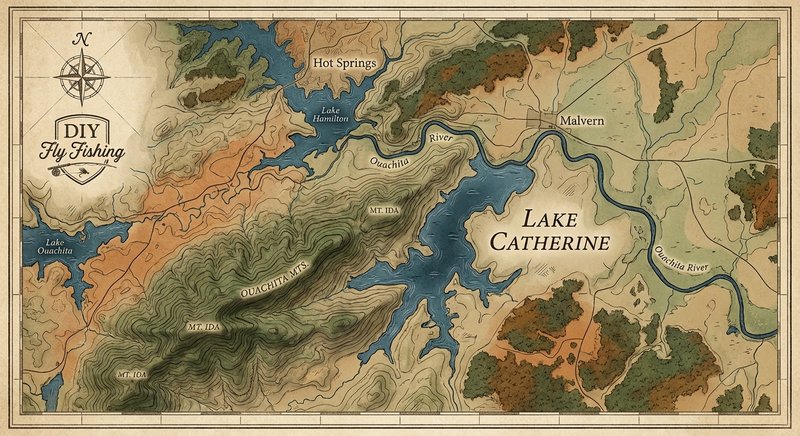
Lake Catherine
Fly fishing in Arkansas · Beginner · Best seasons: Spring, Summer, Fall
Target Species
Largemouth Bass, Crappie, Catfish
About This Water
Hot Springs area reservoir with good bass fishing. Scenic Ouachita Mountain setting.
Fishing Recommendations
Welcome to Lake Catherine, a hidden gem nestled in the Ouachita Mountains just outside of Hot Springs, Arkansas. As the smallest and oldest of the "Diamond Lakes," Catherine offers a unique river-like atmosphere that provides a distinct experience compared to its larger neighbors, Hamilton and Ouachita.
Here is your comprehensive guide to fly fishing Lake Catherine for Largemouth Bass, Crappie, and Catfish.
🎣 Location Overview
Lake Catherine is an 1,100-acre reservoir on the Ouachita River. What makes it special for the fly angler is its narrow, winding geography. Because it feels more like a slow-moving river than a massive inland sea, it is much more manageable for those fishing from a kayak or a skiff.
The water characteristics vary significantly: the upper end (below Carpenter Dam) is influenced by cold-water releases from the bottom of Lake Hamilton, while the main body and lower reaches near Remmel Dam are warmer and host thriving populations of warm-water species. The shoreline is a mix of rocky bluffs, sandy flats, and a high concentration of private boat docks, which serve as the primary structure for fish.
🐟 Target Species & Behavior
Largemouth Bass
These are the kings of the lake. In Catherine, they are highly opportunistic. They hold tight to "black structure"—man-made docks, submerged timber, and the shaded sides of rocky points. They primarily feed on Gizzard Shad, Threadfin Shad, and Bluegill.
Crappie
Lake Catherine has a robust population of "slabs." On a fly rod, these fish are a blast but require precision. They are school-oriented and vertically minded; they hold in submerged brush piles or deep under the center of boat slips. They are almost exclusively piscivorous, chasing tiny minnows and shad.
Catfish (Channel and Flathead)
While rarely targeted by fly anglers, they are a frequent "surprise" catch. They move into the shallower flats near the state park at night to feed. They respond well to heavy, scent-muffled flies or large, dark streamers stripped very slowly along the bottom of creek channels.
📅 Best Times to Fish
- Spring (March – May): Prime Time. Bass move to the shallows for the spawn. Look for "beds" in the sandy pockets of the state park area. Crappie move into 5–8 feet of water around brush.
- Summer (June – August): Focus on the Golden Hour. From sunrise until 9:00 AM and the last two hours before sunset. During the heat of the day, fish move deep or under the darkest parts of the docks.
- Fall (September – November): The "Shad Bust." As water temperatures drop, shad migrate into the backs of the creeks. Bass follow them in a feeding frenzy. This is the best time for topwater action.
🪰 Recommended Flies & Techniques
For Largemouth Bass
- Patterns:
- BoogleBugs or Umpqua Swimming Frogs: Size 2-4. Use these in the early morning against the shoreline.
- Clouser Minnows: (White/Chartreuse) to mimic shad.
- Game Changers: For when you want to target the "lunkers" near the dam.
- Technique: "Dock Skipping." Use a 7-weight rod with a heavy head line (like a Bass Bug taper) to skip poppers or streamers deep under the walkways of boat docks.
For Crappie
- Patterns:
- Micro-Woolly Buggers: Size 10-12 in white, pink, or chartreuse.
- Crappie Candy: A small, bead-head minnow pattern.
- Technique: Use a 4-weight rod with a 9-foot leader. Suspend the fly under a small strike indicator and "twitch" it over submerged brush piles. The strike is often just a subtle movement of the indicator.
For Catfish
- Patterns:
- Black or Olive Bunny Leeches: Size 2, heavily weighted.
- Technique: Use a sinking tip line. Cast into the old river channel or deep holes near the state park bridge and "crawl" the fly across the bottom.
💡 Pro Tips & Local Knowledge
- The "Current" Factor: Even though it’s a lake, when Entergy is generating power at Carpenter Dam (upstream), there is a noticeable pull. Bass will often face "upstream" into the current near points to wait for disoriented shad. Fish the downstream side of points during generation.
- Focus on the State Park: The area around Lake Catherine State Park offers some of the best wade-fishing access. There are several shallow flats and "fish attractors" (sunken cedar trees) marked by the AGFC that are well within fly casting distance.
- The Temperature Gap: Remember that the water gets colder the further upstream you go toward Carpenter Dam. If the bass bite is slow in the upper end, move toward the main lake body where the water is 5–10 degrees warmer.
⚠️ Important Information
- Access: The best boat ramp and shore access is at Lake Catherine State Park. There is also a public ramp near Remmel Dam.
- Regulations: You must have a valid Arkansas Fishing License.
- Safety: If you are fishing near the dams, pay attention to the sirens. Rapidly rising water during power generation can be dangerous for waders and small watercraft.
- The "Trout" Catch: Be aware that the cold water in the upper end allows the AGFC to stock Rainbow Trout in the winter. If you're using small streamers in February, don't be surprised if you hook a trout instead of a bass!
Guide’s Final Word: Lake Catherine is a "tactical" lake. Don't just cast blindly—aim for the shadows, the dock pylons, and the edges of the lily pads. Keep your fly in the "strike zone" (tight to cover) as long as possible. Tight lines!
Bug Hatches & Matching Flies
| Hatch | Type | Peak months | Time of day | Hook sizes | Matching flies |
|---|---|---|---|---|---|
| Midges Chironomidae | midge | January, February, March, December | All Day | #18-24 | Zebra Midge #18-22, Griffith's Gnat #20-22, Top Secret Midge #20-24 |
| Blue Winged Olive Baetis | mayfly | March, April, October, November | Late Morning/Afternoon | #18-22 | RS2 #18-22, Parachute Adams #18-22, Pheasant Tail Nymph #18-20 |
| Grannom Caddis Brachycentrus | caddis | April, May | Mid-Day/Evening | #14-16 | Elk Hair Caddis #14-16, Holy Grail #14-16, Peacock Caddis #16 |
| Sulphurs Ephemerella invaria | mayfly | May, June | Late Afternoon/Evening | #14-18 | Sulphur Parachute #16-18, Flashback Pheasant Tail #16-18, Sulphur Emerger #16 |
| Light Cahill Stenacron interpunctatum | mayfly | June, July | Evening | #12-14 | Light Cahill #12-14, Gold Ribbed Hare's Ear #12-14 |
| Terrestrials (Ants/Beetles) Formicidae/Coleoptera | terrestrial | July, August, September | Late Morning/Afternoon | #12-18 | Chernobyl Ant #10-14, Black Foam Beetle #14-18, Cinnamon Ant #16-18 |
| Cinnamon Caddis Hydropsyche | caddis | August, September, October | Evening | #16-20 | Sparkle Pupa #16-18, Cinnamon Elk Hair Caddis #18 |
| Trico Tricorythodes | mayfly | August, September | Early Morning | #22-26 | Trico Spinner #22-24, Sunken Trico #22-26 |