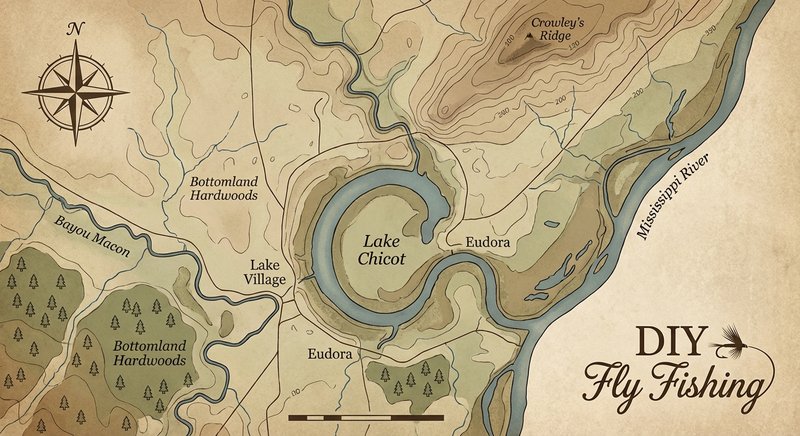
Lake Chicot
Fly fishing in Arkansas · Beginner · Best seasons: Spring, Summer, Fall
Target Species
Largemouth Bass, Crappie, Bream
About This Water
Largest natural lake in Arkansas. Excellent bass, crappie, and bream fishing.
Fishing Recommendations
Welcome to the Mississippi Delta. As your guide, I’m excited to introduce you to Lake Chicot. Located in the southeast corner of Arkansas near the town of Lake Village, Lake Chicot is the largest oxbow lake in North America and the largest natural lake in Arkansas.
While many fly anglers gravitate toward the Ozark trout tailwaters, the "Delta Blues" of Lake Chicot offer world-class warm-water fly fishing in a hauntingly beautiful setting of ancient cypress trees and Spanish moss.
🎣 Location Overview
Lake Chicot is a 20-mile-long, C-shaped oxbow cut off from the Mississippi River centuries ago. What makes it special is its sheer scale and the incredible density of cypress trees that line its perimeter.
The water is generally stained (murky), which is actually an advantage for fly anglers—it allows you to get closer to fish without spooking them. The lake is divided into the "Upper" and "Lower" basins by a causeway. The Lower Lake is larger and more open, while the Upper Lake often offers more sheltered, intimate water for fly casting. This is "structure" fishing at its finest; every cast is aimed at a cypress knee, a fallen log, or a dock piling.
🐟 Target Species & Behavior
Largemouth Bass
Chicot bass are "structure-oriented." They rarely roam open water; they move from cypress tree to cypress tree. They feed primarily on threadfin shad, crawfish, and small bream. Expect explosive strikes near the "knees" (the roots protruding from the water).
Crappie (White and Black)
While usually targeted by gear anglers with minnows, Chicot crappie are massive ("slabs") and highly susceptible to fly fishers using sinking lines. They school around deeper brush piles and submerged timber. During the spring spawn, they move into the shallow cypress roots.
Bream (Bluegill & Redear Sunfish)
This is the bread and butter of Lake Chicot. The bluegill here grow to "hand-size" and larger. They are aggressive, territorial, and will hit surface poppers all day long during the summer months.
📅 Best Times to Fish
- Spring (March – May): The Prime Window. Bass move shallow to spawn when water temps hit 60°F. Crappie follow shortly after. This is the best time for trophy bass on fly.
- Summer (June – August): Best for Bream. The heat can be intense, so focus on the "golden hours"—the first two hours of daylight and the last two hours before sunset.
- Fall (September – November): As temperatures drop, bass become highly active again, following schools of shad toward the shorelines. The "topwater bite" returns with a vengeance.
Pro Timing Tip: Look for the full moon in May and June. This is when the "bream beds" are most active. You can smell the beds (a sweet, fishy scent) and catch fish on every cast.
🪰 Recommended Flies & Techniques
For Largemouth Bass
- Patterns:
- Dahlberg Divers (Chartreuse/White or Frog): The deer hair creates a "gurgle" that calls bass out from the cypress shadows.
- Game Changers: For mimicking the local shad.
- Clouser Minnows: In Black/Orange (crawfish) or Chartreuse/White.
- Technique: Use an 8-weight rod with a weight-forward floating line. Cast as tight to the cypress trunks as possible. If you aren't hitting wood, you aren't fishing.
For Bream (Bluegill)
- Patterns:
- Betts’ Billy Bay Poppers: Size 10 or 12 in yellow or black.
- Bully’s Spider: Black or chartreuse with rubber legs.
- Technique: A 3-weight or 4-weight rod is perfect. Twitch the popper, let it sit until the rings disappear, then twitch again.
For Crappie
- Patterns:
- Woolly Buggers: Size 8 or 10 in white, pink, or chartreuse.
- Crappie Candy: Small bead-head streamers.
- Technique: Use a sink-tip line. Count your fly down to the 5–8 foot range near submerged brush and use a slow, steady strip.
💡 Pro Tips & Local Knowledge
- The "Shade Line" Rule: In the bright Arkansas sun, fish stay in the shadows of the cypress trees. As the sun moves, the fish move to the other side of the tree. Always cast into the darkest water.
- Upper vs. Lower: If the wind is blowing (a common issue on Chicot), head to the Upper Lake. It is narrower and the trees provide a better windbreak for fly casting.
- Watch the Shad: If you see "flickering" water or birds diving in the middle of the lake, bass are pushing shad to the surface. Switch to a white streamer and strip fast.
- The "Drip" Technique: On Chicot, many insects fall from the cypress limbs. Occasionally, a "splat" delivery with a heavy terrestrial fly (like a foam beetle) will trigger a strike from a bass waiting for a meal to fall from the tree.
⚠️ Important Information
- Access: Lake Chicot State Park (on the northern end) offers excellent boat ramps, pier fishing, and even "fishing boat" rentals. There are several public ramps along Hwy 144.
- Navigation: Be extremely careful when navigating outside of the marked channels. The lake is full of submerged stumps that can shear off a lower unit. For fly fishing, a kayak or a flat-bottomed boat with a trolling motor is ideal.
- Regulations: An Arkansas Fishing License is required. Check the Arkansas Game and Fish Commission (AGFC) for current creel limits, as they can change seasonally.
- Safety: This is the Deep South—expect high humidity and mosquitoes. Pack heavy-duty sunblock and bug spray. Also, keep an eye out for alligators; while they generally avoid humans, they are present in Lake Chicot.
Guide’s Final Word: Lake Chicot is a rhythm lake. Once you find the right "depth" on the cypress trees and the right color popper, you can have a 50-fish day that you’ll never forget. Tight lines!
Bug Hatches & Matching Flies
| Hatch | Type | Peak months | Time of day | Hook sizes | Matching flies |
|---|---|---|---|---|---|
| Giant Mayfly (Hex) Hexagenia limbata | mayfly | June, July | Dusk/Evening | #6-10 | Hexagenia Spinner #6-8, Hexagenia Nymph #8-10 |
| Midges Chironomidae | midge | March, April, October | All Day | #18-24 | Zebra Midge #18-22, Griffith's Gnat #20-22 |
| Damselfly Enallagma | terrestrial | May, June, July | Afternoon | #10-14 | Marabou Damselfly Nymph #10-12, Adult Damsel #12-14 |
| Speckled Dun Callibaetis | mayfly | May, September | Morning | #14-16 | Callibaetis Spinner #14-16, Hare's Ear Nymph #14-16 |
| Dragonfly Anisoptera | terrestrial | June, July, August | Afternoon | #4-8 | Dragonfly Nymph (Dredge) #6-8, Foam Dragon #6-10 |
| Grasshoppers Acrididae | terrestrial | August, September | Mid-day | #8-12 | Dave's Hopper #8-12, Joe's Hopper #10-12 |
| Water Boatmen Corixidae | terrestrial | April, October | All Day | #14-18 | Water Boatman #14-16, Prince Nymph #14-18 |
| Cinnamon Caddis Hydropsyche | caddis | May, June | Evening | #14-18 | Elk Hair Caddis #14-18, LaFontaine's Emerger #16 |