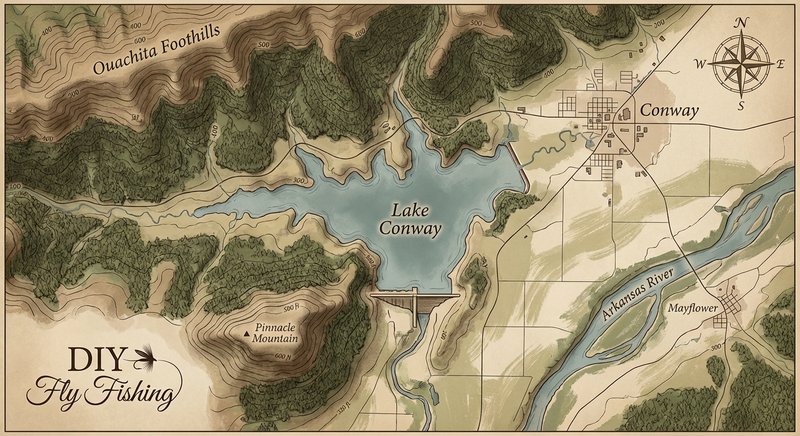
Lake Conway
Fly fishing in Arkansas · Beginner · Best seasons: Spring, Summer, Fall
Target Species
Largemouth Bass, Crappie, Bream
About This Water
Central Arkansas lake with excellent bass fishing. State's largest Game and Fish lake.
Fishing Recommendations
Welcome to the "Stump Capital" of Arkansas. As an expert guide, I can tell you that Lake Conway is a unique, 6,700-acre masterpiece of flooded timber, cypress knees, and lily pads. It is the largest lake ever constructed by a state wildlife agency (AGFC), and for a fly angler, it offers a "Jurassic Park" feel with big rewards—if you know how to navigate its obstacles.
Important Advisory: As of late 2023 and through 2024, Lake Conway is undergoing a massive renovation project involving a major drawdown. Always check current water levels and AGFC updates before heading out.
🎣 Location Overview
Lake Conway is located just south of Conway, AR, in Faulkner County. It is a shallow, fertile, and extremely "trashy" lake—and I mean that in the best way possible. The lake is filled with standing dead timber, cypress brakes, and extensive vegetation.
What makes it special for fly fishing is the shallow depth. With an average depth of only 6 feet, the entire lake is essentially a "littoral zone," meaning fish are rarely out of reach of a fly line. It’s a warm-water paradise where you can target trophy Bass and massive "slab" Crappie in the same afternoon.
🐟 Target Species & Behavior
Largemouth Bass
- Behavior: These are ambush predators. They don't roam open water; they hug structure. They are often found tucked deep inside cypress knees or under lily pad canopies.
- Diet: Gizzard shad, sunfish, crawfish, and an abundance of frogs.
Crappie (Black and White)
- Behavior: Usually associated with deeper brush piles or the edges of cypress brakes. On Lake Conway, they are famous for "running" into very shallow water during the spring spawn.
- Diet: Primary focus is small minnows and aquatic insects.
Bream (Bluegill and Redear Sunfish)
- Behavior: These are the stars for the light-tackle fly angler. They congregate in massive "beds" during the late spring and early summer.
- Diet: Terrestrial insects (grasshoppers, crickets), dragonflies, and aquatic nymphs.
📅 Best Times to Fish
- Spring (March – May): Prime Time. As the water hits 60°F, Bass move to the shallows. When it hits 65-70°F, the Bream and Crappie follow. The "spawn" on Lake Conway is legendary.
- Summer (June – August): Best for early morning or late evening. The heat can be intense, and the moss/vegetation gets thick. Topwater action at dawn/dusk is world-class.
- Fall (September – November): As temperatures drop, Bass become aggressive again, feeding up for winter. This is also a great time for "Bull" Bream.
- Best Windows: Overcast days are superior on this lake because the water is stained; clouds keep the fish from tucking too deep into the thickest timber.
🪰 Recommended Flies & Techniques
For Largemouth Bass
- Patterns:
- Dahlberg Divers: Essential for working around timber.
- Frog Poppers: Foam-bodied frogs with weed guards.
- Game Changers: In white/chartreuse to mimic shad.
- Clouser Minnows: In orange/brown to mimic crawfish.
- Technique: Use a 7-weight or 8-weight rod with a weight-forward floating line. You need a stout leader (16lb–20lb) to pull fish away from the stumps immediately.
For Bream (Bluegill/Redear)
- Patterns:
- BoogleBugs: The gold standard for poppers.
- Bully’s Spider: A rubber-legged wet fly that is irresistible.
- Bead-head Wooly Worms: Size 10-12 in black or chartreuse.
- Technique: A 3-weight or 4-weight rod. Cast to the base of cypress trees. Let the fly sit until the rings disappear, then give it a tiny twitch.
For Crappie
- Patterns:
- Micro-Jig Flies: 1/64oz jigs with marabou tails.
- White/Pink Wooly Buggers: Size 8 or 10.
- Technique: Use a slow, vertical "strip-and-drop" method near submerged brush piles. A sink-tip line can be helpful if they are holding 6-8 feet down.
💡 Pro Tips & Local Knowledge
- Fear the Stump: Do not bring a fiberglass boat or a boat you are precious about. Lake Conway is a "no-wake" lake for a reason—it is a graveyard of stumps just below the surface. Use a kayak, a jon boat, or a dedicated "stump jumper" with a rock guard.
- The "Cypress Knee" Strategy: When targeting Bream, don't just fish the tree trunk. Fish the "knees" (the roots sticking up around the tree). Big Redear Sunfish love to hide in the shadows between the knees.
- Weed Guards are Non-Negotiable: If your fly doesn't have a weed guard, you will spend more time "fishing" for wood than for fish. Even your Bream poppers should have a light mono guard.
- Target the "Canals": There are several dredged boat runs. These deeper channels provide cool water in the summer and are great transition zones for Bass.
⚠️ Important Information
- Access: Numerous public access points (Palarm Creek, Greens Lake, Pierce Creek). Many have boat ramps and fishing piers.
- Regulations: An Arkansas Fishing License is required. Check the AGFC website for current creel limits, as they can change during the current renovation/restocking phases.
- Safety: Wear your PFD. Because of the stumps, it is very easy to hit an underwater obstacle and be tossed from a kayak or small boat.
- Navigation: It is very easy to get lost in the "Gold Creek" or "Palarm" arms because every cypress brake looks identical. Always have a GPS or a phone with an offline map.
Guide’s Final Word: Lake Conway is a "gritty" fishery. It’s not clear, cold trout water—it’s a swampy, buggy, stump-filled arena. But when a 6lb Bass explodes on a topwater popper in the shadow of an ancient cypress tree, you’ll understand why we love it.
Bug Hatches & Matching Flies
| Hatch | Type | Peak months | Time of day | Hook sizes | Matching flies |
|---|---|---|---|---|---|
| Hexagenia (Giant Mayfly) Hexagenia limbata | mayfly | June, July | Dusk and Night | #6-10 | Hexagenia Spinner #6-8, Hexagenia Nymph #8-10, Burrowing Mayfly Emerger #8 |
| Midges Chironomidae | midge | March, April, October, November | Morning/Evening | #18-24 | Zebra Midge #18-22, Griffith's Gnat #20-24, Chironomid Pupa #18-20 |
| Damselfly Enallagma | terrestrial | May, June, July | Daylight | #10-14 | Marabou Damsel Nymph #10-12, Adult Damsel #12-14, Braided Butt Damsel #10 |
| Dragonfly Anisoptera | terrestrial | June, July, August | Daylight | #4-8 | Dragonfly Nymph #4-8, Adult Foam Dragonfly #6-8, Deer Hair Dragonfly #6 |
| Caenis (Angler's Curse) Caenis | mayfly | July, August | Early Morning | #20-26 | Caenis Spinner #22-24, Tiny White Wing #20-26 |
| Long-horned Caddis Oecetis | caddis | June, July, August | Evening/Dusk | #14-18 | Elk Hair Caddis #14-16, Soft Hackle Caddis #16, LaFontaine's Deep Sparkle Pupa #14-18 |
| Field Cricket Gryllus pennsylvanicus | terrestrial | August, September | Afternoon/Evening | #10-14 | Foam Cricket #10-12, Letort Cricket #12-14 |
| Grasshopper Melanoplus | terrestrial | July, August, September | Mid-day | #8-12 | Dave's Hopper #8-12, Rainy's Hopper #10, Charlie Boy Hopper #12 |