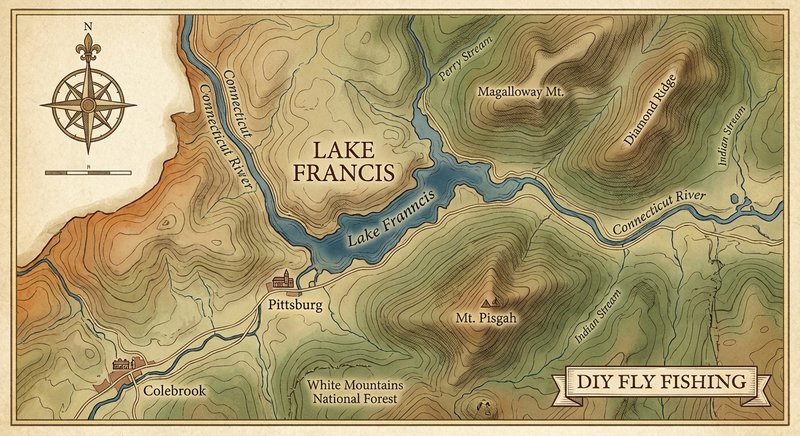
Lake Francis
Fly fishing in New Hampshire · Intermediate · Best seasons: Spring, Summer, Fall
Target Species
Landlocked Salmon, Rainbow Trout, Brook Trout
About This Water
Pittsburg reservoir with salmon and trout. Dam-controlled water levels.
Fishing Recommendations
Welcome to the Great North Woods. As your guide, I can tell you that Lake Francis is one of the crown jewels of New Hampshire’s "High Country." Located in Pittsburg, it is the first major impoundment of the Connecticut River. It serves as the transition point between the wild "Trophy Stretch" of the river and the deeper, cooler waters of the northern lakes.
Here is your comprehensive guide to fly fishing Lake Francis.
🎣 Location Overview
Lake Francis is a 2,000-acre reservoir created by the Murphy Dam. It is unique because it combines the characteristics of a deep-water lake with the influence of a powerful river system.
Anglers love Lake Francis because it offers "big water" opportunities for trophy fish while remaining accessible. It is surrounded by boreal forests and offers a true wilderness feel. What makes it special is the smelt forage base and the migratory patterns of the fish; they move between the lake and the Connecticut River, providing world-class opportunities for both still-water and moving-water fly fishing.
🐟 Target Species & Behavior
- Landlocked Salmon: The "kings" of the lake. They are silver, acrobatic, and extremely aggressive. They follow the smelt. In the spring and fall, they cruise the shallows and congregate at the river inlets.
- Rainbow Trout: Known for their size here. Many holdover in the deep, oxygenated water near the dam or the river mouth. They are opportunistic feeders, taking both insects and baitfish.
- Brook Trout: The native beauties of the North Woods. While some are stocked, many "wild" brookies move down from the tributaries. Look for them in the cooler pockets and near submerged timber.
Feeding Behavior: These fish are primarily piscivorous (bait-eaters), focusing on landlocked smelt. However, during June and July, they become highly focused on insect hatches, specifically the massive Hexagenia mayflies.
📅 Best Times to Fish
- Spring (Ice-out to Mid-June): The Prime Window. As the ice melts, smelt move toward the inlets to spawn. Salmon follow them in massive numbers. Fish are in the top 10 feet of the water column.
- Summer (July - August): Fish move to deeper "thermoclines" (cool water layers) or hug the oxygenated water near the Connecticut River inlet. Early morning and late evening are the only productive times for surface action.
- Fall (September - October): The "Second Prime." As water temperatures drop, salmon and trout begin their pre-spawn staging. They become brightly colored and very aggressive. The mouth of the Connecticut River at the north end of the lake is electric during this time.
🪰 Recommended Flies & Techniques
Streamer Fishing (The Standard)
Since smelt are the primary food source, long, slender streamers are the weapon of choice.
- Patterns: Grey Ghost, Black Ghost, Mickey Finn, Maynard’s Marvel, and the "Soft Chew" Smelt.
- Technique: Use a sinking-tip line. Cast toward the shoreline or river mouths and use an erratic, "injured baitfish" strip.
Dry Fly Fishing (The "Hex" Hatch)
In late June/early July, the Hexagenia limbata (Giant Yellow Mayfly) hatches at dusk.
- Patterns: Hexagenia Drakes (Size 6-8), Yellow Stimulators, or large Wulff patterns.
- Technique: Wait for the "spinner fall" at dusk. Look for the dimples of rising fish and present the fly with a dead drift.
Nymphing (The River Mouth)
- Patterns: Pheasant Tail (14-16), Prince Nymph, and Zebra Midges.
- Technique: Near the inlet where the Connecticut River flows in, use a strike indicator and drift nymphs through the transition zones where the current slows down.
💡 Pro Tips & Local Knowledge
- Follow the "Smelt Breeze": If the wind is blowing steadily into a specific cove or shore, the smelt will be pushed there by the current, and the salmon will follow. Don't be afraid to fish the "choppy" water.
- The "Trophy Stretch" Connection: The section of the Connecticut River between First Connecticut Lake and Lake Francis is the "Trophy Stretch." If the lake fishing is slow, walk the banks where the river enters Lake Francis. This "inlet" area is perhaps the most productive square mile of water in New Hampshire.
- Vary Your Retrieve: Salmon are notorious for following a fly without hitting it. If you see a flash behind your fly, speed up your strip. This mimics a fleeing baitfish and often triggers a reactive strike.
- The "Bridge" Spot: The area around the Route 3 bridge is a natural bottleneck for fish moving between the river and the lake. It is a high-percentage area for shore anglers.
⚠️ Important Information
- Access: The Lake Francis State Park provides excellent boat launching and shore access. There are also several pull-offs along Route 3.
- Regulations: Lake Francis has specific rules. As of the current season:
- The season for trout and salmon generally ends October 31st (but always check the current NH Fish & Game Digest as rules vary between the lake and the river).
- Note that the "Trophy Stretch" of the river is Fly Fishing Only.
- Wading Safety: If fishing the inlet, be wary of fluctuating water levels. The dam releases from First Connecticut Lake can cause the river to rise rapidly.
- Permits: A valid New Hampshire freshwater fishing license is required. You can purchase these online or at local shops like Lopstick or Young's Store in Pittsburg.
Tight lines, and enjoy the silence of the North Woods!
Bug Hatches & Matching Flies
| Hatch | Type | Peak months | Time of day | Hook sizes | Matching flies |
|---|---|---|---|---|---|
| Blue-Winged Olive Baetis spp. | mayfly | May, June, September, October | Late Morning/Afternoon | #18-22 | BWO Sparkle Dun #18-20, Pheasant Tail Nymph #18-22, RS2 #20-22 |
| Hendrickson Ephemerella subvaria | mayfly | May | Afternoon | #12-14 | Hendrickson Parachute #12-14, Red Quill #12-14, Hendrickson Wet Fly #12-14 |
| Chironomids Chironomidae | midge | May, June, July, August | All Day | #18-24 | Zebra Midge #18-22, Griffith's Gnat #20-22, Ice Bud #18-20 |
| Mother's Day Caddis Brachycentrus | caddis | May | Morning/Afternoon | #14-16 | Elk Hair Caddis (Peacock body) #14-16, LaFontaine Sparkle Pupa #14-16 |
| Sulphur Ephemerella invaria | mayfly | June, July | Evening | #14-18 | Sulphur Parachute #14-18, Sulphur Comparadun #14-16, Pheasant Tail #16-18 |
| White Miller Epheron leukon | mayfly | August | Dusk/Late Evening | #12-14 | White Wulff #12-14, White Sparkle Dun #12-14 |
| Light Cahill Stenacron interpunctatum | mayfly | June, July, August | Evening | #12-16 | Light Cahill #12-16, Gold Ribbed Hare's Ear #14-16 |
| Terrestrials Formicidae/Coleoptera | terrestrial | July, August, September | Afternoon | #12-18 | Black Foam Beetle #14-16, Cinnamon Ant #16-18, Amy's Ant #12-14 |