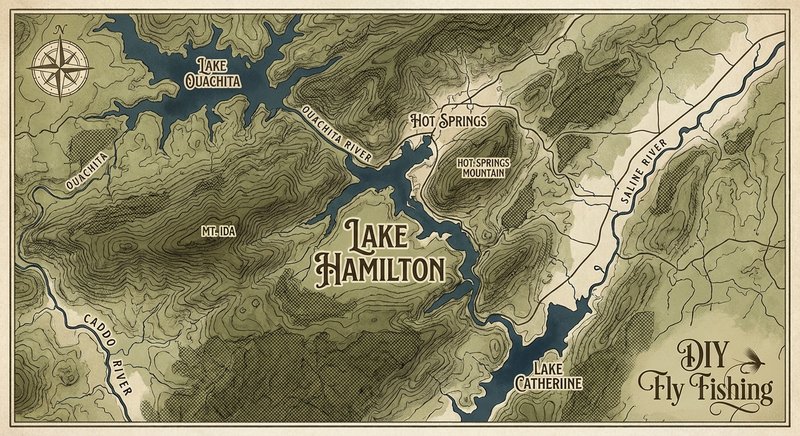
Lake Hamilton
Fly fishing in Arkansas · Beginner · Best seasons: Spring, Summer, Fall, Winter
Target Species
Largemouth Bass, Striped Bass, Catfish
About This Water
Hot Springs area lake with year-round bass fishing. Warm water discharge fishery.
Fishing Recommendations
Welcome to Lake Hamilton, one of Arkansas's most productive—and unique—fisheries. Located right in the heart of Hot Springs, this 7,200-acre reservoir is a "power pool" on the Ouachita River. Unlike the wild, sprawling lakes of the Ozarks, Hamilton is highly developed, lined with thousands of boat docks and luxury homes. For the fly angler, this means mastering "urban" tactics, focusing on man-made structure, and understanding the flow of water from the dams.
🎣 Location Overview
Lake Hamilton is the middle link in a chain of three lakes (Ouachita, Hamilton, and Catherine). What makes it special is its constant activity and structure. Because the shoreline is almost entirely residential, the "cover" here consists of docks, sea-walls, and submerged brush piles placed by homeowners.
The water is generally clear to slightly stained. Because it receives cold-water releases from the bottom of Lake Ouachita (via Blakely Mountain Dam), the upper end of Lake Hamilton stays significantly cooler than the lower end, creating a unique temperature gradient that supports both cool-water Stripers and warm-water Largemouth.
🐟 Target Species & Behavior
Largemouth Bass
Hamilton is a "dock-shooter's" paradise. These bass are highly pressured and smart. They hold tight to the shade of boat slips and under hanging walkways. They primarily feed on threadfin shad, bluegill, and crawfish. During the winter drawdown, they move to the main channel ledges.
Striped Bass
The "Silver Ghosts" are the stars of the show here. They are stocked annually and can reach weights exceeding 30 pounds. They are highly migratory, following massive schools of shad. In the summer, they congregate in the cooler water near the Blakely Mountain Dam (the "upper end"). In spring and fall, they can be found busting bait on the surface in the main lake basins.
Catfish (Channel & Flathead)
While rarely targeted by fly anglers, Lake Hamilton has a massive population. To catch them on a fly, you must target them as predators. They hold in deep holes near the river channel or under docks where people clean fish. They respond to large, scent-heavy streamers or "meat" patterns fished deep and slow.
📅 Best Times to Fish
- Spring (March - May): Prime Time. As water hits 55-60°F, bass move shallow to spawn. The Shad Spawn (usually May) creates a morning frenzy where Stripers and Largemouth will crush anything silver on the surface.
- Summer (June - August): Focus on the "Tailrace" (upper end) for Stripers seeking cool water. For Bass, you must fish Low Light (dawn, dusk, or night) to avoid the heavy recreational boat traffic and the heat.
- Fall (September - November): As water cools, bass move back to shallow docks. Stripers move toward the mid-lake. This is the best time for surface popper action.
- Winter (December - February): The Drawdown. Entergy lowers the lake level by 3–5 feet. This concentrates fish into the main river channel and makes structure easy to identify.
🪰 Recommended Flies & Techniques
For Striped Bass
- Patterns: Clouser Minnows (Chartreuse/White), Gamechangers (4-6 inches), and Deceivers.
- Technique: Use a 7wt to 9wt rod with a fast-sinking integrated line (250-400 grain). You need to get the fly down 15–25 feet in the channel. Look for "boils" on the surface; if you see them, switch to a floating line with a large Gurgler or Pole Dancer.
For Largemouth Bass
- Patterns: BoogleBugs (poppers) for morning/evening. For docks, use "Dahlberg Divers" or weighted Crawfish patterns.
- Technique: The "Dock Skip." You must be able to side-arm cast or skip your fly deep under the boat slips. If you aren't hitting the back of the dock, you aren't in the strike zone. Use an intermediate sinking tip to keep the fly under the docks longer.
For Catfish
- Patterns: Large, dark Wooly Buggers (Size 2-4) or "Gamechanger" styles in black/purple.
- Technique: "Dredging." Use a heavy sink tip and crawl the fly along the bottom of deep channel bends, mimicking a dying shad or a scavenging crawfish.
💡 Pro Tips & Local Knowledge
- The "Blakely Flow": Check the generation schedule for Blakely Mountain Dam. When they are pulling water, the current in the upper end of Hamilton "turns on" the fish. Stripers will stack up in the eddies just like trout in a river.
- Night Fishing is King: During the summer, Lake Hamilton becomes a "washing machine" of boat wakes. Experienced guides fish from 10 PM to 4 AM. The bass move out from under the docks to hunt the sea-walls, and the lake is whisper-quiet.
- The Winter Drawdown Strategy: When the lake is lowered (Nov-Mar), take photos of the exposed shoreline. You will see exactly where the hidden stumps and rock piles are. These are your "honey holes" when the water returns to full pool.
- Fish the Lights: Many homeowners have submerged "green lights" or dock lights. These attract baitfish, which in turn attract bass and stripers. A white baitfish fly cast into the shadows of these lights is a high-percentage move.
⚠️ Important Information
- Licensing: You need an Arkansas Fishing License. If you fish the upper end near the dam, be aware of the "trout water" boundaries, though Hamilton itself is primarily a warm-water permit area.
- Navigation: Be extremely careful during the winter drawdown. Rocks and sandbars that are 5 feet underwater in summer will be inches from your hull in January.
- Boat Traffic: Hamilton is one of the busiest lakes in the south. On summer weekends, fly fishing is nearly impossible between 10 AM and 7 PM due to wakes. Plan accordingly.
- Regulations: Always check the current AGFC (Arkansas Game and Fish Commission) guidebook. There are specific length limits for Largemouth (usually 13 inches) and Stripers (no more than two over 28 inches, though most fly anglers practice 100% C&R for Stripers).
Guide’s Final Word: Lake Hamilton is a game of "Target Practice." If you can't cast accurately to a 6-inch gap under a dock, spend an hour on the lawn before you hit the water. The fish are there—you just have to put the fly in their living room.
Bug Hatches & Matching Flies
| Hatch | Type | Peak months | Time of day | Hook sizes | Matching flies |
|---|---|---|---|---|---|
| Chironomids Chironomidae | midge | February, March, April, November | All day | #18-24 | Zebra Midge #18-22, Griffith's Gnat #20-24, Ice Cream Cone #18-20 |
| Giant Mayfly (Hex) Hexagenia limbata | mayfly | June, July | Dusk/Night | #6-10 | Hexagenia Spinner #6-8, Hex Nymph #8-10, Crippled Hex #8 |
| Damselfly Enallagma | terrestrial | May, June, July | Afternoon | #10-14 | Marabou Damsel Nymph #12-14, Adult Damsel #10-12 |
| Callibaetis Callibaetis | mayfly | May, September | Late Morning | #14-16 | Callibaetis Spinner #14-16, Hare's Ear Nymph #14-16, Parachute Adams #14-16 |
| Cinnamon Caddis Hydropsyche | caddis | May, June | Evening | #14-18 | Elk Hair Caddis (Tan) #14-16, LaFontaine's Emerger #16-18 |
| White Fly Ephoron leukon | mayfly | August, September | Evening/Dusk | #12-14 | White Wulff #12-14, White Miller #14 |
| Terrestrials (Grasshoppers) Orthoptera | terrestrial | July, August, September | Mid-day/Afternoon | #8-12 | Dave's Hopper #8-12, Morrish Hopper #10 |
| Trico Tricorythodes | mayfly | July, August, September | Early Morning | #20-24 | Trico Spinner #22-24, RS2 #20-22 |