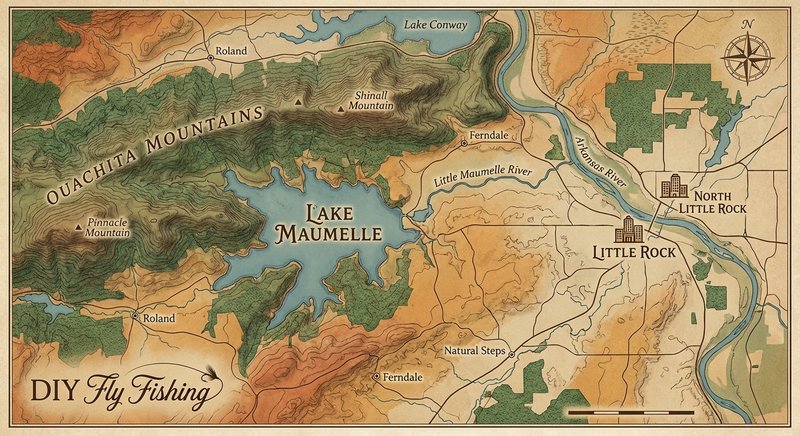
Lake Maumelle
Fly fishing in Arkansas · Intermediate · Best seasons: Spring, Summer, Fall
Target Species
Largemouth Bass, Spotted Bass, Crappie
About This Water
Central Arkansas reservoir with good bass fishing. Clear water near Little Rock.
Fishing Recommendations
As an expert guide who has spent years navigating the diverse waters of the Natural State, I can tell you that Lake Maumelle is a unique gem. Located just west of Little Rock, it serves as the primary drinking water supply for the city. Because of this, it has strict regulations—no swimming, no wading, and no jet skis—which makes it a "quiet" lake and an absolute sanctuary for fly anglers who want to escape the chaos of recreational boaters.
Here is your comprehensive guide to fly fishing Lake Maumelle.
🎣 Location Overview
Lake Maumelle spans roughly 8,900 acres and is characterized by its exceptionally clear water (by Arkansas standards) and diverse structure. The lake is divided into two distinct personalities: the Lower End (East), which is deep, clear, and dominated by rocky points and bluff walls; and the Upper End (West), which is shallower with standing timber, lily pads, and extensive grass beds (milfoil and hydrilla).
What makes Maumelle special is the lack of "shoreline development." You won't see docks or houses; instead, you are surrounded by the Ouachita Mountain foothills. For the fly angler, this means the fish relate to natural structure rather than man-made pilings.
🐟 Target Species & Behavior
Largemouth Bass
The Largemouths here are "cover-oriented." In the spring, they move into the "flats" on the west end to spawn. During summer and fall, they bury themselves in the hydrilla edges or under the shade of standing timber. They primary feed on Gizzard and Threadfin Shad, as well as Bluegill and Crawfish.
Spotted Bass (Kentucky Bass)
Maumelle is famous for its Spotted Bass. These fish prefer the clearer, deeper water on the eastern half of the lake. They hold on rocky points, submerged humps, and steep drop-offs. They are more aggressive than Largemouths and tend to school, often "busting" shad on the surface.
Crappie
Both Black and White Crappie thrive here. They are structural residents, almost always found around submerged brush piles or the "forests" of standing timber in the mid-to-upper lake. In the spring, they move into 3–8 feet of water to spawn, making them prime targets for a 4-weight fly rod.
📅 Best Times to Fish
- Spring (March – May): The Peak. As the water hits 55°F, Crappie move shallow. At 62–65°F, the Bass follow. This is the best time for topwater action and sight-fishing in the clearer coves.
- Summer (June – August): Focus on the "Golden Hour." The midday heat pushes fish deep. Target the first two hours of daylight and the last hour before dark. Night fishing with large dark streamers can also be productive for trophy bass.
- Fall (September – November): The "Shad Push." As water temperatures drop, shad migrate toward the backs of the creeks (like Bringle Creek). The bass follow them in a feeding frenzy. This is the best time for streamer fishing.
🪰 Recommended Flies & Techniques
For Bass (Largemouth & Spotted)
- Topwater: Boogle Bugs (Poppers) in Bluegill or Solar Flare colors. For the grass beds, use Dahlberg Divers or weedless Frog Patterns.
- Streamers: Clouser Minnows (White/Chartreuse or Grey/White) are essential for mimicking shad. For bigger Largemouths, swing a Game Changer or a Wooly Bugger (Size 2-4) in olive or black.
- Technique: Use an intermediate sinking line for the weed edges. A "strip-strip-pause" retrieve is deadly. For Spotted Bass on deep points, a Type 3 or Type 5 sinking line is necessary to get the fly down 10–15 feet.
For Crappie
- Flies: Micro-jig flies, bead-head Wooly Buggers (Size 8-12) in white/pink or chartreuse, and the Crappie Candy streamer.
- Technique: Use a 4-weight or 5-weight rod with a slow, vertical strip. If you find standing timber, "dapping" the fly next to the trunk and letting it sink slowly is the local secret.
💡 Pro Tips & Local Knowledge
- The "Gap" and Sleepy Hollow: Focus your efforts on the area near the Highway 10 bridge (The Gap) and the Sleepy Hollow access. These areas offer the best transition water where deep channels meet shallow feeding flats.
- The Wind Factor: Maumelle is an east-west oriented lake. A strong West wind can make the main body treacherous for small boats. On windy days, tuck into the high-walled coves on the south shore to find calm, fishable water.
- Watch the Birds: If you see gulls diving in the center of the lake, Spotted Bass have pushed shad to the surface. Get there quickly with a Clouser Minnow; it’s fast-paced, "salty" style fishing in the middle of Arkansas.
- Stealth is Key: Because the water is clear and the lake is quiet, these fish are spookier than those in busier lakes. Use longer leaders (9–12 feet) when fishing the flats.
⚠️ Important Information
- Access: There are two main public marinas: West Rock Marina (East end) and Jolly Roger Marina (Mid-lake). There are also public launch ramps at Sleepy Hollow (West end).
- No Wading: This is a crucial rule. You cannot get out of your boat to wade fish. You must fish from a boat, kayak, or the designated shoreline areas.
- Permits: You need a standard Arkansas Fishing License. If you are using your own boat, ensure you follow all AGFC (Arkansas Game and Fish Commission) safety regulations.
- Cleanliness: Since this is a water supply, be extremely diligent about not leaving any trash or monofilament behind. Local enforcement is strict.
Guide’s Final Thought: If you want the best "wilderness" feel within 20 minutes of a major city, put in at Sleepy Hollow at sunrise in late April. The mist over the lily pads and the sound of a Largemouth exploding on a popper is as good as it gets in the South.
Bug Hatches & Matching Flies
| Hatch | Type | Peak months | Time of day | Hook sizes | Matching flies |
|---|---|---|---|---|---|
| Hexagenia (Giant Mayfly) Hexagenia limbata | mayfly | June, July | Late Evening/Dusk | #6-10 | Hexagenia Dry #6-8, Burrowing Mayfly Nymph #8-10 |
| Chironomids (Midges) Chironomidae | midge | March, April, October, November | All Day | #18-24 | Zebra Midge #18-22, Griffith's Gnat #20-24 |
| Damselfly Enallagma | terrestrial | May, June, July | Afternoon | #10-14 | Damselfly Nymph #12-14, Adult Damselfly #10-12 |
| White Mayfly Ephoron leukon | mayfly | August, September | Evening | #12-14 | White Wulff #12-14, Snowshoe Emerger #14 |
| Speckled Dun Callibaetis | mayfly | May, September | Morning | #14-16 | Callibaetis Spinner #14-16, Hare's Ear Nymph #14-18 |
| Long-Horned Sedge Oecetis | caddis | June, July, August | Evening/Night | #12-16 | Elk Hair Caddis (Tan) #14-16, Sparkle Pupa #14-16 |
| Grasshoppers Acrididae | terrestrial | July, August, September | Late Morning/Afternoon | #6-12 | Dave's Hopper #8-12, Morrish Hopper #6-10 |
| Trico Tricorythodes | mayfly | August, September, October | Early Morning | #20-24 | Trico Spinner #22-24, RS2 (Black) #20-22 |
| Dragonfly Anisoptera | terrestrial | June, July, August | All Day | #4-8 | Dragonfly Nymph (Olive) #6-10, Deer Hair Dragonfly #4-8 |