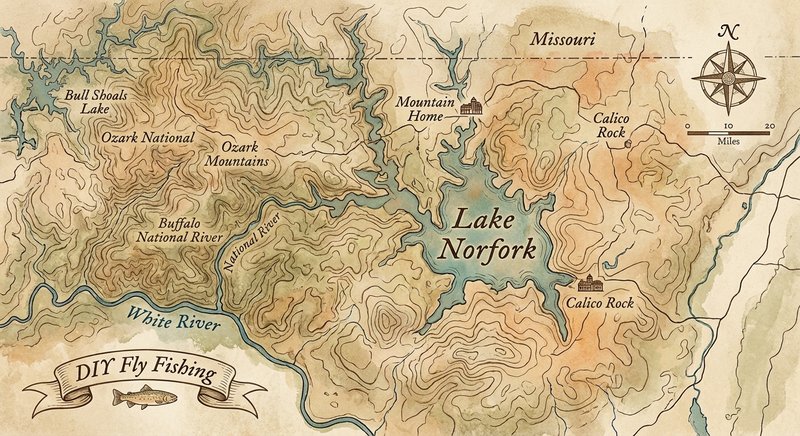
Lake Norfork
Fly fishing in Arkansas · Intermediate · Best seasons: Spring, Summer, Fall
Target Species
Largemouth Bass, Striped Bass, Walleye
About This Water
Ozark reservoir with excellent bass fishing. Striped bass and walleye also present.
Fishing Recommendations
Welcome to Lake Norfork, one of the true "sleeper" fly fishing destinations in the Ozarks. While its neighbor, the White River, gets the global glory for trout, Lake Norfork offers world-class warm-water fly fishing in a deep, crystal-clear highland reservoir setting.
Here is your guide to mastering Lake Norfork.
🎣 Location Overview
Lake Norfork is a 22,000-acre impoundment of the North Fork River. What makes it special is its clarity and structure. Because much of the watershed is protected forest, the water remains remarkably clear, often allowing for sight-fishing opportunities that you won't find in siltier Midwestern lakes.
The lake is characterized by steep limestone bluffs, deep channels, and expansive flats near the creek arms. Anglers love it because it’s less crowded than the trout tailwaters and offers a "big game" experience—hooking a 20-pound Striped Bass on an 8-weight rod is an adrenaline rush unlike any other in fly fishing.
🐟 Target Species & Behavior
Striped Bass
The undisputed kings of the lake. They are nomadic predators that follow massive schools of gizzard and threadfin shad.
- Behavior: They move from deep open water to shallow points and flats to corral baitfish.
- Holding: Look for them over submerged river channels or pushing bait into "pockets" along the shore.
Largemouth Bass
Norfork holds a healthy population of "black bass."
- Behavior: They are ambush predators associated with cover.
- Holding: Focus on standing timber, submerged brush piles, and the "trash lines" (floating debris) after a rain.
Walleye
Arkansas has a quiet but elite Walleye fishery.
- Behavior: They are light-sensitive and prefer deeper water or low-light conditions.
- Holding: They typically hold on gravel points and transition zones where rock turns to mud, usually in 10–25 feet of water.
📅 Best Times to Fish
Spring (March – May) - Prime Window
- Why: This is the "spawn run." Stripers and Walleye move into the upper arms of the lake (toward the Missouri border).
- Time of Day: Early morning and late evening.
- Conditions: Overcast days are best for bringing fish into the shallows.
Summer (June – August)
- Why: Fish go deep, but the "Night Bite" becomes legendary.
- Time of Day: 10:00 PM to 3:00 AM for Stripers; dawn for Largemouth.
- Conditions: Focus on the "thermocline"—usually 20-30 feet down.
Fall (September – November)
- Why: The "Fall Feed." As water temps drop, shad move to the backs of creeks, and predators follow.
- Time of Day: All day during "blitz" events.
- Conditions: Look for bird activity (gulls and terns) diving on bait.
🪰 Recommended Flies & Techniques
For Striped Bass (The Heavy Hitters)
- Flies: Gamechangers (white/chartreuse), Clouser Minnows (extra heavy eyes), and EP Fiber Baitfish patterns (4–7 inches long).
- Technique: Use a fast-sinking integrated head line (250–350 grain). Use a "strip-strip-pause" retrieve to mimic a wounded shad.
- Pro Tip: If you see them busting the surface, switch to a large Crease Fly or Bob's Banger for explosive topwater action.
For Largemouth Bass
- Flies: BoogleBugs (poppers) for morning; Dahlberg Divers; and weighted Crawfish patterns for the bottom.
- Technique: Target "steep-to-shallow" transition points. Cast tight to the standing timber.
For Walleye
- Flies: Heavy Clouser Minnows or "Leech" patterns in purple, gold, or black.
- Technique: You must get the fly to the bottom. Use a full-sink line and "bounce" the fly off the gravel points.
💡 Pro Tips & Local Knowledge
- The "Shadow Line": In the summer, Stripers often hover just inside the shadow line created by the high limestone bluffs. Cast into the shade and strip out into the light.
- Follow the Birds: In the fall, if you see gulls diving, get there immediately. Stripers are pushing shad to the surface.
- The "Norfork Twitch": When fishing streamers for Walleye, use a much slower retrieve than you would for Bass. Walleye are often "lazy" strikers and need the fly to stay in the strike zone longer.
- Specific Spots: Focus on the Hand Cove area and the Robinson Point vicinity for consistent Bass and Striper action. For spring runs, head north toward Tecumseh.
⚠️ Important Information
Access & Logistics
- Boating: This is a big-water lake. While some shore access exists at parks (like Henderson Park or Gamaliel), a boat or kayak is highly recommended to reach the best structure.
- Launch Sites: Numerous COE (Corps of Engineers) ramps are available. Henderson is the most central.
Regulations & Permits
- License: You need an Arkansas Fishing License. If you cross the Missouri line in the upper arms, you need a Missouri permit.
- Limits: Check current AGFC (Arkansas Game and Fish Commission) regulations for length and bag limits, as they change annually to manage the trophy Striper population.
Safety
- The Wind: Norfork can get "whitecaps" quickly. Always check the weather; if the wind is over 15 mph, stick to the protected creek arms.
- Clarity: Because the water is so clear, use longer leaders (9–12 feet) for Bass to avoid spooking them, unless you are using heavy sinking lines for Stripers.
Tight lines! Norfork is a challenge, but the reward of a 30-inch Striper on a fly rod is the pinnacle of Ozark angling.
Bug Hatches & Matching Flies
| Hatch | Type | Peak months | Time of day | Hook sizes | Matching flies |
|---|---|---|---|---|---|
| Midges Chironomidae | midge | January, February, March, December | All Day | #18-26 | Zebra Midge #18-22, Griffith's Gnat #20-24, Palomino Midge #20-22 |
| Sowbugs Isopoda | terrestrial | March, April, May, September | All Day | #14-18 | Ray Charles #14-18, Sow-Bug (Grey/Tan) #14-16, Soft Hackle Sowbug #16-18 |
| Blue Winged Olive (BWO) Baetis | mayfly | March, April, October, November | Afternoon | #18-22 | RS2 #20-22, Parachute Adams #18-22, Pheasant Tail Nymph #18-20 |
| Caddis Brachycentrus | caddis | April, May, June | Late Afternoon/Evening | #14-18 | Elk Hair Caddis #14-18, Pupa Sedge #16-18, Sparkle Pupa #14-16 |
| Sulphurs Ephemerella invaria | mayfly | May, June, July | Evening | #16-18 | Sulphur Parachute #16-18, Sulphur Emerger #16-18, Split Case Sulphur #16 |
| Scuds Gammarus | terrestrial | February, March, April | All Day | #14-20 | UV Scud #16-20, Holographic Scud #14-18, Flashback Scud #16-20 |
| Terrestrials Formicidae / Coleoptera | terrestrial | July, August, September | Mid-day/Afternoon | #10-16 | Chernobyl Ant #10-14, Foam Beetle #14-16, Fur Ant #16-18 |
| Crane Flies Tipulidae | midge | August, September, October | Morning/Evening | #10-14 | Crane Fly Larva #10-12, Daddy Long Legs #12-14 |