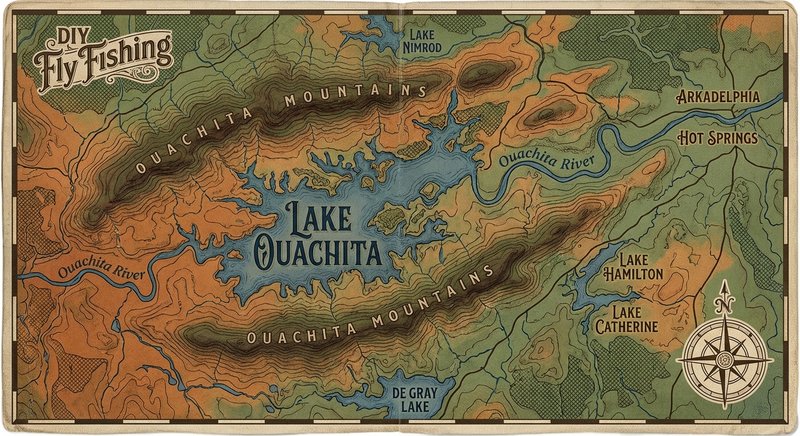
Lake Ouachita
Fly fishing in Arkansas · Intermediate · Best seasons: Spring, Summer, Fall
Target Species
Largemouth Bass, Striped Bass, Bream
About This Water
Arkansas's largest lake with outstanding bass fishing. Crystal clear Ouachita Mountain water.
Fishing Recommendations
Welcome to Lake Ouachita, Arkansas’s largest and arguably most beautiful lake. As a guide, I consider Ouachita a "crown jewel" of the Natural State. Spanning over 40,000 acres and surrounded by the Ouachita National Forest, it is renowned for its incredible water clarity—often referred to as some of the cleanest water in the United States.
For the fly angler, Ouachita offers a unique challenge: it is a deep, "clear water" fishery. Success here requires stealth, an understanding of baitfish migration, and the right sinking lines.
🎣 Location Overview
Lake Ouachita is a massive reservoir created by the Blakely Mountain Dam. What makes it special is the lack of residential development; because it is bordered by National Forest, you won't see rows of houses. Instead, you'll find over 200 islands and thousands of acres of standing submerged timber.
The water is oligotrophic (low nutrient, high oxygen), meaning it is crystal clear. This transparency means fish can see your fly—and you—from a long distance. It’s a diverse ecosystem where you can target "schooling" fish in open water or "structure" fish in the flooded timber and grass beds.
🐟 Target Species & Behavior
Striped Bass (The Heavyweights)
These are the primary draw for fly anglers seeking a fight.
- Behavior: They are nomadic open-water hunters. They follow massive schools of threadfin and gizzard shad.
- Fly Target: In the spring and fall, they push shad into the backs of coves or up against the surface. In summer, they retreat to deeper, cooler "thermoclines."
Largemouth Bass
- Behavior: Ouachita's largemouth are structure-oriented. They hang around the hydrilla (aquatic grass) and the abundant standing timber.
- Fly Target: They feed on crawfish, bluegill, and shad. Unlike the stripers, these fish are ambush predators.
Bream (Bluegill & Longear Sunfish)
- Behavior: These are the most accessible species. They congregate in shallow flats and around rocky shorelines.
- Fly Target: They are opportunistic, eating terrestrial insects and small aquatic nymphs.
📅 Best Times to Fish
- Spring (March – May): Prime Time. As water temps hit 60°F, Stripers move into the shallow arms and flats to "spawn" (though they are landlocked). Largemouth move to the beds in the backs of coves.
- Summer (June – August): Focus on the "Low Light Window." From 5:00 AM to 8:00 AM, stripers and bass will bust shad on the surface. Once the sun is high, fish go deep (20-40 feet), making fly fishing very difficult.
- Fall (September – November): The Shad Migration. As temperatures drop, shad move into the shallows of the major creeks (like North Fork or Irons Fork). The stripers follow them, creating spectacular surface "blitzes."
- Time of Day: On a lake this clear, dawn, dusk, and overcast days are your best friends. Bright sun usually pushes the big fish deep into the timber.
🪰 Recommended Flies & Techniques
For Striped Bass
- Patterns: 4" to 6" Clouser Minnows (White/Chartreuse or Blue/White), Gamechangers, and EP Fiber Minnows.
- Technique: Use an 8-weight or 9-weight rod with a fast-sink tip line (300-400 grain). You must get the fly down to the "strike zone." Use a "heave and leave" method—cast, count to 15, and then use erratic, long strips.
For Largemouth Bass
- Patterns: Umpqua’s Swimming Frog, Dahlberg Divers, and Rubber-legged Poppers for topwater. For sub-surface, use Half-and-Halfs or Crawfish patterns (size 2-4).
- Technique: Focus on the edges of grass lines. In clear water, a "stealth" approach is key—long leaders (9-12ft) and fluorocarbon tippet are essential to avoid spooking fish.
For Bream
- Patterns: Bead-head Wooly Buggers (size 10-12), BoogleBugs (small foam poppers), and Rubber-legged Spiders.
- Technique: A 3-weight or 4-weight rod is perfect. Cast near downed logs or rocky points.
💡 Pro Tips & Local Knowledge
- Follow the Birds: In the fall and spring, watch for seagulls and loons. If birds are diving, Striped Bass are pushing shad to the surface. Get there quickly but cut your motor early to drift into the school.
- The "Timber" Factor: Lake Ouachita is full of "standing timber"—dead trees that still stand underwater. If you hook a big Bass or Striper, you must "horse" them away from the trees immediately, or they will wrap your line and snap your leader. Use 20lb fluorocarbon for your tippet.
- Find the Grass: Look for hydrilla beds. The clearest water often has the best grass growth. These are oxygen-rich environments and act as "nurseries" for the entire food chain.
- Night Fishing: During the heat of summer, many locals fish at night under floating lights. Using a large black Marabou streamer can be deadly for stripers under the lights.
⚠️ Important Information
- Boating Safety: This is a huge lake. Weather can change quickly, and "the gap" between islands can create significant swells. If you aren't in a bass boat or a skiff, stay close to the shore.
- Navigation: Be extremely careful of "stumps." Even in the middle of the lake, a tree top can be inches below the surface. Stick to marked channels when running.
- Permits: An Arkansas Fishing License is required. You can purchase these through the Arkansas Game and Fish Commission (AGFC) website or app.
- Access:
- Spillway Area: Good for shore access and wading near the dam.
- Joplin & Mountain Harbor: Excellent marinas with boat rentals and proximity to prime bass water.
- Brady Mountain: Great central location for accessing the deeper "main body" where stripers school.
Guide’s Final Word: Bring your polarized sunglasses! Because the water is so clear, you can often "sight fish" for cruising bass and bream, which is a rare treat on a Southern reservoir. Tight lines!
Bug Hatches & Matching Flies
| Hatch | Type | Peak months | Time of day | Hook sizes | Matching flies |
|---|---|---|---|---|---|
| Giant Mayfly (Hex) Hexagenia limbata | mayfly | June, July | Evening/Night | #6-10 | Hexagenia Spinner #6-8, Burrowing Mayfly Nymph #8-10, Hex Paradox Emerger #8 |
| Chironomids (Midges) Chironomidae | midge | March, April, October, November | All Day | #18-24 | Zebra Midge #18-22, Griffith's Gnat #20-24, Snowshoe Midge #20-22 |
| Speckled Spinner (Callibaetis) Callibaetis | mayfly | May, June, September | Morning | #12-16 | Callibaetis Cripple #14-16, Parachute Callibaetis #14-16, Hare's Ear Nymph #12-16 |
| Little Black Caddis Chimarra | caddis | March, April | Afternoon | #16-20 | Elk Hair Caddis (Black) #16-18, Z-Wing Caddis #16-20 |
| Cinnamon Caddis Hydropsyche | caddis | May, June | Evening | #14-18 | Cinnamon Ant #14-16, Pupa Sedge #14-18 |
| Grasshoppers Acrididae | terrestrial | July, August, September | Midday | #6-12 | Dave's Hopper #8-12, Charlie Boy Hopper #6-10 |
| Black Ants Formicidae | terrestrial | June, July, August | All Day | #14-20 | Black Foam Ant #14-18, Carpenter Ant #12-14 |
| White Winged Black Midge (Trico) Tricorythodes | mayfly | August, September, October | Morning | #20-24 | Trico Spinner #20-24, RS2 #20-22 |