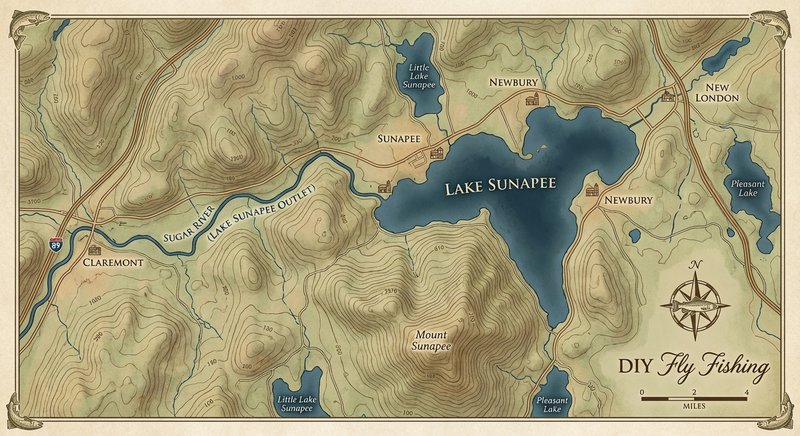
Lake Sunapee
Fly fishing in New Hampshire · Intermediate · Best seasons: Spring, Summer, Fall
Target Species
Landlocked Salmon, Lake Trout, Smallmouth Bass
About This Water
Sullivan County lake with landlocked salmon and lake trout. Clear mountain lake.
Fishing Recommendations
Welcome to the "shining water." As an expert guide familiar with the Granite State’s glacial gems, I can tell you that Lake Sunapee is a premier destination for fly anglers seeking a true Northeast experience. At 4,125 acres and reaching depths of 142 feet, it is a massive, crystal-clear playground that requires a strategic approach.
Here is your comprehensive guide to fly fishing Lake Sunapee.
🎣 Location Overview
Lake Sunapee is the fifth-largest lake in New Hampshire, nestled at the foot of Mount Sunapee. What makes it special is its oligotrophic nature—it is exceptionally deep, cold, and oxygen-rich, which is the perfect recipe for salmonids.
The water clarity is staggering (often 20+ feet of visibility), meaning the fish are "sight-reliant" and can be wary. Anglers love Sunapee because it offers a "triple threat": trophy-sized Landlocked Salmon, hard-fighting Lake Trout, and some of the most aggressive Smallmouth Bass in the region. Unlike the shallower lakes to the south, Sunapee maintains a cold thermocline all summer, keeping the trout and salmon healthy year-round.
🐟 Target Species & Behavior
Landlocked Salmon
The crown jewel of Sunapee. These fish are descendants of Atlantic Salmon that spend their lives in freshwater.
- Behavior: They are pelagic, following schools of rainbow smelt, their primary forage.
- Holding Spots: In spring, they are in the top 10 feet of the water column. As the water warms, they drop to the 30–50 foot range. They love "current"—look for wind-blown points or areas where tributaries enter.
Lake Trout (Lakers)
Sunapee has a robust population of wild and stocked Lake Trout.
- Behavior: They are bottom-dwellers by nature but will move into the shallows (10–20 feet) immediately after ice-out.
- Feeding: They focus on smelt and crayfish. They are less "aerial" than salmon but offer immense pulling power.
Smallmouth Bass
The rocky structure of Sunapee is a Smallmouth paradise.
- Behavior: They hold on steep drop-offs, underwater rock piles, and around the many private docks.
- Feeding: They focus on crayfish and juvenile yellow perch. During June, they are notoriously aggressive during the spawn and post-spawn.
📅 Best Times to Fish
Spring (Ice-Out to Early June) — Prime Time
- Window: This is the best time for fly anglers to target Salmon and Lake Trout on the surface.
- Conditions: Overcast, "fishy" days with a light chop (the "Salmon breeze") are better than bright, still days.
Summer (July to August)
- Window: Best for Smallmouth Bass at dawn and dusk.
- Conditions: For Salmon and Lakers, you will need integrated sinking lines (300–450 grain) to reach the 30+ foot depths.
Fall (September to October)
- Window: Late September brings Salmon back to the surface as they staging for their "run" and water temperatures drop.
- Conditions: Brilliant foliage and aggressive fish. Note that the season for Salmon/Trout usually closes on September 30th (check current NH Fish & Game compendium for specific tributary closures).
🪰 Recommended Flies & Techniques
For Landlocked Salmon & Lake Trout
- Technique: Trolling with a Fly Rod. This is the traditional NH method. Use a 6–8 weight rod with a sinking tip. Troll "streamers" at 2.0 to 3.5 mph.
- Top Flies:
- Gray Ghost: The classic smelt imitation.
- Joe’s Smelt: A local favorite.
- Soft Hackle Streamers: In blue/white or green/white to match smelt.
- Flashy Buggers: Size 4–6 in white or silver.
For Smallmouth Bass
- Technique: Sinking Lines & Topwater. Cast toward rocky points or dock pilings.
- Top Flies:
- Clouser Minnows: Chartreuse/White or Olive/White.
- Poppers: Hard-body poppers in yellow or silver at dawn.
- Crayfish Patterns: Weighted patterns hopped along the bottom in 10–15 feet of water.
💡 Pro Tips & Local Knowledge
- Find the Smelt, Find the Fish: Use your electronics to find "clouds" of baitfish. In Sunapee, the salmon are rarely far from the smelt. If you see loons diving frequently in one area, start fishing there.
- The "Sunapee Chop": If the water is glass-calm, the Salmon will see your leader and boat. You want a 6-inch to 1-foot ripple on the water to break up the light and give the fish confidence to strike a fly.
- The Drop-Offs: Focus on the eastern shore near Blodgett Landing and the area around Lighthouse Island. The transition from 10 feet to 40 feet is where the Smallmouths transition into Salmon territory.
- Stealth Matters: Because the water is so clear, use long fluorocarbon leaders (9–12 feet) for Bass, and at least 30 feet of monofilament backing if trolling for Salmon.
⚠️ Important Information
Access
- State Beach Boat Launch: Located at the southern end in Newbury. Excellent ramp with plenty of parking.
- Sunapee Harbor: Good for small boat launching and some limited shore access near the docks.
- Burkehaven Marina: Another access point on the western side.
Regulations
- License: A valid New Hampshire Fishing License is required for anyone 16 or older.
- Lead Ban: NH has strict laws—it is illegal to use lead jigs or sinkers weighing one ounce or less. Ensure your flies and split shot are lead-free (tungsten or tin).
- Species Specifics: Landlocked Salmon must be at least 15 inches to keep. Always check the NH Fish & Game website for the most current bag limits and season dates.
Safety
- Boat Traffic: During July and August, Sunapee is busy with wakeboats and sailors. If you are in a kayak or float tube, stay close to the shoreline and use a safety flag.
- Weather: Storms can blow over Mt. Sunapee quickly. If the wind picks up from the NW, the lake can get whitecaps in minutes.
Tight lines, and enjoy the beauty of Lake Sunapee! It’s a challenging water, but the reward of a silver Salmon leaping out of that clear blue water is second to none.
Bug Hatches & Matching Flies
| Hatch | Type | Peak months | Time of day | Hook sizes | Matching flies |
|---|---|---|---|---|---|
| Giant Mayfly (Hex) Hexagenia limbata | mayfly | June, July | Dusk/Night | #4-8 | Hexagenia Dry #6-8, Hex Emerger #6-10, Wiggle Hex Nymph #4-8 |
| Midges Chironomidae | midge | April, May, September | All Day | #18-24 | Zebra Midge #18-22, Griffith's Gnat #20-24, Ice Bud Midge #18-20 |
| Brown Drake Ephemera simulans | mayfly | June | Evening | #10-12 | Brown Drake Paradrake #10-12, Ephemera Nymph #10-12 |
| Cinnamon Sedge Pycnopsyche | caddis | August, September | Evening/Night | #10-14 | Goddard Caddis #10-12, Cinnamon Stimulator #12-14 |
| Blue-Winged Olive (BWO) Baetis | mayfly | May, September, October | Afternoon | #18-22 | BWO Sparkle Dun #18-22, RS2 #20-22 |
| Damselfly Enallagma | terrestrial | June, July | Morning/Afternoon | #10-14 | Marabou Damsel Nymph #10-12, Adult Damsel #12-14 |
| Black Ants Camponotus | terrestrial | July, August | Afternoon | #14-18 | Black Foam Ant #14-18, Flying Ant #16 |
| White Mayfly Ephoron leukon | mayfly | August | Dusk | #12-14 | White Wulff #12-14, Ephoron Poly-Spinner #14 |