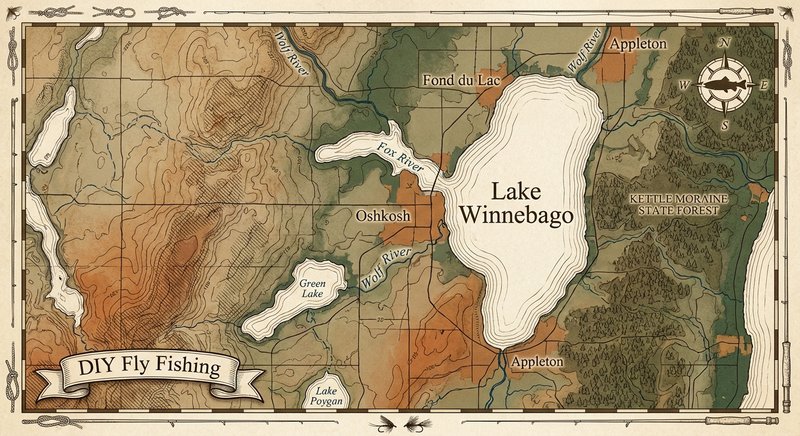
Lake Winnebago
Fly fishing in Wisconsin · Intermediate · Best seasons: Spring, Summer, Fall, Winter
Target Species
Walleye, White Bass, Lake Sturgeon
About This Water
Wisconsin's largest inland lake with walleye and white bass. Sturgeon spearing tradition.
Fishing Recommendations
As an expert guide, I have to be honest with you right out of the gate: Lake Winnebago is one of the most challenging fly fishing environments in the Midwest—not because of the fish, but because of the water. This is a massive, shallow, windswept "sea" characterized by turbid (stained) water and immense rock reefs.
However, for the adventurous fly angler, the "Winnebago System" (including the Fox and Wolf Rivers) offers some of the most prolific warm-water action in the country. If you time the migrations right, you will experience world-class fishing.
🎣 Location Overview
Lake Winnebago is Wisconsin’s largest inland lake, spanning nearly 132,000 acres. It is remarkably shallow, with an average depth of only 15.5 feet. This shallow nature, combined with a fertile, muddy bottom and rocky shorelines, creates a "factory" for forage like gizzard shad, emerald shiners, and lake flies (chironomids).
What makes it special for the fly fisher is the sheer volume of fish. When the walleye and white bass move from the main lake into the tributary rivers (The Wolf and The Upper Fox) or onto the shallow rock reefs, they become highly accessible to fly gear. This is "blue-collar" fly fishing—it’s gritty, windy, and incredibly productive.
🐟 Target Species & Behavior
Walleye
- Behavior: Known as "light-sensitive," Winnebago walleyes hold deep or in the stained "mud line" during bright days. They move into the shallows (2–5 feet) to feed during low light or high wind ("Walleye chop").
- Feeding: They focus heavily on emerald shiners and young-of-the-year perch.
White Bass
- Behavior: The "Wolf River Run" is legendary. In May, millions of white bass push into the rivers and shallow bays. They are aggressive, schooling predators that will chase anything that flashes.
- Feeding: Primarily small minnows and emerging insects.
Lake Sturgeon
- Behavior: Crucial Note: Lake Sturgeon in Winnebago are a protected treasure. While they are famous here, they are not a traditional fly-fishing target. They are bottom-feeders that eat macroinvertebrates.
- Fly Potential: Very low. Most "catches" on flies are accidental snags during the spring run. If targeting them ethically, you would need heavy sink tips and fly patterns mimicking clusters of red worms or chironomids, fished dead-on-the-bottom in the river channels.
📅 Best Times to Fish
- Spring (April – Early June): The Peak. This is when the Walleye and White Bass run up the Wolf and Fox Rivers. Focus on river mouths and shallow rocky points.
- Summer (July – August): Focus on the main lake "reefs" (like Abraham’s Rocks or High Cliff) at dawn and dusk. This is also when the massive "Lake Fly" (midge) hatches occur.
- Fall (September – November): The "downstream" migration. Fish follow the baitfish back into the main lake. This is the best time for trophy Walleye on large streamers.
- Winter (December – March): Primarily an ice-fishing scene. Fly fishing is limited to tailwaters below dams (like the Neenah/Menasha dams) that remain ice-free.
🪰 Recommended Flies & Techniques
Top Fly Patterns
- Clouser Minnow: (Chartreuse/White or Blue/White) – The gold standard for both species. Size 2–6.
- Half and Half: A cross between a Lefty’s Deceiver and a Clouser. Great for moving more water in stained conditions.
- The "Lake Fly" (Midge) Larvae: Size 10–14 red or black zebra midges. Use these when walleyes are gorging on the bottom.
- Gamechangers: Small (3-inch) articulated streamers in perch patterns for Fall Walleye.
- Murdich Minnow: Excellent for White Bass when they are busting bait on the surface.
Techniques
- The "Count Down" Method: Since Winnebago is shallow, use an intermediate sinking line or a Type 3 sink tip. Cast, count to five, and use a "strip-strip-pause" retrieve.
- River Swinging: In the Fox or Wolf rivers, use a Spey or switch rod to swing streamers through the current, much like fishing for Steelhead.
- Indicator Midge Fishing: During the Lake Fly hatch, fishing a blood-worm (midge larvae) pattern under an indicator in 6–10 feet of water can be surprisingly effective for Walleye.
💡 Pro Tips & Local Knowledge
- The "Mud Line" is Your Friend: Winnebago is often windy. When waves crash against a windward shore, they create a "mud line" where clear water meets turbid water. Walleyes sit just inside the murky side to ambush bait in the clear water. Fish your fly right on that edge.
- Night Fishing: If you want a trophy Walleye on a fly, you must fish at night. Head to the rocky shorelines of High Cliff State Park or the Neenah shoreline and cast large, dark-colored streamers.
- The "Lake Fly" Phenomenon: In June, the midges (Lake Flies) hatch in such billions they show up on radar. While they don't bite humans, they clog the water. Walleyes get "full" and lazy; during this time, downsize your flies significantly.
- Wade Access: Unlike many large lakes, Winnebago has some great wading at High Cliff State Park and Garlic Island. Be careful of the "Winnebago Step"—smooth, slippery limestone rocks that will put you in the water quickly.
⚠️ Important Information
- Regulations: Wisconsin DNR fishing licenses are required. Walleye have specific length limits (often a 15-inch minimum, but check current "protected slot" regulations as they vary by year).
- Safety: This lake turns dangerous faster than almost any lake in the US. If the wind exceeds 15mph, stay off the open water in a boat. For waders, be wary of the "east shore" in a west wind—the waves gain immense power crossing 10 miles of open water.
- Invasive Species: This system has Zebra Mussels. They are razor-sharp. If you are wading, thick-soled wading boots are mandatory, or you will slice your feet or waders.
- Sturgeon Regulations: Targeting Sturgeon has extremely strict seasons (usually a short winter spear fishery and a brief hook-and-line season in the fall). Ensure you are in-season before targeting them.
Guide’s Final Word: Winnebago isn't your typical trout stream experience. It’s loud, it’s big, and it’s messy. But when you hook into a 25-inch Walleye or a 3-lb White Bass on a 6-weight rod in three feet of water, you’ll understand why Winnebago is the heart of Wisconsin fishing.
Bug Hatches & Matching Flies
| Hatch | Type | Peak months | Time of day | Hook sizes | Matching flies |
|---|---|---|---|---|---|
| Lake Fly (Giant Midge) Chironomus plumosus | midge | May, June | Evening | #10-14 | Zebra Midge #10-14, Chironomid Bomber #10-12, Griffith's Gnat #12-14 |
| Giant Mayfly (Hex) Hexagenia limbata | mayfly | June, July | Evening/Night | #6-10 | Hexagenia Spinner #6-8, Gold Ribbed Hare's Ear #8-10, Hex Paradun #8-10 |
| White Miller Ephoron leukon | mayfly | August | Evening | #12-14 | White Wulff #12-14, Ephoron Spinner #14, White Miller Nymph #14 |
| Angler's Curse (Trico) Caenis | mayfly | July, August | Early Morning | #20-24 | Trico Spinner #22-24, Caenis Nymph #22, RS2 #20-22 |
| Spotted Sedge Hydropsyche | caddis | June, July, August | Evening | #14-18 | Elk Hair Caddis #14-16, LaFontaine's Deep Sparkle Pupa #14-18, Hydropsyche Larva #14-16 |
| Water Boatman Corixidae | terrestrial | September, October | All Day | #14-16 | Water Boatman Pattern #14-16, Prince Nymph (modified) #14-16, Backswimmer #12-14 |
| Blue-Winged Olive (BWO) Baetis | mayfly | April, May, September, October | Mid-day/Afternoon | #18-22 | Parachute Adams #18-22, BWO Sparkle Dun #18-20, Pheasant Tail #18-22 |
| Damselfly Enallagma | terrestrial | June, July | Afternoon | #10-12 | Marabou Damselfly Nymph #10-12, Adult Damselfly #10-12, Braided Butt Damsel #12 |