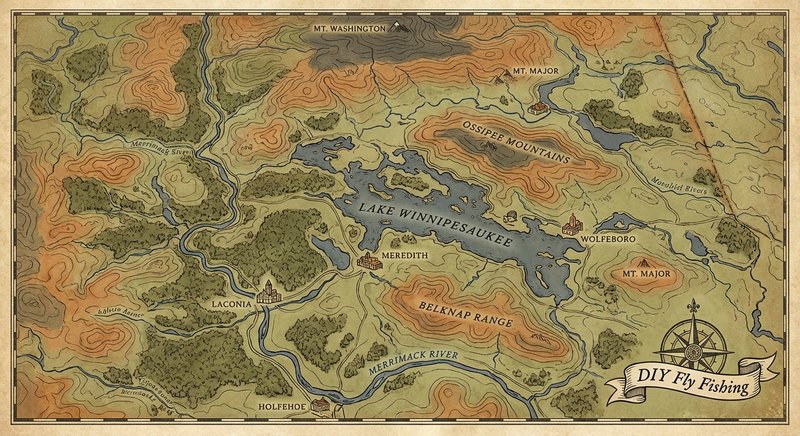
Lake Winnipesaukee
Fly fishing in New Hampshire · Intermediate · Best seasons: Spring, Summer, Fall
Target Species
Landlocked Salmon, Lake Trout, Smallmouth Bass
About This Water
New Hampshire's largest lake with landlocked salmon, lake trout, and bass. Iconic destination.
Fishing Recommendations
Welcome to "The Big Lake." As an expert guide, I can tell you that Lake Winnipesaukee is the crown jewel of New Hampshire fly fishing. Spanning over 70 square miles with 250+ islands, it is a complex, glacial fishery that demands respect and strategy.
Here is your comprehensive guide to fly fishing Lake Winnipesaukee.
🎣 Location Overview
Lake Winnipesaukee is a massive, oligotrophic (deep, cold, and clear) lake. What makes it special for the fly angler is the rare opportunity to target landlocked Atlantic Salmon in a lake environment. The water is exceptionally clear, often allowing you to see bottom in 20 feet of water.
Anglers love "Winni" because it offers a "big water" experience. It isn’t a quiet mountain stream; it’s a dynamic inland sea with rocky reefs, deep basins, and windswept points. Success here requires understanding thermal layers and baitfish migrations.
🐟 Target Species & Behavior
Landlocked Atlantic Salmon
These are the "silver bullets" of the lake. They are incredibly acrobatic and hard-fighting.
- Behavior: They are pelagic, following schools of Osmerus mordax (Rainbow Smelt).
- Where they hold: In early spring, they are in the top 10 feet of the water column. As the water warms, they follow the thermocline deeper (30–50 feet).
- Diet: 90% Smelt.
Lake Trout (Lakers)
Known locally as "fork-tails," these fish grow to impressive sizes in the deep holes.
- Behavior: They love cold water (45–55°F). While usually deep-dwellers, they move into the shallows immediately after ice-out.
- Where they hold: Rock piles, steep drop-offs, and the "edges" where the bottom transitions from sand to rock.
Smallmouth Bass
Winnipesaukee is a world-class Smallmouth destination.
- Behavior: Aggressive and territorial.
- Where they hold: Rocky shoals, boulder fields, and under docks. During the spawn (late May/June), they are visible on sandy flats.
- Diet: Crayfish, Smelt, and Yellow Perch.
📅 Best Times to Fish
Spring (Ice-out to Mid-June) - PRIME TIME
- Window: This is the Holy Grail for fly anglers. When the ice breaks (usually mid-April), Salmon and Lake Trout are in the top 5 feet of water cruising the shorelines to feed.
- Conditions: Overcast days with a "Salmon chop" (a light breeze) are better than bluebird, calm days.
Summer (July - August)
- Window: Early morning (5 AM – 8 AM) is the only time for surface action.
- Conditions: Bass are the primary target for fly anglers now. Salmon retreat to depths of 40+ feet, requiring heavy sinking lines or specialized "deep water" fly tactics.
Fall (September - October)
- Window: Late September brings the Salmon back toward the river mouths and rocky points as they prepare for their spawning run.
- Conditions: Cooler nights trigger a feeding frenzy. The colors on the Salmon are stunning this time of year.
🪰 Recommended Flies & Techniques
For Salmon & Lake Trout
- Top Patterns:
- Gray Ghost (The classic NH streamer)
- Joe’s Smelt
- Black Ghost
- Muddler Minnow (Size 4-8)
- Techniques:
- Trolling the Fly: This is the most effective method. Use a Type 3 or Type 5 sinking line, let out 75–100 feet of line, and move the boat at 1.5 to 2.5 mph.
- The "Winni Twitch": If casting from shore or a drifting boat, use a fast, erratic strip to mimic a wounded smelt.
For Smallmouth Bass
- Top Patterns:
- Clouser Minnow (Chartreuse/White or Olive/White)
- Crayfish Patterns (Heavy lead eyes)
- Poppers (Early morning/late evening)
- Techniques:
- Sight Fishing: In June, cruise the shallows and look for "dark spots" on the sand.
- Dredging Shoals: Use an intermediate line to swing streamers over submerged rock piles.
💡 Pro Tips & Local Knowledge
- Follow the Wind: In the spring, the wind pushes the warm surface water and the Smelt toward specific shorelines. Find the "windward" shore where the water is 2–3 degrees warmer; that’s where the Salmon will be.
- Focus on Inlets: The mouth of the Merrymeeting River in Alton Bay and the area around Governor’s Island bridge are legendary "early season" spots.
- The "Smelt Run": In April, Smelt run up the tributary brooks to spawn at night. Fishing the lake shore near these brook mouths at dawn can be incredibly productive.
- Gear Up: For Salmon, a 9-foot 6-weight rod is perfect. For Smallmouth, an 7-weight helps throw those wind-resistant poppers. Always use fluorocarbon leaders (8lb - 10lb) as the water is gin-clear.
⚠️ Important Information
- Regulations: New Hampshire has strict seasons for Landlocked Salmon. The season typically runs from April 1 to September 30.
- Permits: A valid New Hampshire Freshwater Fishing License is required. You can purchase these online via the NH Fish and Game website.
- Safety: This is a big lake. It can go from calm to 3-foot whitecaps in thirty minutes. If you are in a kayak or small boat, keep a close eye on the weather and stay near the islands for cover.
- Invasive Species: Clean, drain, and dry your gear. New Hampshire is vigilant about preventing the spread of milfoil and other invasive species.
Guide’s Final Word: Winnipesaukee rewards the patient angler. Don't be afraid to cover water. If you aren't seeing baitfish on your fishfinder or in the shallows, move until you do. Find the Smelt, and you’ll find the Silver.
Bug Hatches & Matching Flies
| Hatch | Type | Peak months | Time of day | Hook sizes | Matching flies |
|---|---|---|---|---|---|
| Giant Mayfly (Hex) Hexagenia limbata | mayfly | June, July | Dusk/Night | #6-10 | Hexagenia Spinner #6-8, Hex Nymph #8-10, Paradrake Hex #8 |
| Chironomids Chironomidae | midge | April, May, September | All Day | #16-24 | Zebra Midge #18-22, Ice Bud #16-20, Griffith's Gnat #18-22 |
| Flying Ants Formicidae | terrestrial | August, September | Afternoon | #14-18 | Black Foam Ant #14-16, Cinnamon Flying Ant #16-18 |
| Dark Grannom Caddis Brachycentrus nigrisoma | caddis | May | Late Morning/Afternoon | #14-16 | Deer Hair Caddis #14-16, Peacock Caddis #14, Deep Sparkle Pupa #14-16 |
| Blue Winged Olive Baetis | mayfly | May, September, October | Midday | #18-22 | RS2 #20-22, BWO Parachute #18-22 |
| Damselflies Enallagma | other | June, July | Daylight | #10-14 | Marabou Damsel Nymph #10-12, Adult Damsel #12 |
| Slate Drake Isonychia bicolor | mayfly | July, August, September | Late Afternoon/Evening | #10-14 | Iso Parachute #12, Prince Nymph #10-14, Zug Bug #12-14 |
| White Mayfly Ephoron leukon | mayfly | August | Dusk | #12-14 | White Wulff #12, Ephoron Spinner #14 |