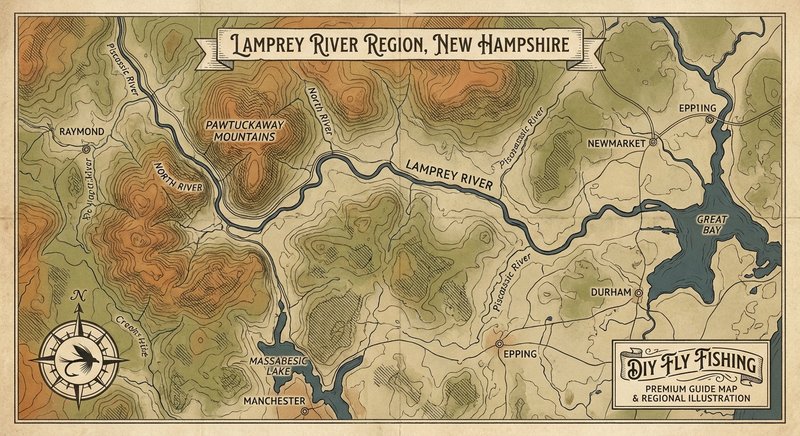
Lamprey River
Fly fishing in New Hampshire · Beginner · Best seasons: Spring, Summer, Fall
Target Species
Brook Trout, Smallmouth Bass
About This Water
Rockingham County stream with trout and bass. Wild and Scenic River.
Fishing Recommendations
The Lamprey River is one of the hidden gems of Southeastern New Hampshire. Designated as a National Wild and Scenic River, it offers a diverse tapestry of water ranging from tumbling pocket water and quick moving riffles to slow, deep pastoral bends. Its accessibility and variety make it a favorite for New England anglers who want to switch between technical trout fishing and aggressive warm-water action.
Here is your comprehensive guide to fly fishing the Lamprey River.
🎣 Location Overview
The Lamprey flows for nearly 50 miles before emptying into the Great Bay. For the fly angler, the most productive sections are located between Epping, Lee, and Durham.
What makes the Lamprey special is its transition. The upper reaches feel like a classic woodland trout stream, while the middle and lower sections widen into a powerhouse smallmouth fishery. The river is characterized by granite boulders, submerged timber, and a rich macroinvertebrate population. It feels remarkably remote despite being a short drive from Manchester or Portsmouth.
🐟 Target Species & Behavior
Brook Trout
- Behavior: The Lamprey is heavily stocked by NH Fish & Game in the spring. While there are some holdover fish, most Brookies are "put-and-take." They are opportunistic but can become selective once the initial stocking pressure wears off.
- Holding Water: Look for "seams" where fast water meets slow water, and deep undercuts beneath overhanging banks. In the late spring, they migrate toward oxygenated "bubble curtains" at the base of small falls or riffles.
- Diet: Early season midges, Hendricksons in May, and various Caddis species.
Smallmouth Bass
- Behavior: The "Bronzeback" is the undisputed king of the Lamprey during the warmer months. These fish are hardy, aggressive, and highly territorial.
- Holding Water: Smallmouths love the rocky ledges and "dead water" behind large boulders. They also frequent the edges of lily pads and fallen trees in the slower reaches.
- Diet: The Lamprey has a massive population of crayfish and hellgrammites. Smallmouths here also key in on shiners and juvenile sunfish.
📅 Best Times to Fish
- Spring (Late April – June): Prime Trout Window. This is when the water temps are ideal (50°F–60°F). The Hendrickson hatch in May is the highlight of the year for dry fly enthusiasts.
- Summer (July – August): Peak Smallmouth Season. As water temperatures rise above 70°F, trout retreat to deep, shaded holes or cold-spring seeps. This is the time to hunt bass with topwater poppers in the early morning or late evening.
- Fall (September – October): The "Second Season." As the water cools, Brook Trout become active again before the spawn. Smallmouths begin a feeding frenzy to bulk up for winter. The foliage makes this the most scenic time to be on the water.
🪰 Recommended Flies & Techniques
For Brook Trout
- Nymphing (Best for Spring): Use a two-fly rig. A Bead-head Pheasant Tail (#14-16) as a dropper under a Gold-ribbed Hare’s Ear (#12).
- Dry Flies: Elk Hair Caddis (#14-18) is the "bread and butter" on this river. For the May hatch, have Light Cahills and Hendricksons ready.
- Streamers: A Black or Olive Woolly Bugger (#8-10) swung through deep pools is the most effective way to find the larger holdover trout.
For Smallmouth Bass
- Topwater: Sneaky Pete Poppers or Foam Frogs in chartreuse or white. Twitch them slowly near woody debris.
- Subsurface: Clouser Minnows (Blue/White or Chartreuse/White) to mimic shiners.
- The Secret Weapon: A Rubber-legged Hellgrammite pattern drifted along the bottom is irresistible to Lamprey Smallmouths.
💡 Pro Tips & Local Knowledge
- The "Wiswall" Stretch: The area around Wiswall Dam in Durham is a legendary spot. Below the dam offers high oxygen and great structure for both species. Above the dam, it becomes more lacustrine (lake-like), which is excellent for kayak fly fishing for bass.
- Stealth Matters: In the Epping sections, the river can be narrow. Avoid wading right into the middle of a pool. Stand back and fish the "near" water first. The shadows of an angler will spook Lamprey trout instantly.
- The "Crayfish Kick": When fishing for Smallmouth, use a weighted fly and let it puff up "dust" on the sandy/rocky bottom. This mimics a fleeing crayfish and triggers a predatory strike.
- Check the Gauges: The Lamprey can rise quickly after a heavy rain. Check the USGS gauge at Newmarket. If it's spiking, the water will be turbid (chocolate milk), and fishing will be tough.
⚠️ Important Information
- Access:
- Mary Blair Park (Epping): Great for wading and family access.
- Lee Hook Road: Offers several pull-offs for access to more rugged, wooded stretches.
- Route 108 Bridge: Good access for the lower stretches.
- Regulations: You must have a valid New Hampshire Fishing License. The Lamprey is generally under "General Fishing" regulations, but always check the current NH Fish & Game Digest for any mid-season changes or special terminal tackle requirements.
- Conservation: This is a Wild and Scenic river. Practice Catch and Release, especially for wild Brookies, and please pack out all trash and spent tippet.
- Wading Safety: The rocks in the Lamprey are notoriously "greasy." Felt-soled boots or studs are highly recommended to avoid a dunking.
Guide’s Final Take: The Lamprey isn't a river where you'll find 20-inch trout every day, but it is a river that rewards the observant angler with beautiful scenery and hard-fighting fish. Fish the riffles for trout in the morning, and the ledges for bass in the afternoon—you can’t beat it.
Bug Hatches & Matching Flies
| Hatch | Type | Peak months | Time of day | Hook sizes | Matching flies |
|---|---|---|---|---|---|
| Hendrickson Ephemerella subvaria | mayfly | April, May | Afternoon | #12-14 | Red Quill #12-14, Hendrickson Emerger #12-14, Pheasant Tail #12-14 |
| Blue-Winged Olive Baetis spp. | mayfly | April, May, September, October | Late Morning/Afternoon | #18-22 | RS2 #18-22, BWO Sparkle Dun #18-22, Parachute Adams #18-22 |
| Grannom Caddis Brachycentrus | caddis | April, May | Morning/Evening | #14-16 | Peacock Caddis #14-16, Deep Sparkle Pupa #14-16 |
| American March Brown Maccaffertium vicarium | mayfly | May, June | Afternoon | #10-12 | March Brown Dry #10-12, Hare's Ear Nymph #10-12 |
| Light Cahill Stenacron interpunctatum | mayfly | June, July | Evening | #14-16 | Light Cahill #14-16, Cream Usual #14-16 |
| Spotted Sedge Hydropsyche | caddis | June, July, August | Evening | #14-18 | Elk Hair Caddis #14-18, LaFontaine Sparkle Pupa #14-16, Green Weenie #14-18 |
| Giant Black Stonefly Pteronarcys dorsata | stonefly | May, June | Evening | #4-8 | Pat's Rubber Legs #4-8, Black Stimulator #6-10 |
| Common Terrestrials Formicidae / Coleoptera | terrestrial | July, August, September | Midday/Afternoon | #12-18 | Black Foam Ant #14-18, Crowe Beetle #12-16 |