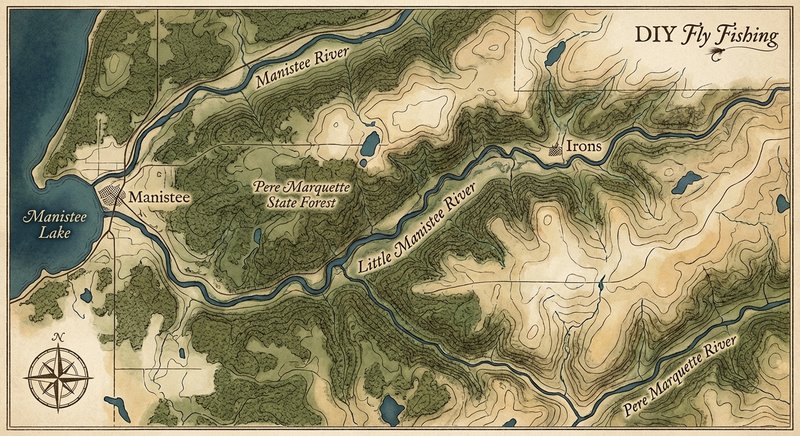
Little Manistee River
Fly fishing in Michigan · Intermediate · Best seasons: Fall, Spring
Target Species
Steelhead, Salmon
About This Water
Known for steelhead and salmon runs. Important spawning tributary for Great Lakes fish.
Fishing Recommendations
As an expert guide who has spent many cold mornings on the banks of Michigan’s "Little River," I can tell you that the Little Manistee is one of the most storied and technically demanding rivers in the Great Lakes region. Unlike its larger neighbor, the Big Manistee, the "Little River" is intimate, brushy, and incredibly prolific. It serves as the primary broodstock source for Michigan’s steelhead program, making it a "factory" for some of the hardest-fighting fish in the state.
🎣 Location Overview
The Little Manistee River (the "Little River") is a small, cold-water gem that flows through Lake, Mason, and Manistee counties. It is characterized by its narrow width (20–40 feet in many places), crystal-clear water, and a bottom comprised of sand, gravel, and heavy woody debris.
What makes it special is its wild character. Because it is much smaller than other Lake Michigan tributaries, the fishing is more intimate. You aren't casting 80 feet of line here; you are "picking pockets" and navigating around downed cedar trees. It is a classic "finesse" river where stealth and precision trump distance.
🐟 Target Species & Behavior
Steelhead (Adreanalin on a Fly)
- Behavior: These are lake-run Rainbow Trout. In the Fall, they enter to feast on Salmon eggs. In the Spring, they enter to spawn.
- Holding: Look for them in the "slots"—deeper troughs of dark water between sandbars or tucked tightly under overhanging cedar sweeps.
- Feeding: In the fall, they are aggressive and opportunistic, focused on protein (eggs and nymphs). In the spring, their focus shifts to spawning, though they will strike out of territorial aggression.
Salmon (Chinook/King & Coho)
- Behavior: These fish enter the river to spawn and die. They are massive (15–25 lbs) and can be extremely destructive to light tackle.
- Holding: They congregate in deep holes during the day and move onto shallow gravel bars to spawn (redds) during low light.
- Feeding: They generally stop feeding once they enter the river, but they will strike flies out of instinct or annoyance.
📅 Best Times to Fish
The Fall (September – November)
- Chinook Salmon: Peak runs usually occur from mid-September through early October.
- Fall Steelhead: The "Chrome" begins following the salmon in October to eat eggs. This is arguably the best time for fly anglers who want aggressive, hard-fighting fish in slightly warmer water.
The Spring (March – May)
- Steelhead: This is the prime spawning run. Late March through mid-April is usually the peak. As the water hits 42–45°F, the fish move from the deep holes onto the gravel.
Prime Conditions
- Water Level: A "rising" river after a rain brings fresh fish in from Lake Michigan.
- Time of Day: Early morning (pre-dawn) and late evening are critical. In the crystal-clear water of the Little River, these fish are very "spooky" under a high sun.
🪰 Recommended Flies & Techniques
Techniques
- Indicator Nymphing: The most effective method. Use a floating line, a long leader (9–12ft), and enough split shot to get the fly to the "zone" (just above the bottom).
- Chuck-and-Duck: A local Michigan tradition used in deeper, faster holes where traditional fly lines struggle to sink. It uses a thin running line and heavy weights.
- Swinging Streamers: Effective in the lower river sections for fresh-run fish.
Recommended Fly Patterns
- Eggs: Glo-bugs, Estaz Eggs, and "Beads" (8mm and 10mm in mottled orange, peach, or Oregon cheese) are the gold standard.
- Nymphs: Hexagenia larvae, Stoneflies (black or golden), and Prince Nymphs (Size 8–12).
- Streamers: Egg-sucking leeches, Wooly Buggers (black/olive), and Skagit-style intruders for swinging.
💡 Pro Tips & Local Knowledge
- Stealth is Everything: Because the river is small and clear, if you can see the fish, they have likely already seen you. Wear drab clothing, move slowly, and avoid splashing.
- The "Sweeps": On the Little River, the fish love to sit under "sweeps"—downed trees overhanging the water. You must be brave enough to lose flies. If you aren't bumping the wood, you aren't where the fish are.
- The Weir: There is a DNR fish-blocking weir on the lower river. Check the status of the weir; when the grates are down, fish stack up below it. When they are up, the fish move rapidly into the middle and upper sections.
- Focus on the "Tail-outs": In the evening, steelhead move from the deep holes to the shallower tail-outs of pools. This is the best time to swing a fly.
⚠️ Important Information
Access
- High Bridge: A popular access point for the lower river.
- 9-Mile Bridge & 6-Mile Bridge: These are the heart of the "fly water" sections.
- The Weir: Located near Old Stronach Rd.
Regulations
- Special Regulations: Parts of the Little Manistee have specific regulations regarding "Type 4" trout water versus "Type 1."
- Licensing: You must have a Michigan All-Species Fishing License.
- Seasonal Closures: The river has specific sections that close to protect spawning fish (usually from Jan 1 to the last Saturday in April, though the section below the Weir remains open). Always check the current Michigan DNR Fishing Guide before heading out.
Special Considerations
- Private Property: While the river is navigable, the banks are often private. Stay in the water (wade-only) unless you are at a designated public access point.
- Gear: Use a 7 or 8-weight rod for Steelhead and a 9-weight for Salmon. High-quality fluorocarbon tippet (8lb–12lb) is essential due to the clear water and sharp debris.
Bug Hatches & Matching Flies
| Hatch | Type | Peak months | Time of day | Hook sizes | Matching flies |
|---|---|---|---|---|---|
| Blue Winged Olive (BWO) Baetis / Pseudocloeon | mayfly | April, May, September, October | Afternoon | #18-22 | RS2 #18-20, Parachute Adams #18-22, BWO CDC Emerger #18-20 |
| Hendrickson Ephemerella subvaria | mayfly | May | Afternoon | #12-14 | Red Quill #12-14, Hendrickson Spinner #12-14, Pheasant Tail Nymph #12-14 |
| Grannom Caddis Brachycentrus | caddis | April, May | Late Morning/Afternoon | #14-16 | Elk Hair Caddis (Olive/Tan) #14-16, Peacock Caddis #16, Deep Sparkle Pupa #14-16 |
| Sulphur Ephemerella invaria/dorothea | mayfly | May, June | Evening | #14-18 | Sulphur Parachute #14-18, Sulphur Snowshoe Emerger #16, Sulphur Spinner #14-18 |
| Brown Drake Ephemera simulans | mayfly | June | Dusk | #10-12 | Brown Drake Paradox #10-12, Brown Drake Spinner #10-12, Brown Drake Nymph #10-12 |
| Giant Michigan Mayfly (Hex) Hexagenia limbata | mayfly | June, July | Night | #4-8 | Hex Hagen #6-8, Robert's Yellow Drake #6-8, Wiggle Hex Nymph #6-8 |
| Isonychia (Slate Drake) Isonychia bicolor | mayfly | July, August, September | Late Afternoon | #10-12 | Iso Parachute #10-12, Zug Bug #10-12, Prince Nymph #10-14 |
| Terrestrials Formicidae / Gryllidae | terrestrial | July, August, September | Mid-day/Afternoon | #8-16 | Chernobyl Ant #8-12, Black Foam Beetle #14-16, Cinnamon Ant #16-18 |