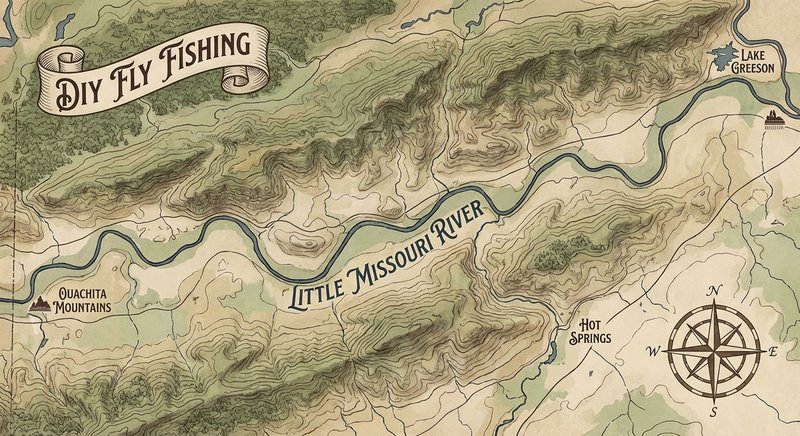
Little Missouri River
Fly fishing in Arkansas · Intermediate · Best seasons: Spring, Fall
Target Species
Smallmouth Bass, Rainbow Trout
About This Water
Ouachita Mountains stream with bass and stocked trout. Scenic wilderness fishing.
Fishing Recommendations
The Little Missouri River in Southwest Arkansas is a hidden gem that offers a unique "split personality" experience for fly anglers. Emerging from the Ouachita Mountains, it provides both a rugged, freestone mountain stream experience and a productive tailwater fishery.
Here is your comprehensive guide to fly fishing the "Little Mo."
🎣 Location Overview
The Little Missouri is unique because it offers two distinct types of water. The Upper Little Missouri (above Lake Greeson near the Albert Pike Recreation Area) is a classic mountain freestone stream characterized by boulder gardens, deep pools, and swift runs.
The Tailwater section (below Narrows Dam/Lake Greeson) is where the river becomes a cold-water sanctuary. This 6-to-10-mile stretch is the southernmost trout fishery in the region. What makes it special is the scenery—unlike the flatter delta regions of Arkansas, this river cuts through rocky ridges and pine forests, offering a "western" feel in the middle of the South.
🐟 Target Species & Behavior
Rainbow Trout
Found primarily in the tailwater section below Narrows Dam. These fish rely heavily on the cold water released from the bottom of Lake Greeson.
- Behavior: They hold in the classic "bubble lines," behind large submerged rocks, and in the deep slots of the shelf rock.
- Feeding: They are opportunistic feeders but can become selective during midge hatches. They rely heavily on aquatic insects like sowbugs and scuds found in the mossy river bottom.
Smallmouth Bass
Found both in the Upper Little Missouri and several miles downstream from the dam where the water warms.
- Behavior: Known as "bronzebacks," these fish are pound-for-pound the hardest fighters in the river. They hold in the slack water behind boulders or in the deep, shaded "blue holes" during the heat of the day.
- Feeding: Their diet is protein-heavy: crawfish, hellgrammites, and baitfish (minnows/sculpins).
📅 Best Times to Fish
Spring (March – May)
- The Window: This is the prime time for both species. Trout are active as the water stabilizes, and Smallmouth begin their pre-spawn movement.
- Conditions: Look for the emergence of March Browns and Caddis. This is your best chance for dry fly action.
Fall (October – December)
- The Window: As air temperatures drop, the Smallmouth feed aggressively to bulk up for winter, and the state begins its heavy winter trout stocking program.
- Conditions: Low, clear water is common. Stealth is required. The fall foliage in the Ouachitas makes this the most scenic time to be on the water.
Best Time of Day
- Trout: Late morning through mid-afternoon. As the sun hits the water, midge activity usually picks up.
- Smallmouth: Low light is king. Target the "golden hours" (first two hours of light and the last two hours before dark) for topwater action.
🪰 Recommended Flies & Techniques
For Rainbow Trout
- Nymphing (Most Effective): Use a two-fly rig under a small indicator.
- Patterns: Zebra Midge (Size 18-22 in black or red), Pheasant Tail (Size 16-18), and Sowbugs (Size 14-16).
- Dry Flies: When bugs are popping, use an Elk Hair Caddis or an Adams Parachute (Size 14-18).
- Streamers: A Wooly Bugger (Olive or Black, Size 8-10) swung through deep holes can trigger aggressive strikes from larger holdover trout.
For Smallmouth Bass
- Topwater: Poppers or Deer Hair Bugs in yellow, orange, or black. Chug them slowly near wood debris.
- Sub-surface: Clouser Minnow (Chartreuse/White), Near Nuff Crawfish, and Hellgrammite patterns.
- Technique: Use a "strip-strip-pause" retrieve. Smallmouth often hit on the pause.
💡 Pro Tips & Local Knowledge
- The "One Turbine" Rule: Check the Southwestern Power Administration (SWPA) generation schedule before you go. If they are generating with two turbines, the river is dangerous and unfishable for waders. One turbine is fishable in some spots but difficult. Zero turbines (low flow) is the gold standard for wading.
- Shelf Rock Strategy: Much of the river bottom consists of "shelf rock" (slanted layers of shale). Fish the "cracks" in these shelves. Trout will tuck into these narrow crevices to escape the current.
- Upper River Smallmouth: If fishing the Albert Pike area, look for "long pools." Smallmouth will sit at the very head of the pool where the fast water enters, waiting for food to be delivered to them.
- Go Small: Because the water is often crystal clear, use long leaders (9-12 feet) and light tippet (5X or 6X) for trout to avoid spooking them.
⚠️ Important Information
- Access Points:
- Tailwater: The "Factory Site," "Riverside Park," and the area immediately below Narrows Dam are the most popular public access points.
- Upper River: Access via the Albert Pike Recreation Area and various low-water bridges in the Ouachita National Forest.
- Regulations:
- A valid Arkansas Fishing License AND a Trout Permit are required if you are fishing for trout or even if you are just keeping trout in your possession.
- Check the Arkansas Game and Fish Commission (AGFC) for specific "Catch and Release" zones which may have bait and hook restrictions (Single barbless hooks are highly recommended).
- Safety: The rocks in the Little Missouri are notoriously slick. Felt-soled boots or studs are a must. Additionally, always keep an eye on the water level; if you see leaves and foam suddenly increasing, the dam has likely started generating—get to the bank immediately.
Bug Hatches & Matching Flies
| Hatch | Type | Peak months | Time of day | Hook sizes | Matching flies |
|---|---|---|---|---|---|
| Midges Chironomidae | midge | January, February, March, December | All Day | #18-24 | Zebra Midge #18-22, Griffith's Gnat #20-24, Morgan's Midge #20-22 |
| Blue Winged Olive Baetis | mayfly | February, March, October, November | Late Morning/Afternoon | #18-22 | Parachute Adams #18-22, RS2 #20-22, Pheasant Tail Nymph #18-20 |
| Grannom Caddis Brachycentrus | caddis | March, April | Afternoon/Evening | #14-16 | Elk Hair Caddis (Olive) #14-16, Peeping Caddis #14-16, Holy Grail #14-16 |
| Sulphur Ephemerella invaria | mayfly | May, June | Late Afternoon/Evening | #16-18 | Sulphur Parachute #16-18, Sulphur Snowshoe Emerger #16-18, Split Case Sulphur #16-18 |
| Spotted Sedge Hydropsyche | caddis | June, July, August | Evening | #14-18 | X-Caddis #14-18, LaFontaine's Deep Sparkle Pupa #14-16, Iris Caddis #16-18 |
| Trico Tricorythodes | mayfly | August, September, October | Early Morning | #22-26 | Trico Spinner #22-26, Trico Parachute #22-24 |
| Light Cahill Stenacron | mayfly | June, July | Evening | #12-14 | Light Cahill Dry #12-14, Gold Ribbed Hare's Ear #12-14 |
| Terrestrials Formicidae/Coleoptera | terrestrial | July, August, September | All Day | #12-18 | Chernobyl Ant #12-14, Black Foam Beetle #14-18, Fur Ant #16-18 |