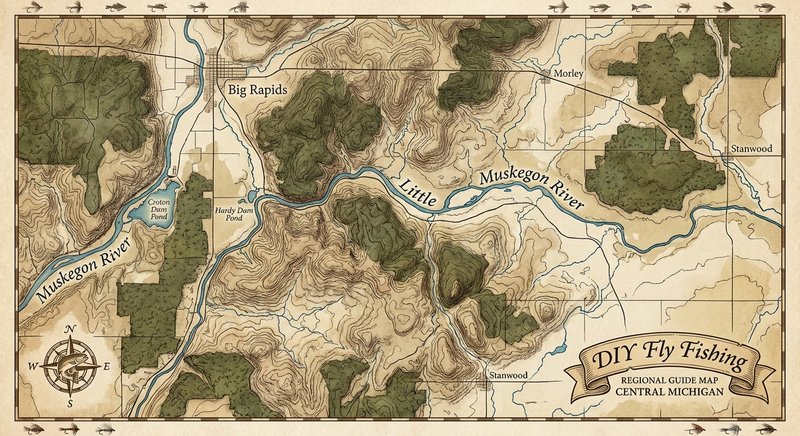
Little Muskegon River
Fly fishing in Michigan · Beginner · Best seasons: Spring, Summer, Fall
Target Species
Brown Trout, Brook Trout
About This Water
Excellent trout stream with good public access. Wild brown trout and natural reproduction.
Fishing Recommendations
The Little Muskegon River (or "The Little Mo," as locals call it) is one of Michigan’s most underrated trout gems. While its big brother, the Muskegon River, is famous for its massive tailwater fishery and steelhead runs, the Little Muskegon offers a completely different experience: intimate, technical, and full of character.
As a guide, I view this river as a "stealth and structure" fishery. It is a classic Michigan sand-and-gravel stream that demands respect and rewarded patience.
🎣 Location Overview
The Little Muskegon flows through Mecosta and Newaygo counties before joining the main Muskegon at Croton Pond. Unlike the wide-open main stem, the Little Mo is a smaller, wadeable river characterized by heavy woody debris, sweeping bends, and a mix of sandy flats and gravel runs.
What makes it special is its intimacy. In many stretches, the canopy closes in over your head, requiring accurate casting and creative "under-the-gun" presentations. The water is often stained with a slight tea-colored tint (tannic), which provides excellent cover for large, predatory trout. It feels like a wilderness stream even though it’s within an hour's drive of Grand Rapids.
🐟 Target Species & Behavior
- Brown Trout: These are the kings of the Little Mo. The river holds a healthy population of resident browns that range from 8 to 14 inches, with "river monsters" exceeding 20 inches hiding in the deepest log jams. They are highly structure-oriented; if there isn't wood or a deep undercut bank, they likely aren't there.
- Brook Trout: You’ll find these jewels primarily in the upper reaches and near the mouths of cold-water tributaries. They are opportunistic feeders but sensitive to water temperature.
- Behavior: During the day, the larger fish are extremely wary and stay tucked deep into "the wood." They become most active during low-light transitions (dawn/dusk) or during major hatches like the Hexagenia limbata.
📅 Best Times to Fish
Spring (Late April – May)
This is "match the hatch" season. As the water warms into the 50s, the bugs start moving.
- Key Windows: Mid-afternoon when the sun warms the water.
- Conditions: Watch for the Hendrickson hatch in late April.
Summer (June – August)
The prime time for dry fly enthusiasts.
- June: The "Holy Grail" month. The Hex hatch occurs in late June, bringing the largest browns out of the wood to feed on the surface at night.
- July/August: Terrestrial season. Mid-day fishing with grasshopper and ant patterns can be surprisingly productive.
Fall (September – October)
The river sees a burst of activity as Brown Trout prepare to spawn.
- Key Windows: Overcast, drizzly days.
- Conditions: This is prime streamer season. The fish become aggressive and territorial.
🪰 Recommended Flies & Techniques
Dry Flies
- The Classics: Adams (Size 12-18), Royal Wulff, and Elk Hair Caddis.
- The "Michiganders": Robert’s Yellow Drake, Borcher’s Special, and any oversized Hexagenia pattern (Size 4-6) for late June nights.
- Terrestrials: Chernobyl Ants, Foam Beetles, and Dave’s Hopper.
Nymphing
The Little Mo is a fantastic nymphing stream, especially in the riffles.
- Patterns: Pheasant Tail (14-18), Prince Nymph (12-16), and Gold-Ribbed Hare’s Ear.
- Pro Tip: Use a "Dry-Dropper" rig to explore the edges of log jams without snagging the bottom as often as a traditional indicator rig.
Streamers
If you want the 20-inchers, you have to throw meat.
- Patterns: Wooly Buggers (Black/Olive), Kelly Galloup’s Dungeon, or the Sculpin Bunny.
- Technique: "Pounding the wood." Cast as close to the submerged logs as possible and give it two or three aggressive strips. If they don't hit it immediately, move on.
💡 Pro Tips & Local Knowledge
- Beware the "Sand Sinks": The Little Muskegon has a lot of sand. Be careful when wading; what looks like a solid bottom can sometimes be "sugar sand" that you'll sink into. Always use a wading staff.
- The "Wood" is Your Friend and Enemy: This river is notoriously "toothy"—it eats flies. If you aren't casting within inches of the logs, you aren't in the zone. Bring extra leaders and plenty of flies.
- Night Fishing: If you're fishing the Hex hatch, arrive at your pool before dark, memorize your casting lanes, and bring a red-lens headlamp to preserve your night vision.
- Stealth is Paramount: Because the river is small, your shadow and the "thump" of your boots on the bank will spook fish 20 feet ahead of you. Move slowly and fish upstream.
⚠️ Important Information
- Access: Much of the river flows through private land, but there are several key public access points:
- The Morley Dam area: Good access above and below the dam site (though the dam was removed/modified, the area remains a focal point).
- Bridge Crossings: Many bridges have small easements for anglers. Always look for "No Trespassing" signs.
- Regulations: The Little Muskegon is generally classified under Michigan Type 1 Regulations (Check the current MI DNR Trout Sidewalk for the most up-to-date info). This typically means a minimum size limit and a specific season (last Saturday in April through September 30th).
- Permits: A valid Michigan Fishing License is required.
- Catch & Release: While legal to keep some fish, I strongly recommend catch and release for all resident trout on the Little Mo to preserve this fragile and beautiful ecosystem.
Guide’s Final Word: The Little Muskegon isn't a river where you'll catch 50 fish a day. It’s a river for the hunter—the angler who enjoys the challenge of a perfect cast into a tight spot for the reward of a buttery-gold Brown Trout. Tight lines!
Bug Hatches & Matching Flies
| Hatch | Type | Peak months | Time of day | Hook sizes | Matching flies |
|---|---|---|---|---|---|
| Hendrickson Ephemerella subvaria | mayfly | April, May | Afternoon | #12-14 | Red Quill #12-14, Hendrickson Emerger #12-14, Pheasant Tail #12-14 |
| Blue Winged Olive Baetis spp. | mayfly | April, May, September, October | Mid-day/Afternoon | #18-22 | BWO Sparkle Dun #18-22, RS2 #20-22, Barr's BWO Emerger #18-20 |
| Sulphur Ephemerella invaria/dorothea | mayfly | May, June | Evening | #14-18 | Sulphur Parachute #16-18, Sulphur Snowshoe Emerger #16-18, Sulphur Spinner #14-18 |
| Brown Drake Ephemera simulans | mayfly | May, June | Evening/Dusk | #10-12 | Brown Drake Cripple #10-12, Brown Drake Paradox #10-12, Brown Drake Spinner #10-12 |
| Hex Hexagenia limbata | mayfly | June, July | Late Night | #6-8 | Hexagenia Spinner #6-8, Robert's Yellow Drake #8, Hex Wiggle Nymph #6-8 |
| Spotted Sedge Hydropsyche spp. | caddis | May, June, July | Evening/Night | #14-16 | Elk Hair Caddis #14-16, LaFontaine's Deep Sparkle Pupa #14-16, Holy Grail Caddis #14-16 |
| Trico Tricorythodes spp. | mayfly | July, August, September | Morning | #22-26 | Trico Spinner #22-26, Trico Drowned Spinner #22-24 |
| Terrestrials | terrestrial | July, August, September | All Day | #10-18 | Dave's Hopper #10-12, Chernobyl Ant #12-14, Black Foam Beetle #14-18 |