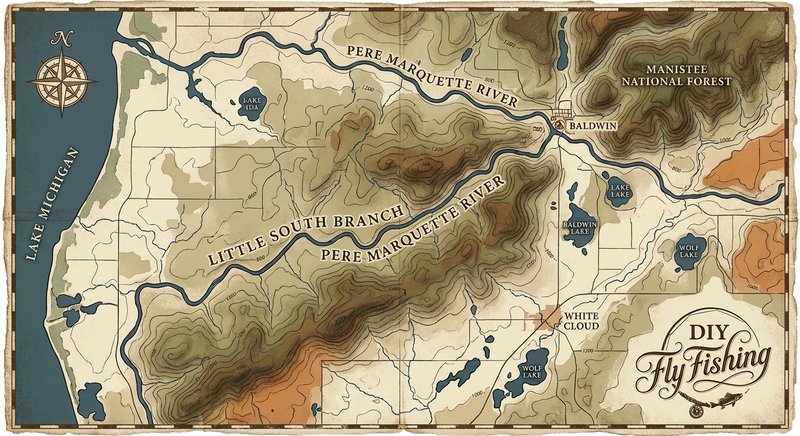
Little South Branch Pere Marquette
Fly fishing in Michigan · Advanced · Best seasons: Spring, Summer, Fall
Target Species
Brook Trout, Brown Trout
About This Water
Small tributary with wild brook trout. Technical fishing in intimate setting.
Fishing Recommendations
The Little South Branch of the Pere Marquette (LSB PM) is a hidden gem in the heart of the Huron-Manistee National Forest. While the main stem of the "PM" gets the glory for its massive salmon and steelhead runs, the Little South is the sanctuary for the purist. It is a classic Michigan cedar-swamp stream: intimate, cold, and teeming with wild trout.
🎣 Location Overview
The Little South Branch is a "Blue Ribbon" trout stream that meanders through wild, forested terrain before joining the Middle Branch to form the main Pere Marquette. It is characterized by its tea-colored (tannic) water, sandy bottom interspersed with gravel runs, and an incredible amount of "sweepers"—downed cedar trees that provide world-class cover for trout.
What makes it special is its stability. Because it is spring-fed and heavily shaded, it stays cooler than the main stem during the dog days of summer, making it a critical thermal refuge for brook and brown trout. Anglers love it for its solitude; while the main river can be crowded with drift boats, the Little South is primarily a wading angler’s game.
🐟 Target Species & Behavior
- Brook Trout: These are the jewels of the Little South. They are predominantly wild, opportunistic feeders. They hold in the faster ripples and near the edges of cold-water springs. They are less "spooky" than browns but require a precise drift.
- Brown Trout: The Little South holds surprisingly large resident brown trout for its size. These fish are predatory and highly structure-oriented. They live deep inside the "log jams" and are often only seen during low-light hours or during major hatches.
- Behavior: During the day, fish hold tight to the woody debris. You have to put your fly inches from the logs to coax a strike. When the sun goes down or the clouds move in, the larger browns move into the shallow tail-outs to feed.
📅 Best Times to Fish
- Spring (Late April – June): This is the prime window. As the water warms to the 50s, the first major hatches occur (Hendricksons and Sulphurs). This is your best chance at a trophy brown on a dry fly.
- Summer (July – August): Focus on the "Trico" hatches in the morning and terrestrial fishing (grasshoppers/ants) in the afternoon. This is also the time for "Mousing" at night—a legendary Michigan pastime.
- Fall (September – October): Brook trout colors become brilliant as they prepare to spawn. Large browns from the main stem may also push up into the Little South. Streamer fishing is most effective now.
- Optimal Windows: The "Golden Hour"—the 60 minutes before and after sunset—is more important here than perhaps anywhere else in the state.
🪰 Recommended Flies & Techniques
Top Fly Patterns
- Dry Flies: Roberts Yellow Drake (a Michigan staple), Parachute Adams (#14-18), Elk Hair Caddis (tan/olive), and the Patriot. For the "Hex" hatch (late June), use a #4-6 Hexagenia Limbata pattern.
- Nymphs: Gold-ribbed Hare’s Ear (#14-16), Prince Nymph, and Pheasant Tails. Small black stonefly nymphs are great in early spring.
- Terrestrials: Chernobyl Ants, Foam Beetles, and Dave’s Hopper.
- Streamers/Mice: Wooly Buggers (olive/black), Zoo Cougar, and the Mouse Rat (for night fishing).
Techniques & Presentation
- The "Bow and Arrow" Cast: The brush is thick. You will often find yourself in spots where a traditional backcast is impossible. Master the bow-and-arrow cast to flick flies under overhanging cedars.
- Tight-Line Nymphing: Because of the wood, long drifts are rare. Use a high-sticking approach to navigate your nymph through short "buckets" between logs.
- Twitch the Dry: For brook trout, a slight "skitter" or twitch of an Elk Hair Caddis can often trigger an aggressive strike that a dead drift won't.
💡 Pro Tips & Local Knowledge
- Wade Stealthily: The LSB is relatively shallow. Sound travels fast through the water. Move slowly, avoid splashing, and try to fish "up-stream" so the silt you kick up doesn't alert the fish ahead of you.
- The "Loomis" Stretch: The area around Loomis Landing is legendary, but it gets pressure. If you are willing to hike a half-mile away from any bridge crossing, the fishing quality improves exponentially.
- Look for "Spring Seeps": On hot August days, look for areas where small trickles of water enter from the banks. These are often several degrees colder, and trout will stack up there like cordwood.
- Heavy Tippet: Don't fish 6X or 7X here. Use 3X or 4X fluorocarbon. When a 16-inch brown hits and immediately dives into a cedar tangle, you need the break-strength to horse him out.
⚠️ Important Information
- Access: Much of the LSB flows through the Manistee National Forest, providing good public access. However, there are private parcels. Always look for "Purple Paint" or signage. Good entry points include the 76th St. bridge and various forest service two-tracks.
- Regulations: The Little South is generally governed by Type 1 Trout Stream regulations (5 fish limit, 8" minimum for brookies, 10" for browns), but the Pere Marquette system is famous for its "Gear Restricted" sections. Always check the current Michigan DNR Fishing Guide before heading out, as rules can change at bridge crossings.
- Gear: A 7.5 to 8.5-foot 4-weight rod is ideal. Anything longer will be difficult to manage under the tree canopy.
- Safety: The bottom can be "mucky" in spots. Use a wading staff and be wary of "sink holes" near submerged logs. Also, bring heavy-duty bug spray; the mosquitoes and "no-see-ums" in the cedar swamps are world-class.
Bug Hatches & Matching Flies
| Hatch | Type | Peak months | Time of day | Hook sizes | Matching flies |
|---|---|---|---|---|---|
| Blue-Winged Olive Baetis spp. | mayfly | April, May, September, October | Midday | #18-22 | RS2 #18-22, BWO Sparkle Dun #18-20, Pheasant Tail #18-20 |
| Hendrickson Ephemerella subvariabilis | mayfly | April, May | Afternoon | #12-14 | Red Quill #12-14, Hendrickson Emerger #12-14, Hare's Ear Nymph #12-14 |
| Sulphur Ephemerella invaria / dorothea | mayfly | May, June | Evening | #14-18 | Sulphur Parachute #14-18, CDC Sulphur Emerger #16-18, Pheasant Tail #16-18 |
| Brown Drake Ephemera simulans | mayfly | May, June | Late Evening | #10-12 | Brown Drake Cripple #10-12, Brown Drake Spinner #10-12, Davenport's Drake #10 |
| Hexagenia Hexagenia limbata | mayfly | June, July | Night | #4-8 | Hexagenia Spinner #4-6, Robert's Yellow Drake #6-8, Hex Nymph #6-8 |
| Cinnamon Caddis Hydropsyche spp. | caddis | May, June, July, August | Evening | #14-18 | Elk Hair Caddis (Tan/Cinnamon) #14-16, LaFontaine's Deep Sparkle Pupa #14-16, Iris Caddis #14-16 |
| Isonychia Isonychia bicolor | mayfly | June, July, August, September | Afternoon/Evening | #10-12 | Iso Parachute #10-12, Isonychia Nymph #10-12, Zug Bug #10-12 |
| Trico Tricorythodes spp. | mayfly | July, August, September | Morning | #20-24 | Trico Spinner #20-24, Trico Parachute #20-22, Zebra Midge #20-22 |
| Terrestrials Formicidae / Gryllidae | terrestrial | July, August, September | All Day | #12-18 | Chernobyl Ant #12-14, Black Foam Beetle #14-16, Cinnamon Flying Ant #16-18 |