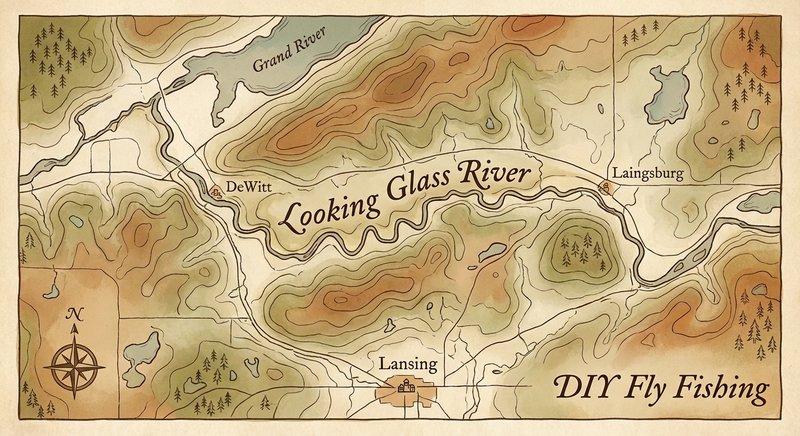
Looking Glass River
Fly fishing in Michigan · Beginner · Best seasons: Spring, Summer, Fall
Target Species
Brown Trout, Smallmouth Bass
About This Water
Tributary of Grand River with wild brown trout. Good insect hatches and dry fly fishing.
Fishing Recommendations
The Looking Glass River in Central Michigan is one of the state’s best-kept secrets. Unlike the high-gradient, gravel-bottomed rivers of Northern Michigan, the Looking Glass is a low-gradient, meandering warm-water and marginal cold-water stream. It offers a unique "backyard" fly fishing experience for those near Lansing or DeWitt, characterized by heavy cover, slow-moving pools, and a surprising population of hard-fighting fish.
🎣 Location Overview
The Looking Glass River flows roughly 70 miles through Clinton, Shiawassee, and Ionia counties before joining the Grand River. It is a quintessential Midwestern "lowland" river.
What makes it special is its intimacy and complexity. It is not a river for long, elegant Spey casts; it is a river for "trench warfare" fly fishing. The river is heavily timbered with fallen trees (sweepers) and log jams, providing incredible habitat. While the water often carries a "sweet tea" stain or slight turbidity, this cover allows both Brown Trout and Smallmouth Bass to grow to impressive sizes by remaining hidden from overhead predators.
🐟 Target Species & Behavior
Brown Trout
- Location: Found primarily in the upper reaches, specifically from the DeWitt area upstream toward the Clinton/Shiawassee county line.
- Behavior: These are highly opportunistic and wary fish. Because the Looking Glass can get warm in the mid-summer, the trout congregate near feeder streams and bottom-fed springs. They are "structure-oriented," meaning they will rarely be found in open water; they sit deep inside log jams or under undercut banks.
- Feeding: They focus on high-protein meals—crayfish, sculpins, and even small frogs.
Smallmouth Bass
- Location: As the river moves downstream toward Portland, the water warms and the Smallmouth take over.
- Behavior: Looking Glass "Smallies" are aggressive. They hold in the slightly faster runs where the river narrows and around the edges of large woody debris.
- Feeding: They are suckers for anything that mimics a fleeing baitfish or a crawling crayfish.
📅 Best Times to Fish
- Spring (Late April – June): This is the prime window for Brown Trout. As the water warms into the 50s, the trout become active. The "Hendrickson" hatch can occur here, though it is less predictable than on northern rivers.
- Summer (July – August): This is the peak for Smallmouth Bass. Use the heat to your advantage—bass are most active when the sun is high. For trout, you must fish early morning or late evening to find safe water temperatures (under 68°F).
- Fall (September – October): Perhaps the best time for trophy fish. Pre-spawn Brown Trout become aggressive and territorial, while Smallmouth feed heavily to prepare for winter. The cooling water makes the fish more comfortable moving out of the deep wood.
🪰 Recommended Flies & Techniques
Top Fly Patterns
- Streamers: Kelly Galloup’s Dungeon (Olive or Black), Wooly Buggers (Size 4-8 in Olive/Orange), and Clouser Minnows (Chartreuse/White).
- Nymphs: Prince Nymphs (Size 12-14), Pheasant Tails, and Rubber-Legged Stoneflies.
- Dries/Terrestrials: Fat Albert (Size 8-10), Chernobyl Ants, and Dave’s Hopper. During late summer, a black foam ant is deadly.
Techniques & Presentation
- The "Pocket Pick": Because of the wood, you cannot swing streamers traditionally. Use a heavy sink-tip line and "jig" your streamer vertically into the pockets between logs.
- The Twitch-and-Drop: When fishing terrestrials for Smallmouth, cast tight to the bank, let it sit until the rings disappear, then give it one aggressive twitch.
- Tight-Line Nymphing: In the few gravel runs available, use a high-stick nymphing technique to prevent your line from getting caught in the slow, swirling eddies.
💡 Pro Tips & Local Knowledge
- The "Wood" Factor: If you aren't losing a few flies, you aren't fishing where the fish are. On the Looking Glass, the biggest fish live in the "gnarly" stuff. Accuracy is more important than distance.
- Stealth is Mandatory: The river is slow and relatively quiet. Heavy wading will send vibrations that shut down a pool instantly. Move slowly and cast from a distance whenever possible.
- Kayak vs. Wading: Wading is possible in many stretches near DeWitt, but the bottom can be "mucky." A kayak or canoe is an excellent way to cover water, but be prepared for "portaging" over frequent log jams.
- Check the Gauge: The Looking Glass reacts strongly to rain. If the USGS gauge at DeWitt shows a sharp spike, the river will be chocolate milk for 2-3 days. Wait for the "falling limb" of the hydrograph when the water is clearing but still high.
⚠️ Important Information
Access Points
- DeWitt: Look for bridge crossings at Herbison Rd, Looking Glass Rd, and DeWitt Rd. There are small public access points and parks (like Riverside Park) that offer entry.
- Downstream: Access is more limited to bridge crossings; always respect private property signs.
Regulations
- License: A valid Michigan Fishing License is required.
- Trout Designations: Much of the Looking Glass is classified as Type 1 trout water. This means the season generally opens the last Saturday in April and closes at the end of September. Check the Michigan DNR Fishing Guide for specific boundary updates each year.
- Gear: A 5-weight rod is sufficient for trout, but a 6 or 7-weight is recommended if you are targeting Smallmouth with large streamers or fighting the wind.
Special Considerations
- Ticks & Bugs: The banks are lush and overgrown. Use DEET or Permethrin-treated clothing to ward off ticks and mosquitoes, which can be thick in the summer months.
- Water Temps: In July and August, carry a thermometer. If the water exceeds 70°F, stop fishing for trout to prevent post-release mortality and switch your focus entirely to Smallmouth Bass.
Bug Hatches & Matching Flies
| Hatch | Type | Peak months | Time of day | Hook sizes | Matching flies |
|---|---|---|---|---|---|
| Blue-Winged Olive Baetis spp. | mayfly | April, May, September, October | Midday | #18-22 | BWO Sparkle Dun #18-20, Pheasant Tail Nymph #18-22, RS2 #20-22 |
| Sulphur Ephemerella invaria | mayfly | May, June | Evening | #14-18 | Sulphur Parachute #14-16, Hare's Ear Nymph #14-18, Sulphur Emerger #16 |
| Grannom Caddis Brachycentrus | caddis | April, May | Morning/Afternoon | #12-16 | Elk Hair Caddis (Olive) #14-16, Peacock Caddis #14-16, Deep Sparkle Pupa #14-16 |
| Hexagenia Hexagenia limbata | mayfly | June, July | Late Evening/Night | #4-8 | Hex Spinner #4-6, Michigan Wigglers #6-8, Robert's Yellow Drake #6-8 |
| White Miller Ephoron leukon | mayfly | August | Evening | #12-14 | White Wulff #12-14, Ephoron Spinner #12-14, Light Cahill #14 |
| Trico Tricorythodes | mayfly | July, August, September | Early Morning | #20-24 | Trico Spinner #20-24, Griffith's Gnat #20-22, Trico Nymph #22 |
| Cinnamon Caddis Hydropsyche | caddis | June, July, August | Evening | #14-18 | Elk Hair Caddis (Tan) #14-16, LaFontaine's Emergent Pupa #16-18, Z-Wing Caddis #14-16 |
| Terrestrials Formicidae / Coleoptera | terrestrial | July, August, September | All Day | #10-16 | Chernobyl Ant #10-12, Black Foam Beetle #14-16, Fur Ant #16-18 |
| Midges Chironomidae | midge | January, February, March, November | Midday | #18-24 | Zebra Midge #18-22, Griffith's Gnat #18-22, Mercury Midge #20-24 |
| Light Cahill Stenacron canadense | mayfly | June, July | Evening | #12-14 | Light Cahill #12-14, Gold Ribbed Hare's Ear #12-14 |