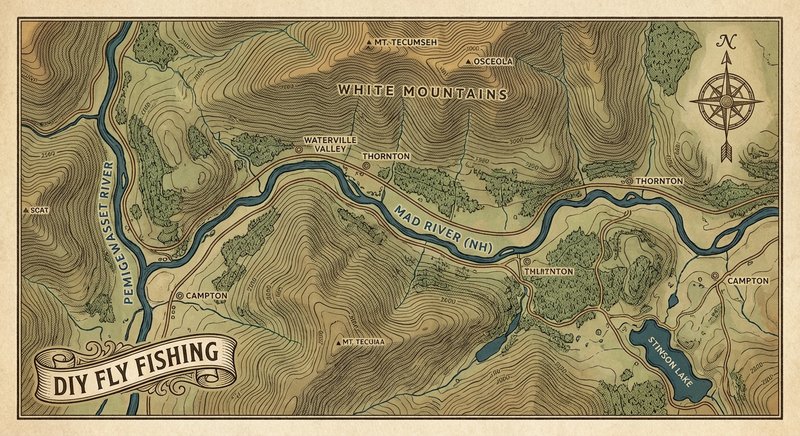
Mad River (NH)
Fly fishing in New Hampshire · Beginner · Best seasons: Spring, Summer, Fall
Target Species
Brook Trout, Rainbow Trout
About This Water
Waterville Valley stream with brook trout. Ski area access.
Fishing Recommendations
The Mad River in New Hampshire is a quintessential White Mountain freestone stream. Tumble-down boulders, crystal clear pools, and dramatic mountain scenery make it a favorite for anglers seeking a classic New England fly fishing experience. Unlike the placid meadow streams of the West, the Mad River is fast, steep, and demanding, rewarding those who can read water and move stealthily.
🎣 Location Overview
Flowing from the Sandwich Range and joining the Pemigewasset River in Campton, the Mad River is characterized by its "pocket water." It is a high-gradient stream, meaning it drops elevation quickly, creating a series of plunges, chutes, and deep, emerald-colored pools.
What makes it special is its accessibility paired with its rugged beauty. While it runs parallel to Route 49 for much of its length, the thick forest and the roar of the water make you feel miles into the backcountry. The water remains cold for much of the year, provided by snowmelt and mountain springs, making it a reliable refuge for trout when other lowland rivers become too warm.
🐟 Target Species & Behavior
The Mad River is primarily a Brook Trout and Rainbow Trout fishery.
- Brook Trout: You will find both wild, "native" brookies in the upper reaches and stocked fish throughout the main stem. Wild brookies are small (6–10 inches) but vibrantly colored and extremely aggressive. They hold in the smallest of pockets and behind mid-stream boulders.
- Rainbow Trout: These are largely stocked by NH Fish & Game. They tend to congregate in the larger, deeper pools and the "tail-outs" where the water slows down before the next drop.
- Behavior: Because the water is fast and nutrient-poor (typical of granite-based freestones), these fish are opportunistic. They don't have the luxury of inspecting a fly for five minutes; if it looks like food and isn't dragging, they will usually strike.
📅 Best Times to Fish
Optimal Seasons
- Spring (Late May – June): This is the prime window. Once the heavy snowmelt (freshet) subsides and the water hits 50°F, the fish become very active.
- Summer (July – August): Unlike many other rivers, the Mad stays fishable in summer due to its elevation and canopy cover. Focus on the early morning or the hour before dusk.
- Fall (September – October): A spectacular time to be on the water. The Brook Trout are in their spawning colors, and the fish feed heavily to prepare for winter.
Prime Conditions
- Time of Day: Mid-morning (9 AM – 11 AM) in the spring; early morning or late evening in the summer.
- Water Level: Look for "median" flows. If the river is chocolate milk after a heavy rain, stay home. If it’s exceptionally low, the fish become very spooky in the clear pools.
🪰 Recommended Flies & Techniques
Top Fly Patterns
- Dry Flies:
- Royal Wulff or Royal Coachman (Size 12-16): High visibility is key in the white water.
- Elk Hair Caddis (Size 14-18): A staple for NH mountains.
- Stimulators (Orange or Yellow, Size 10-14): Great for mimicking large stoneflies or grasshoppers.
- Nymphs:
- Bead-head Pheasant Tail (Size 14-18): The gold standard.
- Prince Nymph (Size 12-16): The flash works well in the turbulent pockets.
- Pat’s Rubber Legs (Coffee/Black): Effective for larger rainbows in deep holes.
- Streamers:
- Black or Olive Woolly Bugger (Size 8-12): Swing these through the deep pools.
Techniques
- High-Sticking / Tight-Line Nymphing: Because of the complex currents, traditional "indicator" nymphing can be difficult. Keeping as much fly line off the water as possible prevents drag.
- Dry-Dropper: This is the most effective way to fish the Mad. Use a buoyant dry fly (like a Stimulator) and hang a small Pheasant Tail nymph 18–24 inches below it.
- Dapping: In the brushy upper sections, you may find yourself simply poking the rod through the trees and "dapping" the fly on the surface.
💡 Pro Tips & Local Knowledge
- The "Pocket Water" Secret: Most anglers walk right past the small "pockets" (the size of a bathtub) behind rocks to get to the big pools. Don't. On the Mad River, a 12-inch trout will often sit in a tiny pocket right against the bank to avoid the main current.
- Wading Safety: The rocks in the Mad River are notoriously "greasy" and round. Felt-soled boots (where legal) or studs are highly recommended. A wading staff is a life-saver here.
- Stealth is Paramount: Because the water is so clear, if you stand on top of a rock overlooking a pool, the fish will see you before you ever cast. Stay low, wear earthy colors, and fish your way upstream (approaching from behind the fish).
- Focus Areas: The stretch near the Waterville Valley area offers great pocket water, while the lower stretches closer to the Campton/Thornton line have larger pools that hold the bigger stocked Rainbows.
⚠️ Important Information
- Access: Route 49 follows the river. There are numerous pull-offs and trailhead parking areas (like the Sandwich Mountain Trailhead) that provide immediate river access.
- Regulations: NH fishing licenses are required. Ensure you check the NH Fish & Game Freshwater Digest, as certain sections may have specific "Fly Fishing Only" or "Catch and Release" designations depending on the season and specific boundaries.
- Wildlife: This is bear and moose country. While they generally avoid the noise of the river, be aware of your surroundings, especially when hiking into the upper reaches.
- Leave No Trace: The White Mountain National Forest is a pristine resource. Please pack out all tippet scraps and trash.
Bug Hatches & Matching Flies
| Hatch | Type | Peak months | Time of day | Hook sizes | Matching flies |
|---|---|---|---|---|---|
| Quill Gordon Epeorus pleuralis | mayfly | April, May | Mid-day/Afternoon | #12-14 | Quill Gordon Dry #12-14, Iron Blue Dun #12-14 |
| Hendrickson Ephemerella subvaria | mayfly | May | Afternoon | #12-14 | Hendrickson Dark #12-14, Red Quill #14, Pheasant Tail #12-14 |
| Blue-Winged Olive (BWO) Baetis | mayfly | April, May, September, October | Late Morning/Overcast days | #18-22 | BWO Sparkle Dun #18-22, RS2 #20-22 |
| Grannom Caddis Brachycentrus | caddis | May | All day/Evening | #14-16 | Elk Hair Caddis (Olive) #14-16, LaFontaine's Deep Sparkle Pupa #14-16 |
| Yellow Sally Isoperla | stonefly | June, July | Afternoon/Evening | #14-16 | Yellow Sally Stimulator #14-16, Little Yellow Stone Nymph #14-16 |
| Light Cahill Stenacron / Stenonema | mayfly | June, July | Evening | #12-14 | Light Cahill #12-14, Gold Ribbed Hare's Ear #12-14 |
| Golden Stonefly Acronuria | stonefly | June, July | Evening/Night | #8-12 | Golden Stone #8-10, Pat's Rubber Legs (Gold/Brown) #8-12 |
| Spotted Sedge Hydropsyche | caddis | June, July, August | Evening | #14-18 | Cinnamon Caddis #16-18, Soft Hackle Hare's Ear #14-16 |
| Ants and Beetles Formicidae / Coleoptera | terrestrial | July, August, September | All day | #12-18 | Black Foam Ant #16-18, Crowe Beetle #12-14 |