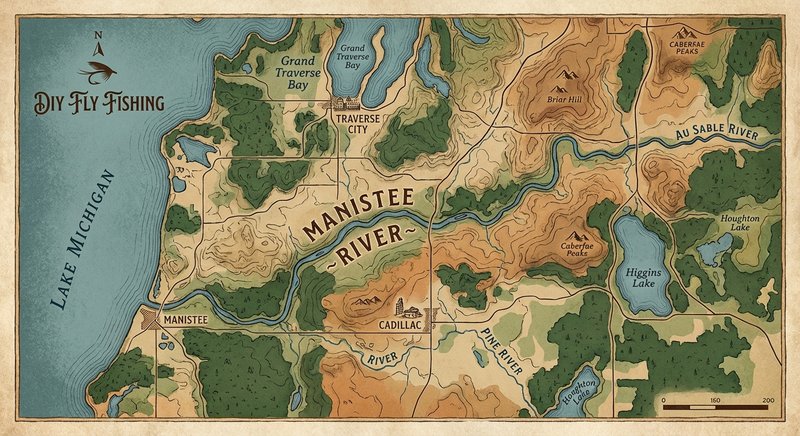
Manistee River
Fly fishing in Michigan · Intermediate · Best seasons: Spring, Summer, Fall
Target Species
Steelhead, Brown Trout, Rainbow Trout
About This Water
Diverse fishing opportunities from steelhead to brown trout. Beautiful northern Michigan scenery.
Fishing Recommendations
The Manistee River, or the "Big Manistee," is the crown jewel of Michigan’s Lower Peninsula. Stretching over 190 miles, it offers a diverse range of water—from the pristine, spring-fed "Holy Waters" near Grayling to the massive, powerful tailwater below Tippy Dam. Whether you are hunting 30-inch Steelhead or "mousing" for trophy Brown Trout at midnight, the Manistee is a legendary destination.
🎣 Location Overview
The Manistee is a river of two personalities, separated by the Hodenpyl and Tippy Dams.
- The Upper Manistee: Above the dams, the river is a classic cold-water trout stream. It flows through sandy soils and cedar swamps. It is famous for its stable flows, clear water, and world-class hatches. It is intimate, wadeable in many spots, and full of "sweepers" (downed trees) that provide incredible cover for trout.
- The Lower Manistee: Below Tippy Dam, the river transforms into a big, brawny tailwater. This is the realm of the migratory giants. The river here is wide and deep, best fished from a drift boat or jet boat, though wade access exists near the dam. The gravel runs here are some of the most productive spawning grounds for Great Lakes Steelhead and Salmon in the world.
🐟 Target Species & Behavior
Steelhead (Adipsyche mykiss)
The Manistee is famous for its "chrome" Lake Michigan Steelhead.
- Behavior: They enter the river in two main pushes. Fall Steelhead are aggressive feeders, following Salmon to eat their eggs. Spring Steelhead are focused on the spawn, holding in deep holes before moving onto gravel riffles.
- Feeding: Eggs, nymphs (stoneflies), and small baitfish (alewives/sculpins).
Brown Trout
The river holds a high density of wild Brown Trout.
- Behavior: Resident Browns are notorious for being "wood-oriented." They tuck deep into log jams during the day. As the sun sets, the big "bruisers" move into the shallows or the heads of pools to hunt.
- Feeding: Early season nymphs, mid-summer hatches (Drakes and Hex), and a heavy diet of streamers or mice for the larger specimens.
Rainbow Trout
Resident Rainbows are found throughout the system, particularly in the swifter riffles and oxygenated water below dams. They are opportunistic feeders and often provide consistent action when the Browns are being moody.
📅 Best Times to Fish
Spring (March – May)
- Prime Window: Late March through April is peak Steelhead season.
- Conditions: Water is high and cold. Look for "black water" days (overcast) for the best bite.
- Hatches: Early black stoneflies and Blue Winged Olives (BWOs) start the trout season in May.
Summer (June – August)
- Prime Window: Late June to mid-July.
- The "Hex" Hatch: This is the most famous event in Michigan fly fishing. The giant Hexagenia limbata mayflies hatch at dusk, bringing the largest trout in the river to the surface.
- Conditions: Prime for dry flies and "mousing" (fishing mouse patterns on the surface at night).
Fall (September – November)
- Prime Window: October and November.
- The Big Push: Chinook and Coho salmon arrive in September. By October, the Fall Steelhead are right behind them. This is also the best time for "Streamer Junkies" to target aggressive, pre-spawn Brown Trout.
🪰 Recommended Flies & Techniques
Nymphing (Steelhead & Trout)
- Technique: Indicator nymphing is the standard. Long leaders (9–12ft) are necessary for the clear water of the Upper Manistee.
- Flies:
- Eggs: Clown eggs, Estaz eggs, and beads (10mm-12mm) in Oregon Cheese or Mottled Orange.
- Nymphs: Prince Nymph (#12-14), Rubber-legged Stoneflies (#6-10), and Pheasant Tails.
Dry Fly (Upper Manistee)
- Technique: "Match the hatch." Dead drifts along log edges are critical.
- Flies:
- The Hex: #4-6 Hexagenia patterns (foam body or deer hair).
- The Classics: Adams, Roberts Yellow Drake, Hendrickson, and various Hopper patterns in August.
Streamer Fishing (The "Big" Water)
- Technique: "Pound the wood." Cast heavy sink-tip lines toward the bank and strip aggressively back to the boat.
- Flies: Kelly Galloup’s Sex Dungeon, Circus Peanut, and Sculpin Helmets. Colors: Olive/White, Black, and "Yellow Madler."
💡 Pro Tips & Local Knowledge
- "Wood is Good": On the Manistee, if you aren't losing a few flies to the logs, you aren't fishing where the fish are. The biggest Browns live in the most "un-fishable" tangled timber.
- The Spey Game: The Lower Manistee is one of the best places in the Lower 48 to swing flies with a two-handed Spey rod for Steelhead. Use Skagit heads and T-11 or T-14 sink tips.
- Night Fishing: For trophy Browns, the river doesn't wake up until 11:00 PM. Mousing (using a Morrish Mouse) near the banks at night is the best way to catch a 20"+ fish.
- Tippy Dam "Suicide Bend": This area is highly pressured. If you have a boat, float away from the dam to find fresher, less-spooked fish.
⚠️ Important Information
Access
- Upper River: Access at 612 Bridge, Sharon Bridge, and Smithville.
- Lower River: Major ramps at Tippy Dam (below the dam), High Bridge, Bear Creek, and Rainbow Bend.
Regulations
- Michigan DNR has specific "Types" for different stretches.
- Upper Manistee (Parts): Often "Artificial Lures Only" and "Catch and Release" or restricted harvest.
- Lower Manistee: Generally more liberal harvest rules but requires an All-Species Fishing License for Steelhead and Salmon.
- Check the Michigan DNR Fishing Guide before you head out.
Safety
- Wading: The Manistee has a "sand-filled" bottom in many places. "Sand holes" can be deceptive—one step you are in knee-deep water, the next you are over your waders. Use a wading staff.
- Boating: The Lower Manistee has many "deadheads" (submerged logs). If you are rowing or motoring, keep a sharp eye out to avoid lower-unit damage.
Bug Hatches & Matching Flies
| Hatch | Type | Peak months | Time of day | Hook sizes | Matching flies |
|---|---|---|---|---|---|
| Hendrickson Ephemerella subvaria | mayfly | April, May | Afternoon | #12-14 | Red Quill #12-14, Hendrickson Emerger #12-14, Pheasant Tail #12-14 |
| Grannom Caddis Brachycentrus | caddis | April, May | Afternoon/Evening | #14-16 | Grannom Pupa #14-16, Elk Hair Caddis (Olive) #14-16, CDC Caddis Emerger #14-16 |
| Sulphur Ephemerella invaria/dorothea | mayfly | May, June | Evening | #14-18 | Sulphur Parachute #16-18, Sulphur Snowshoe Emerger #16-18, Pale Morning Dun Nymph #14-16 |
| Brown Drake Ephemera simulans | mayfly | June | Dusk/Night | #8-12 | Brown Drake Spinner #10-12, Brown Drake Cripple #10-12, Wiggle Nymph #10-12 |
| Giant Michigan Mayfly (Hex) Hexagenia limbata | mayfly | June, July | Night | #4-8 | Hexagenia Spinner #4-6, Robert's Yellow Drake #6-8, Hex Nymph #6-8 |
| Isonychia Isonychia bicolor | mayfly | June, July, August, September | Afternoon/Evening | #10-12 | Iso Parachute #10-12, Prince Nymph #10-14, Iso Cripple #10-12 |
| Trico Tricorythodes | mayfly | July, August, September | Morning | #20-24 | Trico Spinner (Female) #20-24, Trico Parachute #20-22, Zebra Midge #20-22 |
| Blue Winged Olive Baetis | mayfly | April, May, September, October | Afternoon | #18-22 | BWO Sparkle Dun #18-22, RS2 #20-22, Micro Mayfly Nymph #18-20 |
| Terrestrials (Grasshoppers/Ants) Formicidae/Acrididae | terrestrial | July, August, September | All Day | #8-16 | Chernobyl Ant #8-12, Flying Black Ant #14-16, Dave's Hopper #10-12 |