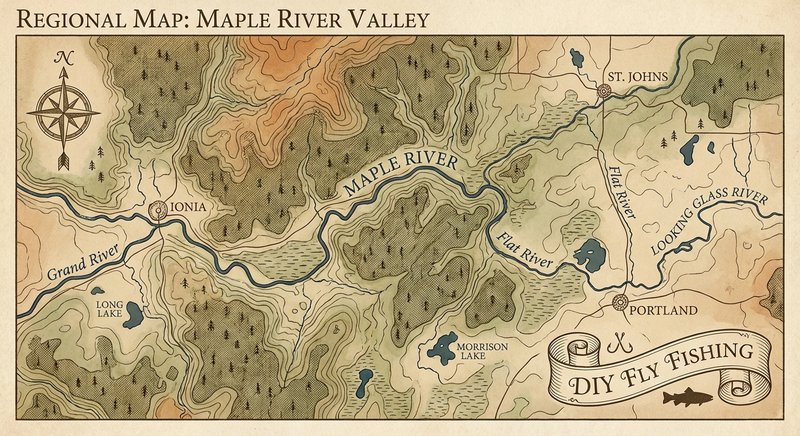
Maple River
Fly fishing in Michigan · Beginner · Best seasons: Spring, Summer, Fall
Target Species
Brown Trout, Rainbow Trout
About This Water
Central Michigan stream with wild brown trout. Quality fishing in agricultural area.
Fishing Recommendations
The Maple River in Emmet County, Michigan, is one of the Northern Lower Peninsula’s most cherished "small water" secrets. Unlike the wide, rolling expanses of the Au Sable or the Manistee, the Maple is intimate, moody, and technically demanding. It is a quintessential spring-fed trout stream that rewards stealth and precision.
Here is your comprehensive guide to fly fishing the Maple River.
🎣 Location Overview
The Maple River is primarily known for its two main branches—the East and West—which converge to form the main stem before flowing into Burt Lake.
What makes it special is its cold, stable water temperature. Even in the heat of a Michigan July, the Maple remains a sanctuary for wild trout due to heavy groundwater influence. The river is characterized by "cedar swamp" aesthetics: dark, tannic water, sandy bottoms interspersed with gravel runs, and an incredible amount of woody debris (log jams and "sweepers"). It is a tight, brushy environment that demands a high level of casting skill but offers a true wilderness experience.
🐟 Target Species & Behavior
The Maple is primarily a Brown Trout fishery, though you will find plenty of Rainbows, particularly in the upper reaches and near the confluence.
- Brown Trout: The stars of the river. They are notoriously spooky and spend most of the day buried deep under undercut banks or within log jams. They move into the current during hatch cycles or under the cover of low light.
- Rainbow Trout: Generally found in the faster, bubblier water and riffles. They tend to be more opportunistic feeders than the browns.
- Behavior: Because the water is clear (despite the tannic tint), these fish have a high "spook factor." They feed heavily on macroinvertebrates (mayflies, caddis) but the larger specimens are highly piscivorous, feeding on sculpins and smaller trout.
📅 Best Times to Fish
Optimal Seasons
- Spring (Late April – June): This is the prime window. The Hendrickson hatch in late April/early May kicks things off, followed by the legendary Sulphurs and Brown Drakes in June.
- Summer (July – August): While other rivers warm up, the Maple stays cool. This is the time for terrestrial fishing (hoppers/ants) and the frantic Hexagenia limbata (Hex) hatch in late June/early July.
- Fall (September – October): A fantastic time for streamer fishing as the Brown Trout become aggressive and territorial ahead of their spawn.
Best Times of Day
- Morning/Evening: During the heat of summer, the "magic hour" at dusk is essential for dry fly action.
- Overcast Days: Cloud cover is your best friend on the Maple; it draws the larger Browns out from under the logs.
🪰 Recommended Flies & Techniques
Top Fly Patterns
- Dry Flies:
- Adams (Parachute or Traditional): Sizes 12–18 (The ultimate searcher).
- Robert’s Yellow Drake: Size 12–14 (A Michigan staple).
- Hexagenia: Size 4–6 (For late June nights).
- Chernobyl Ant / Foam Hoppers: Size 8–12 (For summer terrestrials).
- Nymphs:
- Pheasant Tail: Size 14–18.
- Prince Nymph: Size 12–16.
- Hare’s Ear: Size 14–16.
- Streamers:
- Woolly Bugger (Olive or Black): Size 6–10.
- Sculpin Patterns: Weighted heads to get down into the holes.
Effective Techniques
- Dry Fly Stealth: Use a 7.5 to 9-foot 4wt or 5wt rod. You need a rod with enough backbone to pull a fish out of wood, but delicate enough for soft presentations.
- Tight-Line Nymphing: Given the wood cover, a traditional indicator can often get snagged. High-sticking or Euro-style nymphing through the deeper slots is very effective.
- The "Twitch": When fishing terrestrials near the banks, give the fly a tiny shake to mimic a struggling insect.
💡 Pro Tips & Local Knowledge
- The "Maple River Reach": This isn't a formal cast, but local slang for a very short, flicking roll cast. Because of the overhanging cedars, you will rarely make a full backcast. Practice your "bow-and-arrow" cast before you arrive.
- Focus on the West Branch: For those seeking higher numbers of fish and slightly more open water, the West Branch near the Pellston area is a great starting point.
- Wade Deep, Tread Lightly: The bottom can be "mucky" in spots and sandy in others. Move slowly; the vibrations from a heavy-footed angler will shut down a hole before you even cast.
- The "Log Jam" Rule: If you see a pile of wood that looks impossible to fish, there is a trophy Brown Trout under it. Work a streamer or a heavy nymph as close to the wood as you dare.
⚠️ Important Information
Access Information
- Brutus Road: A popular access point for the main stem.
- Robinson Road: Provides access to the West Branch.
- Lake Street: Access near the dam area in Pellston.
- Note: Much of the land surrounding the Maple is private. Always stay within the high-water mark and respect "No Trespassing" signs.
Regulations
- Type 1 Stream: Generally, this means the season opens the last Saturday in April and closes September 30th.
- Size/Cree Limits: Check the current Michigan DNR Fishing Guide as regulations can change regarding lure restrictions and harvest limits.
Special Considerations
- Bug Spray: The mosquitoes and "no-see-ums" in the cedar swamps are legendary. Bring heavy-duty repellent.
- Waders: Breathable waders are recommended, but ensure they are puncture-resistant; the brush and thorns are unforgiving.
Bug Hatches & Matching Flies
| Hatch | Type | Peak months | Time of day | Hook sizes | Matching flies |
|---|---|---|---|---|---|
| Hendrickson Ephemerella subvaria | mayfly | May | Afternoon | #12-14 | Red Quill #12-14, Hendrickson Emerger #12-14, Pheasant Tail #12-14 |
| Sulphur Ephemerella invaria/dorothea | mayfly | June | Evening | #14-18 | Sulphur Parachute #14-18, CDC Sulphur Emerger #16-18, Gold Ribbed Hare's Ear #14-16 |
| Brown Drake Ephemera simulans | mayfly | June | Evening/Dusk | #10-12 | Brown Drake Cripple #10-12, Brown Drake Spinner #10-12, Wiggle Michigan Stone #10-12 |
| Hex Hexagenia limbata | mayfly | June, July | Night | #6-8 | Hexagenia Spinner #6-8, Roberts Yellow Drake #8, Hex Nymph #6-8 |
| Blue Winged Olive Baetis | mayfly | April, May, September, October | Afternoon | #18-22 | BWO Sparkle Dun #18-22, RS2 #20-22, WD40 #18-22 |
| Grannom Caddis Brachycentrus | caddis | May | Morning/Afternoon | #14-16 | Elk Hair Caddis #14-16, Holy Grail Caddis #14-16, LaFontaine's Deep Pupa #14-16 |
| Trico Tricorythodes | mayfly | July, August, September | Morning | #20-24 | Trico Spinner #20-24, Griffith's Gnat #20-22, Trico Nymph #22 |
| Isonychia Isonychia bicolor | mayfly | July, August | Evening | #10-12 | Iso Parachute #10-12, Zug Bug #10-12, Prince Nymph #10-14 |
| Terrestrials Formicidae / Orthoptera | terrestrial | July, August, September | All Day | #10-18 | Cinnamon Ant #16-18, Dave's Hopper #10-12, Black Foam Beetle #14-16 |