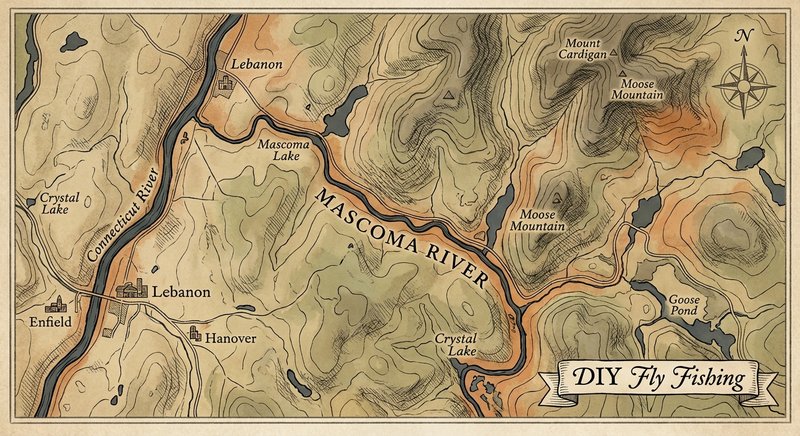
Mascoma River
Fly fishing in New Hampshire · Beginner · Best seasons: Spring, Summer, Fall
Target Species
Brown Trout, Brook Trout
About This Water
Upper Valley stream with brown trout. Good public access near Lebanon.
Fishing Recommendations
The Mascoma River in New Hampshire is a classic New England freestone stream that offers a surprising variety of water for such a short river. Flowing from Mascoma Lake in Enfield through the city of Lebanon and eventually into the Connecticut River, it provides a unique blend of "urban" fishing accessibility and rugged, pocket-water stretches.
Here is your comprehensive guide to fly fishing the Mascoma River.
🎣 Location Overview
The Mascoma is a river of two halves. Above Mascoma Lake, it is a smaller, more intimate stream. However, most fly anglers focus on the stretch below the Mascoma Lake Dam down to its confluence with the Connecticut River.
What makes this water special is its character. It features classic New England "pocket water"—short runs, deep plunge pools, and boulder-strewn riffles. Despite running through the heart of Lebanon, the river is often shielded by steep banks and dense trees, making you feel miles away from civilization. It is a highly productive fishery that benefits from consistent stocking by NH Fish & Game, complemented by a population of holdover Browns and wild Brookies in the cooler tributaries.
🐟 Target Species & Behavior
- Brown Trout: These are the kings of the lower Mascoma. You will find stocked fish, but the river has a reputation for "holdover" Browns that survive the winter and grow quite large (16-18"+). They are wary and love the deep, dark undercuts, bridge abutments, and the "guts" of the deeper pools.
- Brook Trout: While some are stocked in the main stem, the wild Brookies are generally found in the upper reaches and where cooler tributaries enter the river. They are opportunistic and aggressive but easily spooked in the clear water.
- Feeding Behavior: In the spring, they focus on heavy nymphing and the early season hatches. By mid-summer, they shift to oxygenated "fast water" (riffles) and terrestrials. In the fall, Browns become aggressive and territorial as they prepare to spawn.
📅 Best Times to Fish
- Spring (May - June): This is the Prime Window. Water levels stabilize after the snowmelt, and the insect life explodes. The Hendrickson hatch in May is legendary here.
- Summer (July - August): Fishing becomes more technical. You must carry a thermometer; if water temps exceed 68°F, stop fishing to protect the trout. Target the "bubbly" water where oxygen is high, and fish early mornings or late evenings.
- Fall (September - October): A favorite for many. The colors are stunning, and the Browns are on the move. Streamer fishing becomes very effective as the fish get aggressive.
🪰 Recommended Flies & Techniques
Dry Flies
- Hendrickson (Size 12-14): Essential for May.
- Elk Hair Caddis (Size 14-18): A staple all summer long in tan or olive.
- Stimulators (Size 8-12): Great for the pocket water; they float high and are easy for fish to see in broken water.
- Terrestrials: Black Ants and Foam Beetles (Size 14-18) are deadly in August when nothing else is hatching.
Nymphs
- Pheasant Tail & Hare’s Ear (Size 14-18): The standard "bread and butter" nymphs.
- Pat’s Rubber Legs (Size 8-12): Excellent for imitating the large stoneflies found in the Mascoma’s rocky bottom.
- Zebra Midge (Size 18-22): Necessary for the slower, deeper pools during low water.
Streamers
- Woolly Bugger (Black or Olive): Works year-round.
- Mickey Finn: A traditional New England pattern that works wonders for stocked Brookies.
Techniques
- High-Sticking / Euro Nymphing: Because the Mascoma is so "rolly" with different current speeds, tight-line nymphing is the best way to avoid drag and get your flies into the deep pockets behind boulders.
- The "Swing": Swing a caddis pupa or a small streamer through the tail-outs of pools in the evening.
💡 Pro Tips & Local Knowledge
- Utilize the Rail Trail: The Northern Rail Trail parallels long stretches of the river between Enfield and Lebanon. This is your secret weapon for access. Hop on a bike or walk the trail to find "hidden" pockets that aren't right next to the road crossings.
- The Bridge Strategy: The Mascoma flows under several bridges in Lebanon. The shadows and structure provided by bridge pilings are magnets for large Browns. Don't just walk past them—fish the transitions from light to shadow.
- The "White Water" Secret: In the heat of July, don't bother with the slow, glassy pools. Fish the heaviest, whitest water you can find. If there’s a 1-foot deep riffle with bubbles, there is likely a trout sitting there for the oxygen.
- Stealth Matters: Despite being an "urban" river, the fish are pressured. Long leaders (9-12ft) and a quiet approach to the bank will double your catch rate.
⚠️ Important Information
- Access: Key access points include Riverside Park in Lebanon, the Packard Hill Road area, and various pull-offs along Route 4.
- Regulations: Always check the NH Fish & Game Freshwater Fishing Digest. Most of the Mascoma is open under "General Law" (which allows for some harvest), but catch-and-release is highly encouraged to maintain the quality of the fishery.
- Safety: The rocks in the Mascoma are notoriously slippery and "rolly." Studded wading boots and a wading staff are highly recommended, especially in the swifter sections near the city center.
- Licensing: You must have a valid New Hampshire freshwater fishing license, which can be purchased online.
The Mascoma is a gem of the Upper Valley. Treat it with respect, watch your water temps, and you'll find some of the best trout fishing western New Hampshire has to offer. Tight lines!
Bug Hatches & Matching Flies
| Hatch | Type | Peak months | Time of day | Hook sizes | Matching flies |
|---|---|---|---|---|---|
| Blue Winged Olive Baetis spp. | mayfly | April, May, September, October | Mid-day/Afternoon | #18-22 | RS2 #20-22, Parachute BWO #18-22, Pheasant Tail Nymph #18-20 |
| Hendrickson Ephemerella subvaria | mayfly | May | Afternoon | #12-14 | Red Quill #12-14, Hendrickson Nymph #12-14, Sparkle Dun #14 |
| Grannom Caddis Brachycentrus | caddis | May | Morning/Afternoon | #14-16 | Peacock Caddis #14-16, Deep Sparkle Pupa #14-16, Elk Hair Caddis (Dark) #14-16 |
| March Brown Maccaffertium vicarium | mayfly | May, June | Mid-day | #10-12 | March Brown Wet Fly #10-12, Hare's Ear Nymph #10-12, March Brown Spinner #12 |
| Light Cahill Stenacron / Stenonema | mayfly | June, July | Evening | #14-16 | Light Cahill Dry #14-16, Cream Usual #14-16, Gold Ribbed Hare's Ear #14-16 |
| Slate Drake Isonychia bicolor | mayfly | June, July, September | Afternoon/Evening | #10-14 | Iso Parachute #12-14, Zug Bug #10-12, Prince Nymph #12-14 |
| Trico Tricorythodes | mayfly | July, August, September | Early Morning | #22-26 | Trico Spinner #24, Griffith's Gnat #22-24, Trico Emerger #24 |
| October Caddis Pycnopsyche | caddis | September, October | Afternoon/Evening | #8-12 | Orange Stimulator #8-10, Orange Pupa #10-12, Elk Hair Caddis (Orange) #10-12 |
| Grasshopper Orthoptera | terrestrial | July, August, September | Late Morning/Afternoon | #8-12 | Joe's Hopper #10-12, Dave's Hopper #8-12, Morrish Hopper #10 |