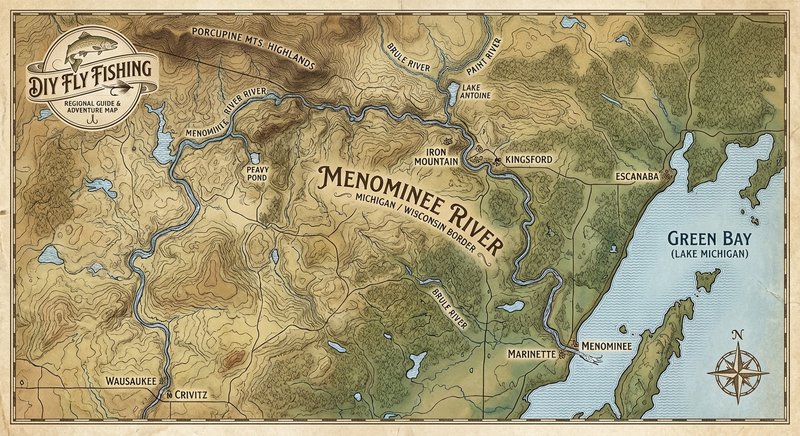
Menominee River
Fly fishing in Michigan · Intermediate · Best seasons: Summer, Fall
Target Species
Smallmouth Bass, Walleye, Steelhead
About This Water
Border water with Wisconsin. Excellent smallmouth bass and occasional steelhead.
Fishing Recommendations
The Menominee River, forming the border between Michigan’s Upper Peninsula and Northeastern Wisconsin, is widely considered the finest Smallmouth Bass river in the Midwest—and arguably one of the top five in the United States. It is a large, powerful system characterized by rugged rock formations, heavy flows, and a "big water" feel that demands respect and proper preparation.
🎣 Location Overview
The Menominee is a diverse river that transitions from a wild, boulder-strewn corridor in its upper reaches to a massive, slow-moving powerhouse as it nears Green Bay. What makes it special is its productivity. Because of the numerous hydroelectric dams, the river acts as a series of tailwaters, which stabilizes water temperatures and provides a consistent flow of nutrients.
Anglers love the Menominee because it offers a "Western" feel in the heart of the Northwoods. You aren't just fishing for numbers here; you are hunting for 20-inch trophy Smallmouth in heavy current. The riverbed is primarily composed of granite boulders, ledge rock, and gravel bars, providing world-class habitat for both fish and the forage they depend on.
🐟 Target Species & Behavior
Smallmouth Bass
The "Bronze Back" is the king of the Menominee. Unlike lake-dwelling bass, these fish are conditioned by heavy current, making them incredibly strong.
- Behavior: They hold in "soft" water behind large boulders, in the seams where fast and slow water meet, and along deep ledge rock.
- Forage: Their diet is dominated by Crayfish (especially the invasive but abundant Rusty Crayfish), Emerald Shiners, and Hellgrammites.
Walleye
The Menominee has a massive population of Walleye. While often targeted by gear anglers, they are a fantastic fly-rod challenge, especially in the evening.
- Behavior: They stack up in deep holes during the day and move into shallower gravel runs or the "heads" of pools at dusk to feed.
Steelhead
In the lower section of the river (below the Hattie Street Dam in Marinette/Menominee), Lake Michigan Steelhead run in the fall.
- Behavior: These are aggressive, lake-run rainbows. They hold in the faster "riiffles" and deeper runs of the lower river. They are often found behind spawning salmon, picking up loose eggs.
📅 Best Times to Fish
Summer (June – August)
- Peak Smallmouth: This is the prime window for topwater action.
- Conditions: Stable flows and warm water (65–75°F) keep the bass metabolism high.
- Time of Day: Low light (dawn and dusk) is best for topwater, while mid-day is perfect for dredging crayfish patterns.
Fall (September – November)
- Trophy Season: As water temperatures drop, the largest Smallmouth bulk up for winter. This is the best time for a true 5lb+ fish.
- Steelhead & Walleye: Late October and November bring the Steelhead into the lower river and see a massive uptick in Walleye activity in the mid-river stretches.
- Conditions: Look for "Indian Summer" days for bass, or overcast/rainy days for Steelhead.
🪰 Recommended Flies & Techniques
For Smallmouth Bass
- Topwater: BoogleBugs (size 4), Umpqua’s Swimming Frog, and Murdich Minnows (fished on an intermediate line just below the surface).
- Streamers: Kelly Galloup’s Dungeon (Olive or White), Clouser Minnows (Chartreuse/White), and Sculpin Helmet patterns.
- Crayfish: Near Nuff Crayfish or Holschlag’s Hackle-Back Crayfish.
- Technique: Use a 7-weight rod with a weight-forward floating line for poppers, or a 200-250 grain sink-tip for streamers. Cast toward the bank and strip aggressively through the seams.
For Walleye
- Flies: Wooly Buggers (Black or Purple), Zonkers, and heavy Rabbit Strip Leeches.
- Technique: "Dredging." Use a heavy sink-tip line to get the fly to the bottom. Slow, rhythmic strips are more effective than fast erratic movements.
For Steelhead
- Flies: Glo-Bugs (Eggs) in Oregon Cheese or Pink, Intruders (Blue/Black), and Stonefly Nymphs.
- Technique: Indicator nymphing in the lower river is the most productive, but "swinging" large flies with a Spey or Switch rod is the most rewarding way to catch them.
💡 Pro Tips & Local Knowledge
- The "Rock Garden" Stretches: Focus your efforts on the stretches between the dams near Quiver Falls and Pemene Falls. These areas have the highest gradient and the best oxygenation, which translates to the most aggressive fish.
- Watch the Gauges: The Menominee is a "working river." Hydroelectric dams can change the water level by several feet in an hour. Always check the USGS gauges (Menominee River near Koss, MI) before heading out. If the water is rising fast, the fishing usually shuts off; if it’s falling or stable, it's game on.
- The "Figure-Eight": Much like Muskies, Large Smallmouth on the Menominee will often follow a streamer right to the boat. Always finish your retrieve with a change of direction.
- Boat vs. Wade: While there are wadeable spots near the dams, this is a big river. To truly experience it, a drift boat or a jet boat is highly recommended to cover the vast amounts of productive water between access points.
⚠️ Important Information
Access & Logistics
- Boundary Water: The Menominee is a boundary water between MI and WI. Generally, a valid fishing license from either state is recognized when fishing the main stem of the river (check current regulations for specific tributary rules).
- Public Access: Significant access points include Piers Gorge, Quiver Falls, Chalk Hills, and White Rapids. Many of these are managed by the power companies (like Wisconsin Public Service) and offer boat launches and primitive camping.
Regulations
- Smallmouth: Michigan and Wisconsin have different harvest seasons and size limits. Most serious fly anglers practice 100% Catch and Release for Smallmouth here to preserve the trophy genetics.
- Safety: The Menominee is dangerous. The "Piers Gorge" section contains Class IV rapids. Do not attempt to float the gorge in a fishing craft. Always wear a PFD.
Special Considerations
- Invasive Species: To prevent the spread of New Zealand Mudsnails and Didymo, ensure you clean, drain, and dry your waders and boots before moving to other UP or Wisconsin trout streams.
Bug Hatches & Matching Flies
| Hatch | Type | Peak months | Time of day | Hook sizes | Matching flies |
|---|---|---|---|---|---|
| Giant Michigan Mayfly (Hex) Hexagenia limbata | mayfly | June, July | Late Evening/Night | #4-8 | Hexagenia Spinner #4-6, Wiggle Nymph #6-8 |
| Brown Drake Ephemera simulans | mayfly | June | Evening | #10-12 | Brown Drake Paradrake #10-12, Harrop's Last Chance Drake #10-12 |
| White Miller (White Fly) Ephoron leukon | mayfly | August | Evening | #12-14 | White Wulff #12-14, Snowshoe White Miller #12-14 |
| Hendrickson Ephemerella subvariabilis | mayfly | May | Afternoon | #12-14 | Red Quill #12-14, Pheasant Tail Nymph #12-14 |
| Cinnamon Caddis Hydropsyche | caddis | June, July, August | Evening/Dusk | #14-18 | Elk Hair Caddis (Tan) #14-16, LaFontaine's Deep Sparkle Pupa #14-18 |
| Sulfur Ephemerella invaria | mayfly | June | Evening | #14-16 | Sulfur Parachute #14-16, Sulfur Emerger #14-16 |
| Trico Tricorythodes | mayfly | August, September | Morning | #20-24 | Trico Spinner #20-24, RS2 (Black) #20-22 |
| Giant Stonefly Pteronarcys dorsata | stonefly | May, June | All Day | #4-8 | Pat's Rubber Legs #4-8, Stimulator (Orange) #6-10 |
| Blue Winged Olive Baetis | mayfly | April, October | Afternoon | #18-22 | BWO Sparkle Dun #18-22, Barr's BWO Emerger #18-22 |