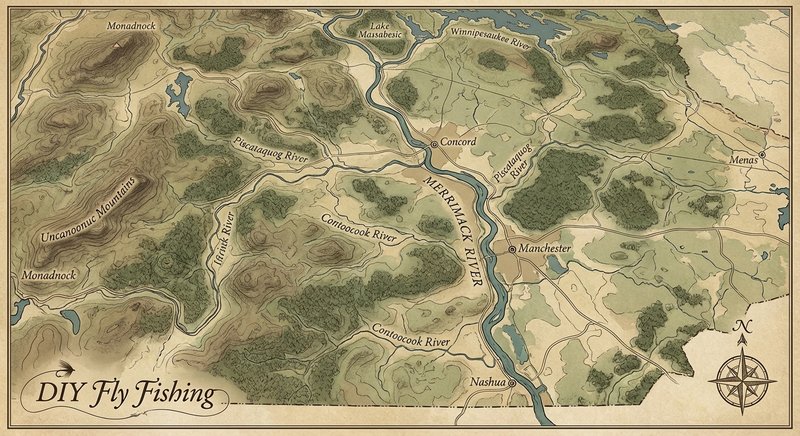
Merrimack River
Fly fishing in New Hampshire · Beginner · Best seasons: Spring, Summer, Fall
Target Species
Smallmouth Bass, Brown Trout, American Shad
About This Water
Southern NH river with diverse fishing. Trout, bass, and shad runs.
Fishing Recommendations
The Merrimack River in New Hampshire is a resilient, powerful, and often overlooked fishery. While many anglers head north to the White Mountains for tiny brook trout, the Merrimack offers a "big water" experience with exceptional diversity. From its origin at the confluence of the Pemigewasset and Winnipesaukee Rivers in Franklin down to the Massachusetts border, it transitions from a cold-water trout fishery to a premier smallmouth destination, with a legendary migratory run in between.
🎣 Location Overview
The Merrimack is a river of contrasts. Its upper reaches (Franklin to Concord) maintain cooler temperatures conducive to trout, while the middle and lower stretches (Manchester to Nashua) broaden into classic smallmouth habitat characterized by rocky ledges, deep pools, and bridge abutments.
What makes it special is its size and structure. This is not a mountain creek; it is a wide, powerful river that requires an understanding of current seams and underwater topography. It has an "industrial-natural" vibe—you might be casting under a massive concrete bridge one moment and find yourself in a secluded, eagle-filled forest the next.
🐟 Target Species & Behavior
Smallmouth Bass
The "Bronzeback" is the king of the Merrimack. These fish are incredibly hardy and take advantage of the river's massive forage base of crayfish, hellgrammites, and shiners.
- Behavior: They love current. Look for them in the "pocket water" behind boulders, along the edges of rocky shelves, and in the tail-outs of long runs.
- Feeding: Aggressive. They will smash topwater bugs in the heat of summer and chase large streamers in the fall.
Brown Trout
While the Merrimack is stocked, the upper sections hold surprisingly large holdover Browns.
- Behavior: These fish are opportunistic but wary. They hold in the deeper, cooler oxygenated runs near Franklin and Boscawen.
- Feeding: They focus on caddis and stonefly nymphs during the day, but become apex predators at night or during high water, looking for high-protein meals like sculpins or smaller trout.
American Shad
Known as the "Poor Man's Salmon," these silver bullets arrive in late spring.
- Behavior: They are migratory and do not feed once they enter freshwater, but they are highly aggressive and will strike at bright, flashy flies out of instinct or annoyance.
- Holding: They congregate in deep channels and "stack up" below dams (like Amoskeag in Manchester).
📅 Best Times to Fish
- Spring (May – June): This is Shad Season. The run usually peaks in late May when the lilacs bloom. This is also the best time for trophy Brown Trout before the water warms up.
- Summer (July – August): Prime Smallmouth time. Low water levels make the river easier to wade, and the topwater action is world-class during the early morning and late evening.
- Fall (September – October): As temperatures drop, both Smallmouth and Trout go on a feeding binge. Smallmouths move to deeper wintering holes, and Brown Trout become more active during daylight hours.
🪰 Recommended Flies & Techniques
For Smallmouth Bass
- Flies: BoogleBugs (Poppers), Murdich Minnows, Gamechangers, and Murray’s Hellgrammite.
- Technique: "Chug and Sit." Cast a popper toward the bank or a ledge, pop it once, and let it sit until the rings disappear. For streamers, use a sink-tip line and swing them through riffles.
For Brown Trout
- Flies: Elk Hair Caddis (Size 14-16), Bead-head Pheasant Tails, and Gold-Ribbed Hare’s Ear. For streamers, use a Black or Olive Woolly Bugger.
- Technique: Tactical nymphing with an indicator in the faster runs. In low light, swing a large streamer through the deep pools.
For American Shad
- Flies: Shad Darts (Fly version), "Shad Flies" (small, brightly colored flies with bead heads—pink, chartreuse, and orange are best).
- Technique: The "Shad Swing." Use a heavy sink-tip line to get the fly down deep. Cast quartering downstream, let it sink, and let the current swing the fly across the face of the fish.
💡 Pro Tips & Local Knowledge
- The Ledge Factor: The Merrimack is full of underwater granite ledges that run parallel to the current. Smallmouths sit right in the "slots" between these ledges. If you aren't ticking the bottom with your flies, you're missing the fish.
- Sewalls Falls: Located in Concord, this is one of the most famous stretches. It offers great wade access and a mix of all three species. The "Island" area here is a hotspot.
- Watch the Flow: The Merrimack is dam-controlled. Always check the USGS Gauge at Franklin Junction or Concord. If the CFS (cubic feet per second) is spiking, stay off the water—it becomes dangerous and murky.
- The "Hatch" to Watch: In late June, keep an eye out for the White Miller (Caddis) hatch. It can bring every fish in the river to the surface for a chaotic hour at dusk.
⚠️ Important Information
- Access: Notable access points include the Sewalls Falls Recreation Area (Concord), Thomas Edson Boating Access (Manchester), and various pull-offs along Route 3 in Boscawen.
- Regulations: A valid New Hampshire Fishing License is required. Note that certain areas near dams have specific "No Fishing" zones (usually 150-400 feet below the spillway). Always check the NH Fish & Game Compendium.
- Safety: The Merrimack is a large river with a slippery, rocky bottom. Wading boots with studs and a wading staff are non-negotiable. Be wary of sudden water rises due to dam releases.
- Conservation: Practice Catch and Release, especially for the large holdover Brown Trout and the spawning Shad, to ensure the fishery remains healthy.
Bug Hatches & Matching Flies
| Hatch | Type | Peak months | Time of day | Hook sizes | Matching flies |
|---|---|---|---|---|---|
| Blue Winged Olive Baetis | mayfly | April, May, September, October | Mid-day/Afternoon | #18-22 | RS2 #18-22, BWO Sparkle Dun #18-20, Pheasant Tail Nymph #18-22 |
| Hendrickson Ephemerella subvaria | mayfly | April, May | Afternoon | #12-14 | Red Quill #12-14, Hendrickson Emerger #12-14, Gold Ribbed Hare's Ear #12-14 |
| Grannom Caddis Brachycentrus | caddis | May | Morning/Afternoon | #14-16 | Elk Hair Caddis (Olive) #14-16, Pupa-Le-Do #14-16, Peacock Caddis #14-16 |
| March Brown Maccaffertium vicarium | mayfly | May, June | Afternoon | #10-12 | March Brown American #10-12, Gold Ribbed Hare's Ear #10-12, March Brown Spider #12 |
| Sulphur Ephemerella invaria/dorothea | mayfly | June, July | Evening | #14-18 | Sulphur CDC Dun #14-18, Parachute Sulphur #14-16, Sulphur Emerger #16-18 |
| White Miller Ephoron leukon | mayfly | August | Late Evening/Dusk | #12-14 | White Wulff #12-14, Ephoron Dun #12-14, White Miller Spinner #12-14 |
| Slate Drake Isonychia bicolor | mayfly | June, September | Afternoon/Evening | #10-12 | Isonychia Parachute #10-12, Zug Bug #10-12, Prince Nymph #10-12 |
| Light Cahill Stenacron/Stenonema | mayfly | June, July | Evening | #12-16 | Light Cahill #12-16, Light Cahill Wet Fly #14, Cream Usual #14-16 |