Millwood Lake
Fly fishing in Arkansas · Intermediate · Best seasons: Spring, Summer, Fall
Target Species
Largemouth Bass, Crappie, Catfish
About This Water
Southwest Arkansas reservoir famous for trophy bass. Timber-filled waters.
Fishing Recommendations
Millwood Lake in Southwest Arkansas is not your typical fly fishing destination. This is a 29,260-acre submerged forest. Known nationally as one of the best bass lakes in the country, it offers a "Jurassic Park" feel with its massive cypress trees, standing dead timber, and lily pad fields. For the fly angler, it is a challenging but high-reward environment that demands heavy tackle and accurate casting.
🎣 Location Overview
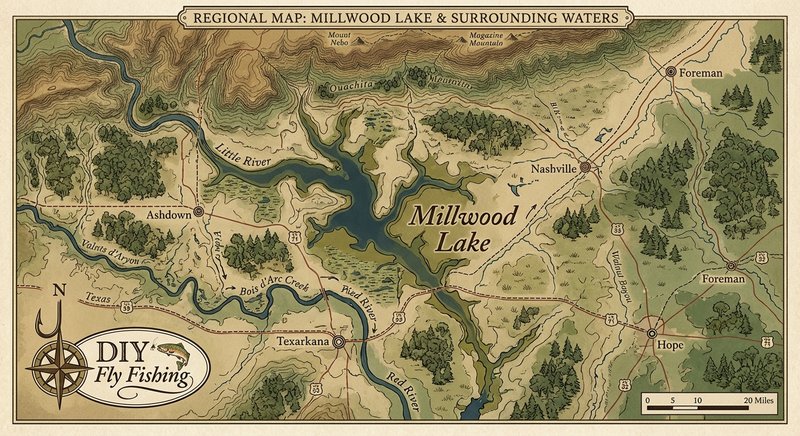
Millwood Lake is an impoundment of the Little River, located near Ashdown, Arkansas. What makes it special—and notorious—is the sheer volume of underwater hazards. When the lake was flooded, much of the timber was left standing.
The water is generally stained to "heavy tea" colored, which is actually an advantage for fly anglers as it allows you to get closer to fish without spooking them. This is "jungle fishing." You aren't making 60-foot hero casts here; you are picking apart pockets in the vegetation and "punching" flies into the shadows of ancient cypress knees.
🐟 Target Species & Behavior
Largemouth Bass
Millwood is a "Lunker" factory. Because of the Florida-strain stockings, bass here grow massive. They are ambush predators that hold tight to the timber and the edges of the lily pad "carpets." They feed primarily on shad, bluegill, and crawfish.
Crappie
Locally called "specks," Millwood crappie are remarkably large. They congregate around submerged brush piles and the main river channel ledges. For fly anglers, they are a blast on light rods when they move shallow to spawn.
Catfish (Channel & Flathead)
While rarely targeted on the fly, Millwood has a massive population. During the summer "cicada falls" or when the river is rising, you can occasionally hook them in the shallows on heavy, dark streamers or "mop flies" fished near the bottom.
📅 Best Times to Fish
- Spring (March – May): The Prime Window. As the water hits 60°F, bass and crappie move into the shallow flats and shorelines to spawn. This is when they are most accessible to fly anglers.
- Summer (June – August): Focus on the first two hours of daylight and the last hour before dark. During the day, fish retreat to the "cool" shadows of the deep timber or the Little River channel.
- Fall (September – November): As temperatures drop, bass follow shad migrations into the creek arms (like McGuire Creek). The "topwater bite" can be spectacular all day during overcast fall days.
- Time of Day: Early morning is king. The water is usually calmest then, making it easier to maneuver a boat or kayak through the stumps.
🪰 Recommended Flies & Techniques
Top Patterns
- For Bass:
- BoogleBugs & Large Poppers: Size 2 to 1/0. Use weedless versions. Black/Yellow or Frog patterns are local favorites.
- Dahlberg Divers: Exceptional for "swimming" over submerged logs.
- Gamechangers (White/Chartreuse): To mimic the abundant shad.
- Crayfish Patterns: Heavy lead-eyed flies in burnt orange or olive, fished on a sink-tip line near the cypress knees.
- For Crappie:
- Clouser Minnows: Size 6-8 in Pink/White or Chartreuse/White.
- Wooly Buggers: Beaded, size 8, in white or silver to mimic minnows.
Techniques
- The "Stop and Pop": When using topwater, less is often more. Cast into a pocket in the lily pads, let the rings disappear, then give it one sharp pop. Wait 5-10 seconds. Most strikes occur while the fly is stationary.
- The Short Game: Use a heavy 8-weight or 9-weight rod with a "Bass Bug" taper line. You need the mass of the line to turn over large, wind-resistant flies and the backbone of the rod to pull a 6-pound bass out of the timber before it wraps you around a stump.
💡 Pro Tips & Local Knowledge
- Mind the Lanes: Millwood is dangerous for boaters. There are marked boat lanes—stay in them until you reach your fishing zone. Even then, move at idle speed. Use a kayak or a shallow-draft bass boat if possible.
- Follow the "Green": Look for "coontail" moss and lily pads. If you find a spot where the Little River current pushes bait against a weed edge, you've found a goldmine.
- Color Matters: In Millwood's stained water, contrast is more important than matching the hatch. Use Black and Blue or Chartreuse and White. If the water is particularly muddy, go all black to provide a strong silhouette.
- The "Bow-and-Arrow" Cast: In the thick timber, you often won't have room for a backcast. Practice your roll casting and bow-and-arrow casts before you arrive.
⚠️ Important Information
- Alligators: Millwood is home to one of the largest populations of American Alligators in Arkansas. They are generally shy, but do not wade fish. Stay in your boat and keep your pets out of the water.
- Permits: An Arkansas Fishing License is required. You can purchase these via the AGFC (Arkansas Game and Fish Commission) website or app.
- Access:
- Millwood State Park: Excellent facilities and boat ramps.
- Yarborough Landing: Great access to the main lake timber.
- Cottonshed Landing: Famous for big bass and thick cover.
- Submerged Hazards: This cannot be overstated—even if the water looks open, there are stumps just 2 inches below the surface. A sturdy trolling motor with a "weedless" prop is mandatory.
Millwood is a "bucket list" lake for the warm-water fly angler. It rewards patience, accurate casting, and a bit of bravery when navigating the flooded forest. Tight lines!
Bug Hatches & Matching Flies
| Hatch | Type | Peak months | Time of day | Hook sizes | Matching flies |
|---|---|---|---|---|---|
| Hex (Giant Burrowing Mayfly) Hexagenia limbata | mayfly | June, July | Dusk/Night | #6-10 | Hexagenia Spinner #6-8, Burrowing Mayfly Nymph #8-10, Crippled Hex #8 |
| Damselfly Enallagma spp. | terrestrial | May, June, July, August | Mid-day | #10-14 | Adult Damsel #10-12, Marabou Damsel Nymph #12-14 |
| Chironomid (Midge) Chironomidae | midge | March, April, October, November | All Day | #18-24 | Zebra Midge #18-22, Griffith's Gnat #20-24, Snowshoe Midge #20 |
| Long-horned Sedge Oecetis inconspicua | caddis | June, July, August | Evening | #12-16 | Elk Hair Caddis #14-16, Caddis Pupa #14-16 |
| Dragonfly Anisoptera | terrestrial | June, July, August | Afternoon | #4-8 | Dragonfly Nymph #6-8, Gumdrop Dragonfly #6-10 |
| Trico Tricorythodes spp. | mayfly | August, September | Morning | #20-24 | Trico Spinner #22-24, RS2 #20-22 |
| Grasshopper Orthoptera | terrestrial | July, August, September | Mid-day/Afternoon | #8-12 | Hopper Juan #8-10, Dave's Hopper #10-12 |
| Water Boatman Corixidae | terrestrial | April, October | All Day | #14-18 | Water Boatman #14-16, Backswimmer #14 |