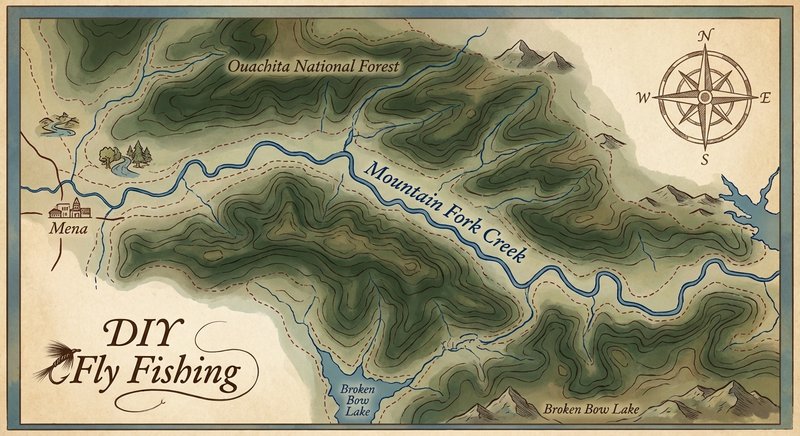
Mountain Fork Creek
Fly fishing in Arkansas · Intermediate · Best seasons: Spring, Fall
Target Species
Smallmouth Bass, Rainbow Trout
About This Water
Remote Ouachita stream with bass and seasonal trout. Pristine mountain water.
Fishing Recommendations
Mountain Fork Creek, Arkansas (often referred to as the Mountain Fork River by locals) is a hidden gem tucked into the rugged Ouachita Mountains of Western Arkansas. Unlike its more famous downstream counterpart in Oklahoma (the Lower Mountain Fork tailwater), the Arkansas section is a wild, free-flowing mountain stream.
As your guide, I’m excited to break down this technical and rewarding fishery.
🎣 Location Overview
Mountain Fork Creek is a classic "freestone" stream characterized by crystal-clear pools, fast-moving riffles, and massive shale and sandstone boulder gardens. What makes it special is its wildness. Located primarily within the Ouachita National Forest near the Oklahoma border (west of Mena, AR), it offers a primitive experience far from the crowds of the White or Little Red Rivers.
The water is highly reactive to rainfall. It can transform from a trickle to a raging torrent in hours, then clear up into a stunning turquoise-tinted stream within a few days. Anglers love it for the solitude and the opportunity to catch "Mean Mountain" Smallmouths in a truly scenic, forested canyon environment.
🐟 Target Species & Behavior
While the creek holds several species, the "Big Two" are the primary draw:
Smallmouth Bass (The Bronze Back)
The "Smallies" here are native, wild, and incredibly strong for their size.
- Behavior: They are ambush predators. They hold in the "slack water" behind large boulders, in the deep undercut banks of the pools, and at the "tail-outs" where a pool begins to accelerate into a riffle.
- Feeding: They focus heavily on crawfish, hellgrammites, and small baitfish (stonerollers and shiners).
Rainbow Trout
Note: This is a seasonal fishery. The Arkansas Game and Fish Commission (AGFC) typically stocks the Mountain Fork near the Hwy 246 bridge and other access points during the cooler months.
- Behavior: These are hatchery-reared fish that eventually become "stream smart." They hold in the oxygenated water at the head of pools (where the whitewater settles) and behind current breaks.
- Feeding: They look for opportunistic meals: midges, small nymphs, and the occasional terrestrial or pellet-imitation fly.
📅 Best Times to Fish
Optimal Seasons
- Spring (March – June): This is the prime window for Smallmouth Bass. As water temperatures hit 55°F–60°F, the bass become aggressive. This is also when the last of the winter-stocked trout are still active.
- Fall (October – November): The water cools down, and the Smallmouth have a "final gorge" before winter. This is also when trout stocking usually resumes. The fall colors in the Ouachitas make this the most beautiful time to be on the water.
Best Times of Day
- Smallmouth: Low light is your friend. Early morning (dawn to 10:00 AM) and late evening (6:00 PM to dusk) are when the biggest bass move into the shallows to hunt.
- Trout: Mid-day can be surprisingly productive in the winter/early spring as the sun warms the water slightly, triggering insect activity.
Prime Conditions
Look for a "falling hydrograph." If it rained two days ago and the water is clearing but still has a slight "stain" to it, the fishing will be epic.
🪰 Recommended Flies & Techniques
For Smallmouth Bass
- Top Fly Patterns:
- Clouser Minnow: (Chartreuse/White or Olive/White) – Size 2–6. The king of the Mountain Fork.
- Near Nuff Craw: (Brown or Orange) – Fish this deep and slow on the bottom.
- Murdoch Minnow: A great suspending streamer for slower pools.
- Poppers: (Yellow or Black) – Use these during low light in early summer.
- Technique: Use a 6-weight rod with a weight-forward floating line. Cast toward the bank or behind boulders, let the fly sink, and use erratic, short strips.
For Rainbow Trout
- Top Fly Patterns:
- Gold Ribbed Hare's Ear: Size 14–16.
- Zebra Midge: (Red or Black) Size 18–20 under an indicator.
- Wooly Bugger: (Olive or Black) Size 8–10.
- Egg Patterns/Mop Flies: Effective for recently stocked fish.
- Technique: 4-weight or 5-weight rod. "High-stick" nymphing through the riffles or a slow swing with a Wooly Bugger through the deeper holes.
💡 Pro Tips & Local Knowledge
- The "Stealth" Factor: Because the water is so clear, these fish are spooky. Wear earthy tones (no bright white shirts) and avoid splashing. Long casts are often necessary to avoid lining the fish.
- Focus on the Shale: The Mountain Fork has unique tilted shale formations. Smallmouth love to tuck into the "slots" created by these rock layers. Parallel your casts to these ridges.
- The "Hwy 246" Bridge: This is the most common access point. For better fishing, be prepared to hike at least a half-mile upstream or downstream away from the bridge to find the unpressured "monsters."
- Wading Safety: The rocks here are notoriously slippery and often unstable. Felt-soled boots or studs are mandatory. A wading staff is highly recommended if the water is up.
⚠️ Important Information
- Access: Much of the land surrounding the creek is private, though the creek itself flows through National Forest sections. Stick to public access points (like the Hwy 246 bridge) and stay within the high-water marks when wading.
- Regulations:
- An Arkansas Fishing License is required.
- If you are targeting trout, you must have a Trout Permit.
- Check the AGFC Guidebook for current length and creel limits, as regulations can change.
- Cell Service: Expect zero cell service once you drop into the canyon. Download your maps for offline use and let someone know your "back-by" time.
- Floats: This creek is generally too shallow/rocky for drift boats. Kayaks or canoes are possible during high water (Spring), but expect to "drag" your boat over many shallow shoals. It is primarily a wade-fishing destination.
Bug Hatches & Matching Flies
| Hatch | Type | Peak months | Time of day | Hook sizes | Matching flies |
|---|---|---|---|---|---|
| Blue-Winged Olive Baetis spp. | mayfly | March, April, October, November | Midday | #18-22 | Parachute Adams #18-22, RS2 #20-22, Pheasant Tail Nymph #18-20 |
| American Grannom (Caddis) Brachycentrus occidentalis | caddis | April, May | Afternoon/Evening | #14-16 | Elk Hair Caddis #14-16, Holy Grail #14-16, Peacock Caddis Larva #14-16 |
| Golden Stonefly Hesperoperla pacifica | stonefly | May, June | Morning/Evening | #6-10 | Kaufmann's Stone #6-10, Stimulator (Yellow) #8-12, Pat's Rubber Legs #8-10 |
| Light Cahill Stenacron canadense | mayfly | June, July | Evening | #12-14 | Light Cahill #12-14, Gold Ribbed Hare's Ear #12-14 |
| Hellgrammite Corydalus cornutus | terrestrial | May, June, July, August | All Day | #4-8 | Murray's Hellgrammite #4-8, Critter Mite #6-8 |
| Trico Tricorythodes | mayfly | August, September | Early Morning | #22-26 | Trico Spinner #22-24, Griffith's Gnat #22-24 |
| Terrestrial (Grasshopper) Melanoplus spp. | terrestrial | July, August, September | Late Morning/Afternoon | #8-12 | Dave's Hopper #10-12, Morrish Hopper #8-12 |
| Midges Chironomidae | midge | January, February, March, December | Morning/Afternoon | #18-24 | Zebra Midge #18-22, Griffith's Gnat #20-22, Top Secret Midge #20-24 |