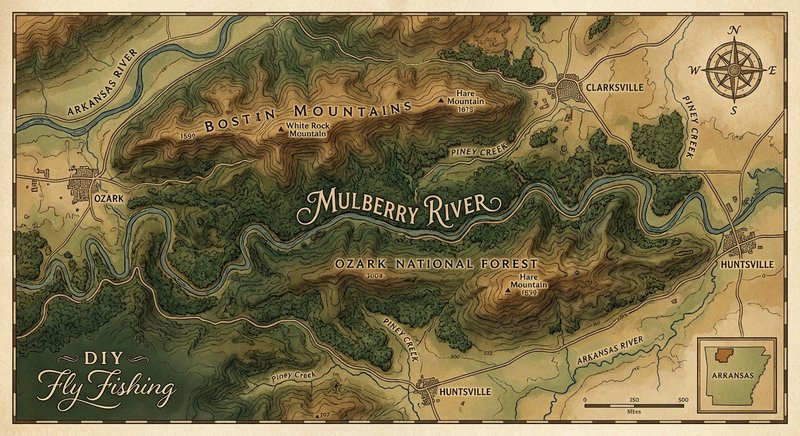
Mulberry River
Fly fishing in Arkansas · Intermediate · Best seasons: Spring, Summer, Fall
Target Species
Smallmouth Bass, Rainbow Trout
About This Water
Scenic Ozark National Forest stream. Smallmouth bass and seasonal trout stocking.
Fishing Recommendations
Welcome to the Ozarks. As your guide, I can tell you that the Mulberry River is one of the crown jewels of Arkansas fly fishing. Designated as a National Wild and Scenic River, it offers a rugged, intimate experience that feels worlds away from the tailwater crowds of the White or Little Red Rivers.
Here is your comprehensive guide to fly fishing the "Wild and Scenic" Mulberry.
🎣 Location Overview
The Mulberry River snakes through the heart of the Ozark National Forest in Northwest Arkansas. What makes it special is its freestone character—unlike the dam-controlled tailwaters nearby, the Mulberry relies on rainfall and springs.
The water is characterized by high limestone bluffs, dense forest canopies, and a bottom comprised of carved bedrock, shale ledges, and large boulders. It is famous for its "emerald" tint during normal flows. Anglers love it because it is a true "paddler’s river," offering miles of wilderness access that can only be reached by canoe, kayak, or adventurous bushwhacking.
🐟 Target Species & Behavior
Smallmouth Bass (The "Ozark Brownie")
The Mulberry is a premier Smallmouth fishery. These fish are lean, aggressive, and exceptionally strong for their size due to living in constant current.
- Behavior: They are ambush predators. They hold in the "slack water" behind large boulders, under root balls, and along deep shale shelves.
- Feeding: Their primary diet consists of crawfish, hellgrammites (dobsonfly larvae), and baitfish like sculpins and shiners.
Rainbow Trout
While the Mulberry is primarily a warm-water fishery, the Arkansas Game and Fish Commission (AGFC) stocks Rainbow Trout during the cooler months (typically November through April).
- Behavior: These are hatchery-reared fish. They tend to congregate in the deeper pools near stocking points and in the swifter "oxygenated" riffles.
- Feeding: They respond well to classic "attractor" nymphs and small streamers, but as they acclimate, they will take midges and small mayfly imitations.
📅 Best Times to Fish
Spring (March – May)
- Conditions: Peak water levels. This is the best time for floating the river.
- Target: Smallmouth become active as water temps hit 55°F. This is also the tail end of the trout season.
- Window: Mid-morning to late afternoon as the sun warms the rock beds.
Summer (June – August)
- Conditions: Water levels drop, often becoming too low to float. This is wet-wading season.
- Target: Smallmouth Bass. They move into the swifter "pocket water" to find higher oxygen levels.
- Window: Dawn and Dusk. The "Topwater Window" is legendary during these months.
Fall (September – November)
- Conditions: Low, clear, and stunningly beautiful foliage.
- Target: Smallmouth are "bulking up" for winter and become very aggressive. Trout stocking usually begins in late fall.
- Window: All day. The cooling water keeps the bass active longer.
🪰 Recommended Flies & Techniques
For Smallmouth Bass
- Topwater: BoogleBugs (Size 4-8) in "Panther" or "Yellow Jacket." These are indestructible poppers. Also, Morrish Hoppers or Chubby Chernobyls during the summer grasshopper season.
- Streamers: The Clouser Minnow (Chartreuse/White or Olive/White) is the gold standard. For crawfish imitations, use the Near-Nuff Craw or Schmidt’s Junk Yard Dog.
- Nymphs: Pat’s Rubber Legs (Size 6-10) in coffee/black to mimic hellgrammites.
For Rainbow Trout
- Nymphs: Gold Ribbed Hare’s Ear, Pheasant Tails, and Zebra Midges (Size 16-20).
- Attractors: Egg patterns or Pink Squirrels work well for recently stocked fish.
Presentation Tips
- The "Splatt" Factor: For Smallmouth, don't be afraid to let your popper hit the water hard. The noise mimics a terrestrial falling off a bluff and triggers a strike.
- Swing the Riffles: When fishing streamers, cast quartering downstream and let the fly "swing" through the current transitions.
💡 Pro Tips & Local Knowledge
- The Shale Ledge Secret: The Mulberry has unique underwater shale "steps." Bass love to tuck deep under these ledges. If you aren't bouncing your fly off the bottom or ticking the ledge, you're missing the big fish.
- Watch the Gauge: Use the USGS Gauge at Mulberry.
- 2.0 to 4.5 feet: Ideal for floating/fishing.
- Below 2.0 feet: You will be dragging your boat; switch to wade fishing.
- Above 5.0 feet: The river becomes dangerous for fishing; focus on safety.
- Stealth is Key: Because the water is so clear, Smallmouth can see you from a distance. Wear earthy tones (olive/tan) and avoid "lining" the fish with a heavy fly line. Use a longer leader (9ft to 12ft) in the summer.
- The "High Bank" to "Redding" Stretch: This is arguably the most productive 5-mile stretch for both scenery and fish density.
⚠️ Important Information
Access Points
- Turner Bend: The hub of the river. Great for shuttles, supplies, and advice.
- Wolf Pen, High Bank, and Redding: These are US Forest Service sites that provide excellent access for both wading and launching boats.
Regulations & Permits
- License: An Arkansas Fishing License is required. If you are targeting trout, you must have a Trout Stamp.
- Smallmouth Limits: There are specific length and creel limits for Smallmouth in the Ozark Zone (usually a 12-inch minimum). However, local fly anglers almost exclusively practice Catch and Release to protect these slow-growing fish.
Special Considerations
- Flash Floods: The Mulberry is a "flashy" river. It can rise several feet in hours after a heavy rain in the headwaters. Always check the weather for the entire watershed.
- Private Property: While the riverbed is public, much of the land bordering the river is private. Respect "Purple Paint" (the Arkansas signal for No Trespassing).
Guide’s Final Word: The Mulberry isn't about high fish counts; it's about the quality of the environment. Bring a 6-weight rod for the bass, some sturdy wading boots, and take a moment to look up at the bluffs. Tight lines!
Bug Hatches & Matching Flies
| Hatch | Type | Peak months | Time of day | Hook sizes | Matching flies |
|---|---|---|---|---|---|
| Blue-Winged Olive Baetis | mayfly | March, April, October, November | Mid-day/Afternoon | #18-22 | Parachute BWO #18-20, RS2 #20-22, Pheasant Tail #18-20 |
| March Brown Maccaffertium vicarium | mayfly | March, April | Afternoon | #10-14 | March Brown Dry #12-14, Gold Ribbed Hare's Ear #10-12, March Brown Wet #12-14 |
| Grannom Caddis Brachycentrus | caddis | April | Late Afternoon/Evening | #14-16 | Elk Hair Caddis (Olive) #14-16, Peacock Caddis Larva #14-16, LaFontaine's Deep Sparkle Pupa #14-16 |
| Golden Stonefly Acronuria | stonefly | May, June | Evening/Night | #6-10 | Pat's Rubber Legs #6-10, Chubby Chernobyl (Gold) #8-12, Kaufmann's Stone #6-8 |
| Sulphur / Light Cahill Ephemerella invaria | mayfly | May, June | Evening | #14-16 | Light Cahill #14-16, Sulphur Parachute #16, Mercer's Pupa #14-16 |
| Hellgrammite Corydalus cornutus | terrestrial | May, June, July, August | All Day | #4-8 | Murray's Hellgrammite #4-8, Bitch Creek Nymph #6-8, Near Nuff Sculpin #4-6 |
| White Fly Ephoron leukon | mayfly | August, September | Evening/Dusk | #12-14 | White Wulff #12-14, Snowshoe Emerger #14, White Paradox #12 |
| Grasshopper Orthoptera | terrestrial | July, August, September | Mid-day/Afternoon | #6-12 | Dave's Hopper #8-12, Morrish Hopper #10-12, Fat Albert #6-10 |
| Micro-Caddis / Trico Tricorythodes | mayfly | August, September, October | Morning | #20-24 | Trico Spinner #22-24, Griffith's Gnat #20-22, Zebra Midge #20-22 |