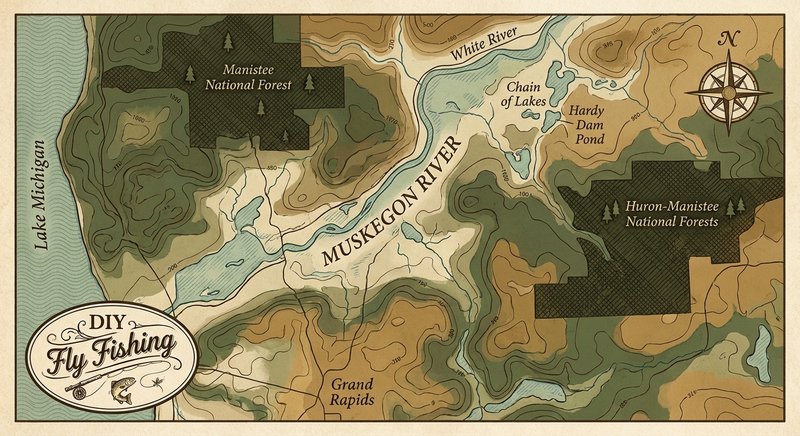
Muskegon River
Fly fishing in Michigan · Beginner · Best seasons: Spring, Summer, Fall
Target Species
Steelhead, Brown Trout, Smallmouth Bass
About This Water
Large river with diverse fishing. Steelhead, salmon, and warm water species available.
Fishing Recommendations
The Muskegon River is one of the Midwest’s premier "tailwater" fisheries. Flowing from Houghton Lake and regulated by the Croton Dam, it offers a remarkably stable environment that supports year-round fishing. Known for its wide, gravel-bottomed reaches and massive runs of migratory fish, the "Mo" is a bucket-list destination for any serious fly angler.
🎣 Location Overview
The Muskegon is a large, powerful river characterized by its gentle gradient and vast expanses of "textbook" trout water. Unlike the tight, brushy creeks of Northern Michigan, the Muskegon is expansive, making it ideal for both drift boat fishing and long-distance casting.
What makes it special is the Croton Dam tailwater effect. The dam regulates water temperatures, keeping the river cooler in the summer and warmer in the winter compared to other systems. This creates a prolific insect biomass and provides a sanctuary for massive Great Lakes Steelhead and resident Brown Trout that grow to trophy proportions. It is often described as "big water fishing with a small water feel" due to its accessible wading and clear sight-fishing opportunities.
🐟 Target Species & Behavior
Steelhead (Adfluvial Rainbow Trout)
These are the undisputed kings of the Muskegon. They enter from Lake Michigan to spawn.
- Behavior: They hold in deep "staging" holes before moving onto shallow gravel runs to spawn.
- Feeding: While they don't feed actively like residents, they are highly opportunistic, hitting eggs, nymphs, and streamers out of aggression or instinct.
Brown & Rainbow Trout (Resident)
The Muskegon holds a high density of resident trout, many in the 16–22 inch range.
- Behavior: They are highly keyed into the "conveyor belt" of food. During the Steelhead spawn, they sit directly behind spawning beds to gorge on displaced eggs.
- Feeding: Massive hatches of Caddis, Blue Winged Olives, and Isonychia drive their surface behavior, while sculpins and crayfish dominate their subsurface diet.
Smallmouth Bass
As the water warms in the summer, the lower sections of the river become a world-class Smallmouth fishery.
- Behavior: They prefer structured areas—downed timber, rock ledges, and the edges of weed beds.
- Feeding: They are aggressive predators, targeting baitfish, leeches, and crayfish.
📅 Best Times to Fish
- Spring (March – May): Prime Steelhead Season. Late March through April is peak spawning time. This is also when the "Fry Hatch" occurs, making trout fishing explosive.
- Summer (June – August): Dry Fly & Smallmouth Time. June brings the legendary "Caddis Blizzard." July and August are peak for Smallmouth Bass and terrestrial fishing (hoppers) for trout.
- Fall (October – December): Steelhead & Streamer Season. October brings the Salmon run, followed by the "Fall Steelhead" which are the hardest fighting fish of the year. This is also the best time to hunt trophy Browns with large streamers.
Optimal Windows: Overcast days are gold on the Muskegon, especially for Steelhead and streamer fishing. Morning/evening transitions are best for summer dry fly action.
🪰 Recommended Flies & Techniques
For Steelhead
- Technique: Indicator Nymphing or "Chuck and Duck" (though fly-first indicator rigs are preferred).
- Flies: Glo-bugs (Oregon Cheese, Nuked Egg), Estaz Stones, Sparrow Nymphs, and intruder-style streamers for swinging with a Spey rod.
For Brown Trout
- Technique: "Matching the hatch" during the summer; "Egg-sucking" techniques in the spring/fall.
- Flies:
- Dries: Elk Hair Caddis (sz 14-18), Robert's Yellow Drake, Isonychia patterns.
- Streamers: Kelly Galloup’s Dungeon, Sparkle Minnows, and Sculpin patterns.
For Smallmouth Bass
- Technique: Strip-set streamer retrieves or topwater popping.
- Flies: Murdich Minnows, Gamechangers, and Boogle Bugs (poppers).
💡 Pro Tips & Local Knowledge
- Focus on the "Upper": The most productive trout and Steelhead water is the first 10–12 miles below Croton Dam. As you move further downstream towards Newaygo and beyond, the water warms and transitions more heavily to Smallmouth.
- The "Fry" Factor: In May, millions of Steelhead and Salmon fry hatch. Use small, iridescent streamers (size 10-12) to target resident trout that are keyed into this protein source.
- Wading Safety: While the river looks calm, it is wide and powerful. The bottom is "greasy" gravel. Use studded wading boots and a wading staff, especially near the dam.
- Swing the Flats: If the nymphing crowd is thick, grab a Spey rod. The Muskegon has massive, flat runs that are tailor-made for swinging intruders for Steelhead.
⚠️ Important Information
Access Points
- Croton Dam: The primary launch and wading access.
- Pine Street: A popular mid-river drift boat launch and wading spot.
- Thornapple Avenue: Excellent access for the lower trout reaches and Smallmouth water.
Regulations
- Type 4 Water: The section from Croton Dam to Parchment Avenue is open all year. However, specific bag limits and tackle restrictions apply.
- Licensing: A standard Michigan Fishing License is required. If you are targeting Steelhead/Salmon, ensure you have the "all-species" upgrade.
- Etiquette: The Muskegon can get busy during the spring. Give other anglers (especially those on gravel) plenty of space. If you are in a boat, avoid rowing directly over the water someone is wading.
Special Considerations
The Muskegon is a "big" river. Even for experienced casters, a 9ft 6wt or 7wt is the standard rod for trout to handle the wind and larger flies, while an 8wt or 9wt is necessary for Steelhead.
Bug Hatches & Matching Flies
| Hatch | Type | Peak months | Time of day | Hook sizes | Matching flies |
|---|---|---|---|---|---|
| Midges Chironomidae | midge | January, February, March, April | Late Morning/Afternoon | #18-24 | Zebra Midge #18-22, Griffith's Gnat #20-24, Palomino Midge #20-22 |
| Early Black Stonefly Capniidae | stonefly | February, March, April | Midday | #12-16 | Black Copper John #14-16, Little Black Stone #14-16, Early Girl Stone #14-16 |
| Hendrickson Ephemerella subvaria | mayfly | April, May | Afternoon | #12-14 | Red Quill #12-14, Hendrickson Emerger #12-14, Pheasant Tail #12-14 |
| Blue Winged Olive Baetis / Pseudocloeon | mayfly | May, September, October | Cloudy Afternoons | #18-22 | RS2 #18-22, BWO Parachute #18-22, WD-40 #18-20 |
| Caddis (Grannom & Spotted Sedge) Brachycentrus & Hydropsyche | caddis | May, June | Evening | #14-18 | Elk Hair Caddis #14-16, LaFontaine's Deep Pupa #14-18, Holy Grail Caddis #14-16 |
| Sulphur Ephemerella invaria / dorothea | mayfly | May, June | Evening | #14-18 | Sulphur Parachute #16-18, Sulphur Snowshoe Emerger #16-18, Split Case Sulphur #16 |
| Gray Drake Siphlonurus | mayfly | June | Late Evening/Dusk | #10-12 | Gray Drake Spinner #10-12, Adams #10-12, Hare's Ear #10-12 |
| Trico Tricorythodes | mayfly | July, August, September | Early Morning | #20-24 | Trico Spinner #22-24, Sunken Trico #20-22, Drowned Trico Spinner #22-24 |
| Isonychia (Slate Drake) Isonychia bicolor | mayfly | June, July, September | Late Afternoon/Evening | #10-12 | Iso Parachute #10-12, Prince Nymph #10-12, Zug Bug #10-12 |