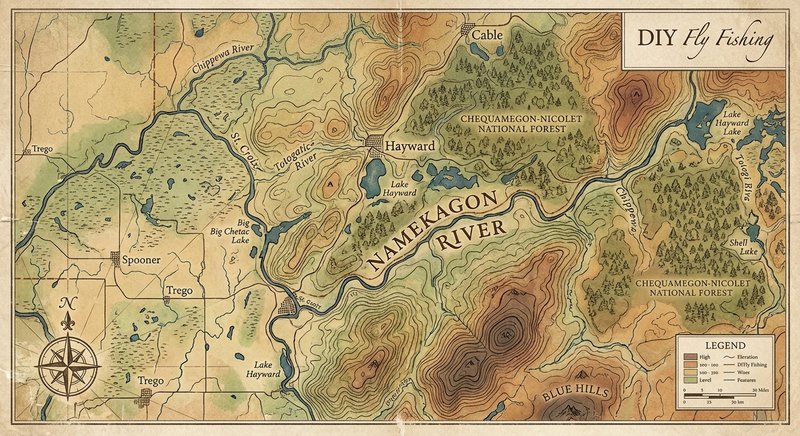
Namekagon River
Fly fishing in Wisconsin · Intermediate · Best seasons: Spring, Summer, Fall
Target Species
Brown Trout, Smallmouth Bass, Musky
About This Water
National Wild and Scenic River with trout and musky. Northwoods wilderness.
Fishing Recommendations
The Namekagon River is one of the crown jewels of the Midwest. As part of the St. Croix National Scenic Riverway, it is a federally protected, free-flowing river that offers a true wilderness experience. Often called "The Name," it transitions from a cold-water trout stream in its upper reaches to a premier warm-water smallmouth and musky fishery as it winds toward its confluence with the St. Croix.
🎣 Location Overview
The Namekagon is characterized by its tea-colored (tannic) water, sandy bottoms, and an abundance of "woody debris"—fallen white pines and oaks that provide world-class cover for predators.
What makes it special is its wild character. Because it is managed by the National Park Service, the banks are largely undeveloped. You won't see many houses; instead, you’ll see eagles, trumpeter swans, and black bears. The river is diverse: the "Upper Namekagon" (Cable to Hayward) is classic trout water, while the "Lower Namekagon" (Hayward to the St. Croix) is a sprawling, multi-species playground.
🐟 Target Species & Behavior
Brown Trout
The upper river holds wild and holdover Browns. These fish are notorious for being "wood-oriented." They don't sit in the middle of the stream; they tuck deep into log jams.
- Behavior: Highly opportunistic. They feed heavily on nymphs during the day but become aggressive streamers hunters or dry-fly sippers during evening hatches.
Smallmouth Bass
The "Lower" river is a world-class Smallmouth destination. These fish are lean, mean, and use the current to their advantage.
- Behavior: They hold behind boulders, in "slack water" eddies, and along the deep cut banks. They are extremely aggressive toward topwater patterns in the heat of summer.
Musky
The Namekagon is a "low density, high reward" Musky river. These are wild fish, not hatchery stock.
- Behavior: Ambush predators. They hold in the deepest holes and the thickest timber. They are notorious for following a fly right to the boat, requiring a perfect "Figure-8" to trigger a strike.
📅 Best Times to Fish
- Spring (May – June): This is the prime window for Trout. The water is cool, and the aquatic insect activity is at its peak. Late May brings the Hendrickson and Sulphur hatches.
- Summer (July – August): This is the Smallmouth heyday. Low, clear water makes for incredible sight-fishing and topwater action. For trout, this is "The Hex" window (late June/early July), where the massive Hexagenia limbata mayfly hatches at night.
- Fall (September – October): The "Big Game" season. As water temps drop, Musky activity skyrockets. Brown Trout also become aggressive as they prepare for the fall spawn (please avoid fishing for spawning fish on "redds").
🪰 Recommended Flies & Techniques
For Brown Trout
- Dry Flies: Hexagenia patterns (Size 4-6) for night fishing, Stimulators (Size 8-12), and Elk Hair Caddis.
- Streamers: Black or Olive Woolly Buggers, or "The Sparkle Minnow."
- Technique: "Pounding the banks." Cast your fly as close to the wood as possible. If you aren't risking losing your fly in the logs, you aren't fishing where the big browns live.
For Smallmouth Bass
- Topwater: Boogle Bugs, Murdich Minnows (fished high), and Foam Poppers in yellow or black.
- Sub-surface: Clouser Minnows (Chartreuse/White) and Crawfish patterns.
- Technique: The "Popper-Dropper." Run a large foam popper with a small hellgrammite or crayfish nymph tied 24 inches behind it.
For Musky
- Flies: Large (8–12 inch) articulated streamers. High-contrast colors work best in the tannic water: Black/Orange, Firetiger, or White/Chartreuse.
- Technique: Use a 10-weight rod and an intermediate sinking line. You must perform a Figure-8 at the end of every single cast. Namekagon muskies are famous for following.
💡 Pro Tips & Local Knowledge
- Respect the "Tea": The water is dark due to tannins from cedar swamps. Because of this, fish have a harder time seeing flies in deep water. Use flies with rattles or patterns that push a lot of water (like Buford-style heads) to help fish find the fly via their lateral line.
- The "Quiet" Approach: The Namekagon is often shallow. If you are in a drift boat or canoe, be silent. Banging an oar against the side of the boat will clear a hole of big fish instantly.
- The Hayward Transition: The dam in Hayward is the dividing line. Above the dam is mostly trout; below the dam is where the smallmouth and musky dominance begins.
- Stay Late: On the Namekagon, the best trout fishing often happens 20 minutes after you think it’s too dark to see. Bring a headlamp with a red light setting.
⚠️ Important Information
- Access: The National Park Service maintains excellent landings (e.g., Phipps, County K, Trego). Most are suitable for canoes, kayaks, and drift boats. Power boats are discouraged and often impossible due to low water and logs.
- Regulations: The Namekagon has specific "Trout Tool" regulations. Some stretches are Catch and Release only or have artificial-only restrictions. Always check the current Wisconsin DNR Trout Regulations.
- Safety: The river is full of "deadheads" (sunken logs just below the surface). If you are rowing or paddling, go slow. Cell service is spotty once you drop into the river valley.
- Shuttles: Local fly shops in Hayward and Seeley offer shuttle services for a fee—it is well worth the money to have your vehicle waiting at the downstream landing.
Guide’s Final Word: The Namekagon isn't about high fish counts; it's about the quality of the environment and the size of the predators. Bring your A-game, plenty of bug spray, and an extra 0X leader.
Bug Hatches & Matching Flies
| Hatch | Type | Peak months | Time of day | Hook sizes | Matching flies |
|---|---|---|---|---|---|
| Hendrickson Ephemerella subvaria | mayfly | May | Afternoon | #12-14 | Red Quill #12-14, Hendrickson Emerger #14, Pheasant Tail #12-14 |
| Grannom Caddis Brachycentrus | caddis | May | Morning/Afternoon | #14-16 | Elk Hair Caddis (Olive) #14-16, Holy Grail #14-16, LaFontaine's Deep Pupa #16 |
| Brown Drake Ephemera simulans | mayfly | June | Evening/Dusk | #10-12 | Brown Drake Cripple #10-12, Brown Drake Spinner #10-12, Gold Ribbed Hare's Ear #10 |
| Sulphur Ephemerella invaria | mayfly | June, July | Evening | #14-18 | Sparkle Dun #16-18, Pale Morning Dun #14-16, Sulphur Soft Hackle #16 |
| Hexagenia Hexagenia limbata | mayfly | June, July | Late Evening/Night | #6-10 | Hexagenia Paradun #6-8, Giant Michigan Spinner #6-8, Hex Nymph #8 |
| White Fly Ephoron leukon | mayfly | August | Evening/Dusk | #12-14 | White Wulff #12-14, Snowshoe White Fly #12-14, White Fly Spinner #14 |
| Trico Tricorythodes | mayfly | August, September | Morning | #20-24 | Trico Spinner #22-24, Griffith's Gnat #20-22, RS2 #22 |
| Blue-Winged Olive Baetis | mayfly | April, October | Afternoon | #18-22 | BWO Parachute #18-22, Baetis Nymph #18-20, CDC Emerger #20 |
| Golden Stonefly Acroneuria | stonefly | June, July | Evening/Night | #8-12 | Golden Stone Nymph #8-10, Stimulator (Yellow) #10-12, Pat's Rubber Leg #8-12 |