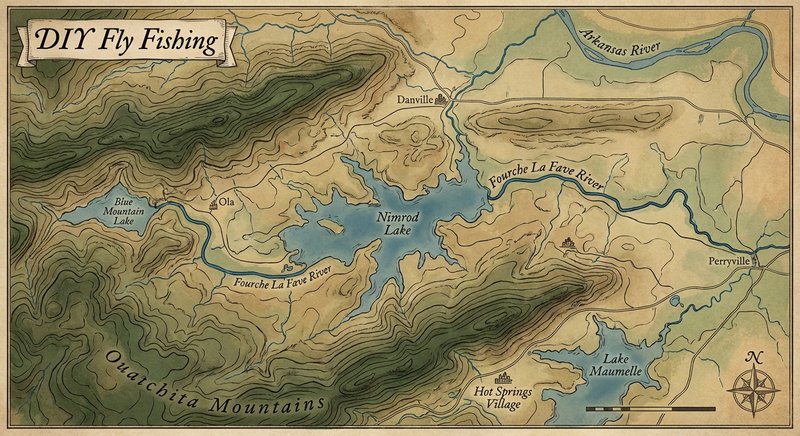
Nimrod Lake
Fly fishing in Arkansas · Beginner · Best seasons: Spring, Summer, Fall
Target Species
Largemouth Bass, Crappie, Catfish
About This Water
Central Arkansas reservoir with good bass fishing. Scenic Fourche LaFave setting.
Fishing Recommendations
Welcome to the Ouachita Mountains of Arkansas. As a guide, I can tell you that Nimrod Lake is a bit of a "sleeper" hit for fly anglers. While it’s famous among gear anglers for its slab crappie, its relatively shallow depths and abundant timber make it a fantastic playground for those willing to throw big flies for bass or target panfish on the fly.
Nimrod is the oldest Corps of Engineers lake in Arkansas, and its age shows in all the right ways—tons of established structure and a very healthy ecosystem.
🎣 Location Overview
Nimrod Lake is situated on the Fourche LaFave River between the Ozark and Ouachita National Forests. It spans approximately 3,550 acres, though this can vary wildly based on seasonal rainfall.
What makes Nimrod special is its wild, rugged character. Unlike the deep, crystal-clear reservoirs like Lake Ouachita, Nimrod is a "river-run" lake. It is characterized by stained to murky water, extensive standing timber, and shallow flats. For the fly angler, this is an advantage: the fish aren't 40 feet deep; they are often tucked into wood or cruising the edges of lily pads in 3 to 10 feet of water, putting them well within reach of a fly line.
🐟 Target Species & Behavior
Largemouth Bass
Nimrod bass are "wood-oriented." They hold tight to submerged stumps, fallen logs, and standing timber.
- Behavior: They are ambush predators here. Because the water is often stained, they rely heavily on their lateral lines to detect vibration.
- Feeding: They gorge on gizzard shad, sunfish, and crawfish.
Crappie (Black and White)
Nimrod is arguably the crappie capital of the region.
- Behavior: They congregate in massive schools around "brush piles" and underwater timber. In the spring, they move into incredibly shallow water (1–3 feet) to spawn.
- Feeding: Almost exclusively small minnows and shad.
Catfish (Channel & Flathead)
While less common on the fly, Nimrod has a massive population.
- Behavior: They roam the flats at night and hold in the old river channel during the day.
- Feeding: Scavengers, but active hunters of shad and crawfish.
📅 Best Times to Fish
Spring (March – May) — Prime Window
This is the "Golden Era" at Nimrod.
- Crappie: Late March to April, when they move to the bank. This is the only time you can consistently target them with a fly rod.
- Bass: Pre-spawn and spawn (April) find bass in the shallow coves.
- Condition: Watch the water levels; spring rains can make the lake muddy. A "falling" lake is usually better than a "rising" lake here.
Summer (June – August)
- Bass: Best at dawn and dusk. Topwater action is electric during the first hour of light.
- Night Fishing: This is the best time for catfish and big bass using large, dark-colored streamers that move a lot of water.
Fall (September – November)
- Shad Busts: As the water cools, shad move into the creeks. Look for "boils" on the surface. Bass and crappie will follow them. This is the best time for fast-paced streamer fishing.
🪰 Recommended Flies & Techniques
For Largemouth Bass
Since the water is stained, you need bulk and vibration.
- Patterns:
- Dahlberg Divers (Chartreuse or Black/Blue)
- Game Changers (Shad patterns)
- Clouser Minnows (with extra-large flash)
- Poppers: Large foam poppers in yellow or orange.
- Technique: "Pound the wood." Cast as tight to the standing timber as possible. Let the fly sit until the rings disappear, then give it a sharp strip to create a "thump."
For Crappie
- Patterns:
- Woolly Buggers (Size 8-10, White or Chartreuse)
- Crappie Candy (Small epoxy minnows)
- Micro-Jig Flies (Tied on 1/64 oz jig heads)
- Technique: Use a slow-sinking intermediate line. Count the fly down to the depth of the brush and use a very slow, rhythmic "twitch-twitch-pause" retrieve.
For Catfish
- Patterns: Large, heavy Lead-Eyed Buggers or Meat Whistles in dark brown or black.
- Technique: Dredge the bottom near the river channel bends. You need a 7 or 8-weight rod for this.
💡 Pro Tips & Local Knowledge
- Follow the "Mud Line": After a rain, look for where the clearer creek water meets the murky lake water. Bass will sit on this "line" to ambush prey.
- The Sunlight Factor: On Nimrod, the sun warms the dark, stained water quickly. In the spring, the northern banks get the most sun and will hold the most active fish.
- The "Fourche LaFave" River End: If the main lake is too windy (it can get whitecaps), head to the upper end where the river enters. It’s narrower, more protected, and feels more like "river fishing" than "lake fishing."
- Short Leaders: Don't use 9-foot trout leaders. Use 4 to 6 feet of straight 15lb or 20lb fluorocarbon for bass. The fish aren't line-shy in this water, and you need the strength to pull them out of the timber.
⚠️ Important Information
Access
- Boats: A kayak or a small bass boat is highly recommended. Wading is difficult due to the soft, silty bottom and submerged timber.
- Public Access: Sunlight Bay, Project Office, and Quarry Cove are the best boat ramps for access to prime fishing.
Regulations
- License: A valid Arkansas Fishing License is required.
- Limits: Crappie limits are generous but strictly enforced. Check the current AGFC (Arkansas Game and Fish Commission) guidebook for the specific daily creel limits on Nimrod, as they can change seasonally.
Special Considerations
- Navigation: CAUTION. Nimrod is full of "stump fields." If you are in a motorized boat, stay in the marked channels until you are ready to fish, then move at idle speed. You will hit wood here.
- Hydraulic Action: The lake is a flood control reservoir. If the Corps is releasing water through the dam, the current near the dam can be dangerous for small watercraft. Check the USACE Water Levels before you go.
Tight lines! If you hit the spring crappie spawn right at Nimrod, you'll have one of the busiest days you've ever had on a fly rod.
Bug Hatches & Matching Flies
| Hatch | Type | Peak months | Time of day | Hook sizes | Matching flies |
|---|---|---|---|---|---|
| Giant Mayfly (Hex) Hexagenia limbata | mayfly | June, July | Evening/Dusk | #6-10 | Hexagenia Spinner #6-8, Burrowing Mayfly Nymph #8-10 |
| Speckled Dun Callibaetis | mayfly | May, September | Morning | #14-16 | Callibaetis Spinner #14-16, Hare's Ear Nymph #14-16 |
| Damselfly Enallagma | terrestrial | May, June, July | Mid-day/Afternoon | #10-14 | Adult Damselfly #10-12, Marabou Damsel Nymph #12-14 |
| Dragonfly Anisoptera | terrestrial | June, July, August | Afternoon | #4-10 | Dragonfly Nymph (Olive) #4-8, Deer Hair Dragonfly #6-10 |
| Midges Chironomidae | midge | March, April, October | All Day | #18-24 | Zebra Midge #18-22, Griffith's Gnat #18-20 |
| Grasshoppers Melanoplus | terrestrial | August, September | Afternoon | #8-12 | Dave's Hopper #8-12, Chernobyl Ant #8-10 |
| Black Ants Formicidae | terrestrial | July, August | Afternoon | #12-18 | Black Foam Ant #14-18, Fur Ant #16-18 |
| Spotted Sedge Hydropsyche | caddis | April, May, October | Evening | #14-16 | Elk Hair Caddis #14-16, LaFontaine's Emerger #14-16 |