No
Fly fishing in New Hampshire · Advanced · Best seasons: Summer, Fall
Target Species
Brook Trout
About This Water
White Mountain wilderness stream. Remote backcountry brook trout.
Fishing Recommendations
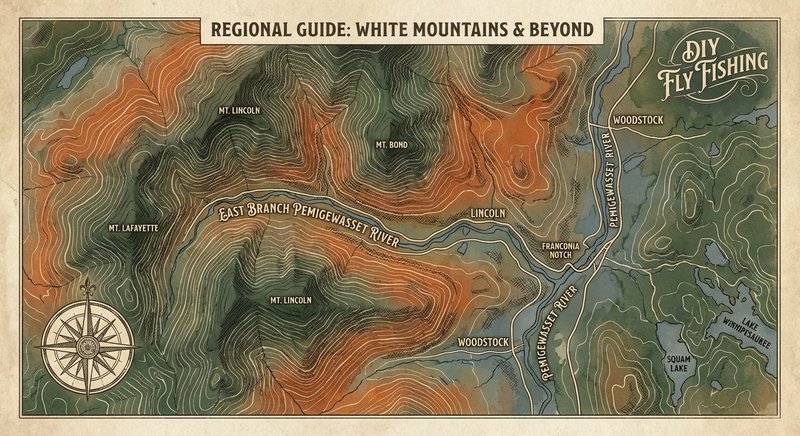
The East Branch of the Pemigewasset River, often simply called the "East Branch," is one of the crown jewels of New England fly fishing. Located in the heart of the White Mountains, it offers a true "Blue Ribbon" experience for anglers seeking wild, native fish in a rugged, backcountry setting.
🎣 Location Overview
The East Branch is a classic freestone river that flows through the Lincoln/Woodstock area and deep into the Pemigewasset Wilderness. What makes it special is its raw, high-gradient character. This is a river of massive granite boulders, deep crystalline pools, and pocket water that looks like it was designed by a landscape architect for trout.
Unlike the main stem of the Pemi, the East Branch remains colder and more oxygenated. It is a "boulder garden" river, meaning the water is constantly tumbling, creating the perfect habitat for native Brook Trout. Anglers love it because it offers a sense of solitude—once you hike a mile or two past the trailhead, you are in a pristine wilderness where the only sound is the rushing water and the wind in the hemlocks.
🐟 Target Species & Behavior
The primary target here is the Wild Brook Trout. While you may occasionally find a stray Rainbow or Brown Trout near the lower reaches in Lincoln, the upper river is the kingdom of the Salvelinus fontinalis.
- Behavior: These are opportunistic feeders. Because the East Branch is a nutrient-poor freestone system, the fish can’t afford to be picky. However, they are extremely "spooky." The water is exceptionally clear, and the fish have a high awareness of overhead predators (herons, hawks, and anglers).
- Where they hold: Look for "pillows" of water in front of large boulders, the soft seams on the edges of fast chutes, and the deep tail-outs of pools at dusk. In the heat of summer, they will congregate at the heads of pools where the water is most oxygenated.
- Size: Most wild fish are in the 6–10 inch range, but 12-inch "trophy" wild brookies are present for the patient angler.
📅 Best Times to Fish
While the river is beautiful year-round, your specified seasons are indeed the prime windows.
- Summer (Late June – August): This is the peak for dry fly fishing. While other NH rivers might get too warm, the East Branch stays cooler longer.
- Time of Day: Early morning (6 AM – 10 AM) and "the magic hour" before dark.
- Fall (September – Mid-October): This is arguably the best time. The Brook Trout take on their brilliant spawning colors (vibrant oranges and reds). They become more aggressive as they prepare for winter.
- Conditions: Look for those crisp, overcast September days. As the water temperature drops into the 50s, the fish become very active.
- Note on Flow: Avoid the river immediately after heavy rain; as a freestone mountain river, it rises rapidly and becomes dangerous to wade.
🪰 Recommended Flies & Techniques
Top Fly Patterns
- Dry Flies:
- Royal Wulff or Royal Coachman (Size 12-16): A classic high-visibility attractor.
- Elk Hair Caddis (Tan/Olive, Size 14-18): Mimics the abundant caddis life.
- Stimulators (Orange or Yellow, Size 10-14): Great for imitating stoneflies or grasshoppers in late summer.
- Ausable Wulff: Specifically designed for these types of Adirondack/White Mountain waters.
- Nymphs:
- Pheasant Tail (Size 16-20): The gold standard.
- Prince Nymph (Size 14-16): The flash helps in the bubbly, oxygenated water.
- Copper John: Adds weight to get down in deep plunge pools.
- Streamers:
- Black or Olive Woolly Bugger (Size 8-10): Effective in the fall for larger, aggressive males.
Techniques & Presentation
- The "Dry-Dropper": This is the most effective way to fish the East Branch. Use a buoyant dry fly (like a Stimulator) and hang a small Pheasant Tail nymph 18–24 inches below it.
- Short Line Nymphing: In the heavy boulder sections, you rarely need to cast more than 15 feet. High-stick your rod to keep the line off the conflicting currents.
- Stealth: Wear earthy colors (greens/browns) to blend into the forest. Approach pools from downstream and stay low. If you can see the fish, they have likely already seen you.
💡 Pro Tips & Local Knowledge
- The "Lincoln Woods" Approach: Park at the Lincoln Woods Trailhead. Most people fish within a half-mile of the bridge. If you hike 3+ miles in on the flat wilderness trail, the fishing pressure drops significantly and the fish size tends to increase.
- Focus on the Tributaries: Don't ignore the small feeder streams that enter the East Branch. During the heat of August, Brookies will often "thermally refuge" in these smaller, colder inlets.
- The "Skating" Technique: In the evening, try "skating" a caddis across the surface of a flat pool. The vibration often triggers a violent strike from a Brookie that wouldn't take a dead-drifted fly.
- Wading Safety: The rocks in the East Branch are notoriously slippery and often loose. Studded wading boots and a wading staff are highly recommended.
⚠️ Important Information
- Access: The primary access is via the Lincoln Woods Trailhead on the Kancamagus Highway (Route 112). There is a small daily parking fee ($5 USD at the time of writing).
- Regulations:
- New Hampshire fishing licenses are required (available online or at local shops in Lincoln).
- Be sure to check the current NH Fish & Game "Freshwater Fishing Digest," as some sections may have specific "Fly Fishing Only" or "Catch and Release" designations depending on the year.
- Wilderness Ethics: This area is part of the White Mountain National Forest. Practice Leave No Trace principles. If you are fishing deep in the wilderness, be "Bear Aware" and carry out everything you carry in.
- Cell Service: Expect zero cell service once you leave the town of Lincoln. Let someone know your plan before heading into the Pemi Wilderness.
Bug Hatches & Matching Flies
| Hatch | Type | Peak months | Time of day | Hook sizes | Matching flies |
|---|---|---|---|---|---|
| Quill Gordon Epeorus pleuralis | mayfly | May | Mid-day | #12-14 | Quill Gordon Dry #12-14, Gold Ribbed Hare's Ear #12-14 |
| Hendrickson Ephemerella subvariabilis | mayfly | May | Afternoon | #12-14 | Red Quill #12-14, Hendrickson Emerger #14 |
| Grannom Caddis Brachycentrus | caddis | May | All day | #14-16 | Elk Hair Caddis (Olive) #14-16, Pupa (Green) #14-16 |
| Giant Stonefly Pteronarcys dorsata | stonefly | June | Evening/Night | #4-8 | Pats Rubber Legs (Black) #4-8, Stimulator (Orange) #8-10 |
| Sulphur Ephemerella invaria/dorothea | mayfly | June, July | Evening | #14-18 | Sulphur Parachute #14-18, Pheasant Tail #14-18 |
| Light Cahill Stenacron interpunctatum | mayfly | July, August | Evening | #12-14 | Light Cahill #12-14, Gold Ribbed Hare's Ear (Light) #12-14 |
| Blue-Winged Olive Baetis | mayfly | May, September, October | Mid-day/Afternoon | #18-22 | BWO Sparkle Dun #18-22, RS2 (Olive) #20-22 |
| Golden Stonefly Acronesuria | stonefly | June, July | Evening | #8-12 | Golden Stimulator #10-12, 20 Incher Stone #8-12 |
| Cinnamon Caddis Hydropsyche | caddis | July, August | Evening | #14-16 | Tan Elk Hair Caddis #14-16, Soft Hackle (Tan) #14-16 |
| Terrestrials Formicidae / Coleoptera | terrestrial | July, August, September | Mid-day | #12-18 | Flying Ant (Black) #14-18, Foam Beetle #12-16 |