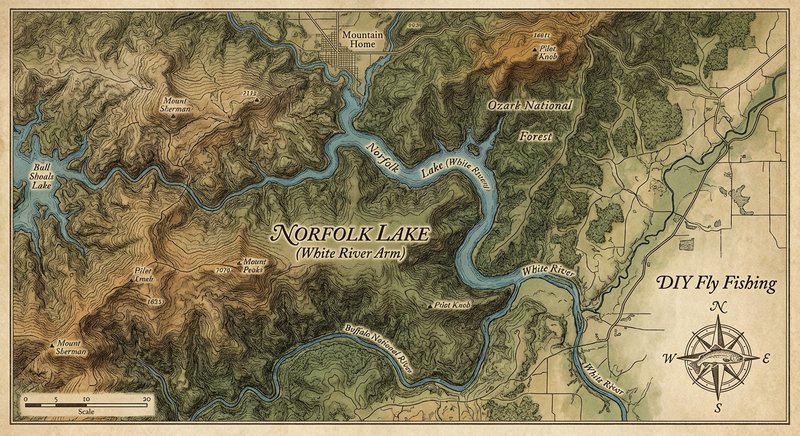
Norfolk Lake (White River Arm)
Fly fishing in Arkansas · Intermediate · Best seasons: Spring, Summer, Fall
Target Species
Largemouth Bass, Smallmouth Bass, Crappie
About This Water
Upper arm of Norfork Lake with excellent bass fishing. Clear Ozark water.
Fishing Recommendations
As your guide to the Ozarks, it’s a pleasure to break down the White River Arm of Norfork Lake. While many anglers flock to the tailwaters below the dam for trout, the upper section where the White River feeds into the lake is a premier warm-water fly fishing destination. It offers a unique transition from moving river water to deep, clear highland reservoir conditions.
🎣 Location Overview
Norfork Lake is a classic highland reservoir characterized by deep, gin-clear water, steep bluff walls, and hundreds of miles of shoreline. The White River Arm, located on the northwestern side of the lake, is particularly special because it retains a "riverine" feel longer than the main body of the lake.
Anglers love this area because it offers diverse structure: flooded timber, rocky points, gravel bars, and deep drop-offs. Because the water is so clear, it provides a "sight-fishing" quality rarely found in other southern reservoirs. It’s a place where you can catch a trophy Smallmouth in the morning and fill a basket with Crappie in the afternoon, all while surrounded by the rugged beauty of the Ozark National Forest.
🐟 Target Species & Behavior
Largemouth Bass
- Behavior: The "kings of the brush piles." They are ambush predators that hold tight to structure. In the White River Arm, they utilize the transition zones where the river channel meets the lake flats.
- Feeding: Primarily shad, bluegill, and crawfish.
Smallmouth Bass
- Behavior: The "Bronzebacks" here prefer the rockier sections. Look for them on secondary points, submerged islands (humps), and gravel banks. They are more mobile than Largemouths and will often chase baitfish into open water.
- Feeding: Highly focused on crawfish and "young-of-the-year" shad.
Crappie
- Behavior: These are school-oriented fish. In Norfork, they are almost always associated with standing timber or man-made brush piles. They move vertically in the water column based on light intensity.
- Feeding: Almost exclusively small minnows and aquatic insects.
📅 Best Times to Fish
Spring (March – May)
- Window: This is prime time. As water temperatures hit 55°F, fish move shallow to spawn.
- Conditions: Look for "staging" fish on secondary points in March. By late April, fish are on the nests in the back of coves.
- Time of Day: Mid-day when the sun warms the shallows.
Summer (June – August)
- Window: Early morning and late evening are mandatory.
- Conditions: Fish go deep during the day (20-30 feet). However, the "Night Bite" on Norfork is legendary for big Bass using large surface flies.
- Time of Day: 5:00 AM – 9:00 AM and 7:00 PM – Dark.
Fall (September – November)
- Window: The "Second Spring." As temperatures drop, shad migrate to the backs of the creeks, and the predators follow.
- Conditions: Look for "boiling" fish (surface activity) on the main channel.
- Time of Day: All day, provided there is some cloud cover.
🪰 Recommended Flies & Techniques
For Bass (Largemouth & Smallmouth)
- Topwater: Dahlberg Divers or BoogleBug Poppers (Size 2-4) in white, chartreuse, or black (for low light).
- Streamers: Game Changers or Murdich Minnows (white/silver) to mimic shad. For crawfish imitations, use Clouser Minnows or Near Nuff Craws in olive/orange.
- Technique: Use an intermediate or sink-tip line to get streamers down to the 8–12 foot range along bluff walls. For Smallmouth, "strip-and-pause" retrieves are deadly.
For Crappie
- Flies: Woolly Buggers (Size 8-10) in white, pink, or chartreuse. Micro-jigs under a strike indicator are also highly effective.
- Technique: "Vertical fly fishing." Position the boat over submerged timber and drop the fly down. Use a slow, rhythmic jigging motion. An indicator can help keep your fly at a specific depth above the brush.
💡 Pro Tips & Local Knowledge
- Follow the Shad: In the White River Arm, the location of the fish is 100% dependent on the location of the Threadfin Shad. If you don't see baitfish on your electronics or dimpling the surface, move until you do.
- The "Bluff Transition": One of the best spots to find Smallmouth is where a steep limestone bluff transitions into a flat gravel bank. Fish the exact line where the rock type changes.
- Wind is Your Friend: Because the water is so clear, a "slick" surface makes fish spooky. A light chop on the water breaks up the light and makes bass much more aggressive toward fly presentations.
- The Stealth Factor: Use long leaders (9–12 feet) and fluorocarbon tippet. These fish see a lot of lures; a delicate fly presentation on 10lb fluoro often triggers strikes when gear anglers are struggling.
⚠️ Important Information
- Access: The Henderson Park and Panther Bay areas offer excellent boat ramps and access points to the White River Arm. For those without a boat, public bank access is limited due to the steep terrain; a kayak or belly boat is highly recommended.
- Regulations: An Arkansas Fishing License is required. There are specific length and bag limits for Smallmouth (usually 12 inches) and Crappie (usually 10 inches and a limit of 15). Always check the current AGFC (Arkansas Game and Fish Commission) guidebook before heading out.
- Safety: Norfork is a deep lake. If you are in a small craft, be wary of large wake from pontoon boats and bass boats. Always wear a PFD.
- Clean, Drain, Dry: To prevent the spread of invasive species like Zebra Mussels, ensure your boat and gear are thoroughly cleaned before and after entering the water.
Guide’s Final Thought: The White River Arm is a thinking man’s fishery. Don't be afraid to change depths and colors frequently until you find the "pattern of the day." Tight lines!
Bug Hatches & Matching Flies
| Hatch | Type | Peak months | Time of day | Hook sizes | Matching flies |
|---|---|---|---|---|---|
| Midges Chironomidae | midge | January, February, March, December | All Day | #18-24 | Zebra Midge #18-22, Griffith's Gnat #20-24, WD-40 #20-22 |
| Giant Mayfly (Hex) Hexagenia limbata | mayfly | June, July | Evening/Night | #6-10 | Hexagenia Spinner #6-8, Burrowing Mayfly Nymph #8-10, Full Motion Hex #8 |
| Callibaetis Callibaetis spp. | mayfly | May, June, September | Morning/Afternoon | #14-16 | Callibaetis Spinner #14-16, Hare's Ear Nymph #14-16, Callibaetis Cripple #14-16 |
| White Miller Nectopsyche | caddis | July, August | Evening | #12-14 | White Elk Hair Caddis #12-14, White Miller Soft Hackle #12-14, LaFontaine's Sparkle Pupa #14 |
| Damselfly Enallagma/Ischnura | terrestrial | June, July, August | Morning/Afternoon | #10-14 | Marabou Damselfly Nymph #10-12, Adult Damsel (Blue) #12-14, Parachute Damsel #12 |
| Tricos Tricorythodes | mayfly | August, September, October | Early Morning | #20-24 | Trico Spinner #20-24, Trico Dun #20-22, RS2 (Black) #20-24 |
| Grasshoppers Acrididae | terrestrial | July, August, September | Afternoon | #8-12 | Dave's Hopper #8-12, Fat Albert #8-10, Morrish Hopper #10-12 |
| Black Ants Formicidae | terrestrial | May, June, September | All Day | #14-18 | Cinnamon Ant #16-18, Black Foam Ant #14-18, Fur Ant #16 |