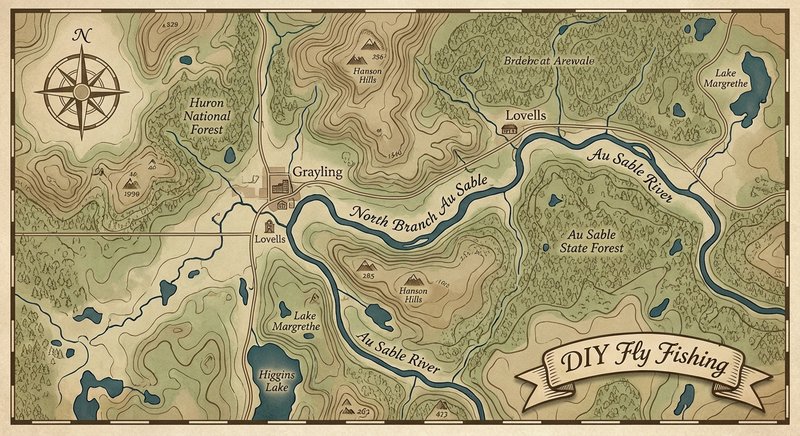
North Branch Au Sable
Fly fishing in Michigan · Intermediate · Best seasons: Spring, Summer, Fall
Target Species
Brook Trout, Brown Trout
About This Water
Tributary of the famous Au Sable. Quality brook and brown trout in scenic setting.
Fishing Recommendations
The North Branch of the Au Sable River is often called the "Queen" of Michigan’s trout streams. While the Main Stream gets the fame for size and the South Branch for its wild scenery, the North Branch is beloved for its intimacy, its prolific brook trout population, and its status as the cradle of American fly fishing conservation.
Here is your comprehensive guide to fishing the North Branch.
🎣 Location Overview
The North Branch is a classic limestone-influenced freestone river. Unlike the Main Stream, which can feel big and daunting, the North Branch is intimate. It is characterized by a relatively shallow, sandy bottom punctuated by extensive gravel runs and "cedar sweepers" (fallen trees).
What makes it special: This is arguably the finest brook trout water in the Lower Peninsula. It is also exceptionally easy to wade—it’s often called a "ballroom floor" because the flat, sandy/gravel bottom allows for easy walking. It is the spiritual home of the "Au Sable River Boat" and sits just miles from where Trout Unlimited was founded.
🐟 Target Species & Behavior
- Brook Trout: The North Branch is the star of the show for wild Brookies. They are opportunistic but wary. They hold tight to wood cover and under overhanging tag alders. Most are 7–10 inches, but 12-inch specimens are common for skilled anglers.
- Brown Trout: While less numerous than brookies, the North Branch holds some very large, "retired" browns. These fish are nocturnal and highly structure-oriented. They hide in the deep, dark holes created by log jams and under-cut banks.
Feeding Behavior: These fish are highly keyed into surface activity. Because the river is shallow, fish are always looking up. Even in the heat of summer, a well-placed terrestrial will bring a fish to the surface.
📅 Best Times to Fish
- Spring (Late April – June): This is the "Grand Slam" of Michigan fly fishing.
- May: The Hendrickson hatch starts the season in earnest.
- June: The "Magic Month." You get Sulphurs, Brown Drakes, and the legendary Hexagenia limbata (Hex) hatch toward the end of the month.
- Summer (July – August): Best for morning Trico hatches (tiny white mayflies) and midday terrestrial fishing (grasshoppers/ants).
- Fall (September – October): Brook trout colors become magnificent as they prepare to spawn. Large browns become aggressive and will strike streamers.
Prime Window: On the North Branch, the "evening rise" is sacred. The last two hours of daylight are often more productive than the rest of the day combined.
🪰 Recommended Flies & Techniques
Top Fly Patterns
- Dry Flies:
- The Roberts Yellow Drake: A local legend for the Brown Drake hatch.
- Adams (Parachute or Standard): Developed in Michigan; it’s the universal soldier here.
- Borcher’s Special: A must-have Michigan pattern that mimics many dark mayflies.
- Royal Wulff: Excellent for prospecting brookies in faster water.
- Terrestrials: Foam Ants (Black/Cinnamon) and Dave’s Hoppers.
- Nymphs: Prince Nymphs, Pheasant Tails (size 14-18), and Gold-Ribbed Hare’s Ears.
- Streamers: Woolly Buggers (Olive/Black) and Muddler Minnows.
Techniques
- The Reach Cast: Because the water is clear and the current is glassy, a reach cast is essential to prevent "micro-drag."
- Downstream Dry Fly: A local "guide secret" on the North Branch is to wade downstream and drop a dry fly down to a rising fish. This ensures the fish sees the fly before the leader.
- Dapping: In the tight tag alders, sometimes you don't cast—you simply "dap" the fly over the wood.
💡 Pro Tips & Local Knowledge
- The "Sheep Ranch" Stretch: Focus your efforts on the area known as the Sheep Ranch. It has some of the best gravel and consistent hatches on the river.
- Log Jams are Key: If you aren't casting within inches of a log jam, you're missing the fish. Brook trout on the North Branch live inside the wood.
- Dam 4 to Twin Bridges: This is a classic "all-day" float or wade. It features some deeper holes where the larger browns hide.
- The "Au Sable Twitch": When fishing a spent-wing caddis or a terrestrial, give it a tiny, almost imperceptible twitch. This often triggers a strike from a cautious brookie.
⚠️ Important Information
Regulations
- Flies Only / Catch & Release: A large portion of the North Branch (from Sheep Ranch down to the confluence with the Main Stream) is designated as "Gear Restricted." This means Artificial Flies Only and Catch and Release for all trout.
- Always check the current Michigan DNR Trout Sidewalker for specific boundary changes.
Access
- Public access is excellent. Look for the "brown signs" at road crossings.
- Kellogg’s Bridge, Twin Bridges, and Sheep Ranch are the primary access points.
Special Considerations
- Temperature: The North Branch can get warm in late July. If the water hits 70°F, stop fishing to protect the trout—they cannot recover well from a fight in warm water.
- Sand Traps: You will see wooden structures in the river designed to catch sand. These are part of a massive conservation effort to keep the gravel clean for spawning. Do not walk on the sediment inside these traps.
Guide’s Final Word: The North Branch isn't about trophy hunting; it’s about the soul of the sport. Bring a 3-weight or 4-weight rod, a box of dries, and take your time. It’s a river that rewards patience and observation over brute force.
Bug Hatches & Matching Flies
| Hatch | Type | Peak months | Time of day | Hook sizes | Matching flies |
|---|---|---|---|---|---|
| Hendrickson Ephemerella invaria | mayfly | April, May | Afternoon | #12-14 | Red Quill #12-14, Hendrickson Emerger #14, Pheasant Tail #12-14 |
| Sulphur Ephemerella dorothea | mayfly | May, June | Evening | #16-18 | Sulphur Parachute #16-18, Sulphur Spinner #16-18, CDC Sulphur Emerger #16 |
| Brown Drake Ephemera simulans | mayfly | May, June | Evening/Dusk | #10-12 | Brown Drake Paradrake #10-12, Brown Drake Spinner #10-12, Brown Drake Nymph #10 |
| Hex Hexagenia limbata | mayfly | June, July | Night | #4-8 | Hexagenia Parachute #6-8, Robert's Yellow Drake #6-8, Hex Spinner #4-6 |
| White Miller Ephoron leukon | mayfly | August | Evening | #12-14 | White Miller Spinner #12-14, White Wulff #12-14 |
| Trico Tricorythodes | mayfly | July, August, September | Morning | #20-24 | Trico Spinner #20-24, Trico Drowned Spinner #22 |
| Blue-Winged Olive Baetis spp. | mayfly | May, September, October | Afternoon | #18-22 | BWO Sparkle Dun #18-22, RS2 #20-22 |
| Grannom Caddis Brachycentrus | caddis | April, May | Morning/Afternoon | #14-16 | Elk Hair Caddis (Olive) #14-16, Holy Grail Caddis #14-16 |
| Ants and Beetles Hymenoptera / Coleoptera | terrestrial | July, August | Midday | #12-18 | Cinnamon Ant #14-18, Foam Beetle #12-16 |