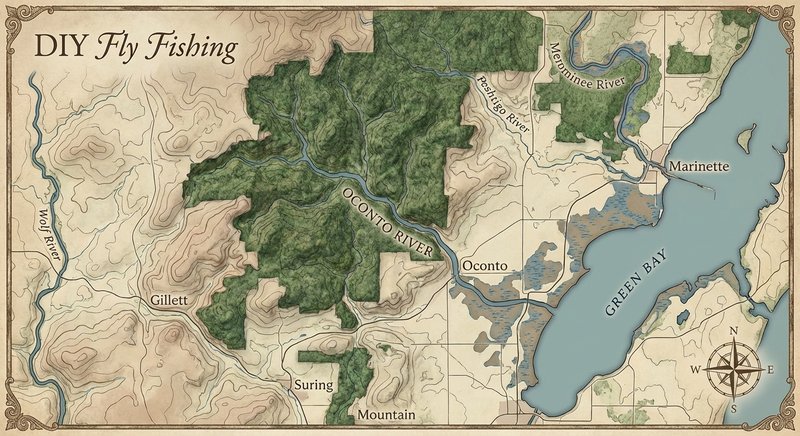
Oconto River
Fly fishing in Wisconsin · Intermediate · Best seasons: Spring, Summer, Fall
Target Species
Brown Trout, Steelhead, Brook Trout
About This Water
Northeast Wisconsin river with trout and steelhead. Lake Michigan tributary.
Fishing Recommendations
The Oconto River is one of Wisconsin's most diverse and rewarding fly fishing destinations. It offers a rare "best of both worlds" experience: a pristine, spring-fed coldwater fishery in its upper reaches for resident trout, and a powerful Great Lakes tributary system in its lower reaches for migratory lake-run fish.
Here is your comprehensive guide to fly fishing the Oconto.
🎣 Location Overview
The Oconto River system, located in Northeastern Wisconsin, is a sprawling drainage that transitions through various landscapes. The river is generally categorized into two distinct sections:
- The Upper Oconto (North, South, and Main Branches): This is classic "Northwoods" trout water. Characterized by sandy bottoms mixed with gravel runs, heavy woody debris, and cedar-lined banks. It flows through the Chequamegon-Nicolet National Forest, offering a remote, wilderness feel.
- The Lower Oconto: Below the dams (particularly the Stiles Dam), the river transforms into a powerhouse for Lake Michigan migratory fish.
What makes it special is the density of the North Branch. It is arguably one of the finest trout streams in the Midwest, offering incredibly prolific insect hatches and a high count of wild fish per mile.
🐟 Target Species & Behavior
- Brown Trout: The Oconto is famous for its wild Browns. In the upper branches, they are wary and light-sensitive. They hold tight to undercut banks and submerged logs ("sweepers"). During the "Hex" hatch in summer, the monsters come out of the wood to feed on the surface.
- Brook Trout: Found primarily in the colder headwaters and smaller tributaries like the McCaslin Brook and the upper North Branch. They are opportunistic feeders but require cold, highly oxygenated water.
- Steelhead (Adfluvial Rainbow Trout): These fish run from Green Bay into the lower Oconto. They are aggressive and powerful. They hold in the deeper "buckets" behind gravel bars and in the main current seams during their spring and fall migrations.
📅 Best Times to Fish
- Spring (March – May):
- Steelhead: Peak season for the lower river is late March through April.
- Trout: The early season (April/May) features excellent Hendrickson and Blue Winged Olive (BWO) hatches.
- Summer (June – August):
- The "Golden Month": Mid-June to mid-July is the peak for dry fly enthusiasts. This is when the Hexagenia limbata (Hex) hatch occurs at dusk.
- Daytime: Focus on Terrestrials (hoppers/ants) in August.
- Fall (September – November):
- Brown Trout: Fall is streamer time. Resident Browns become aggressive and territorial as they prepare to spawn.
- Steelhead: A smaller but significant run of "fall-run" Steelhead enters the lower river alongside King Salmon (Chinook).
🪰 Recommended Flies & Techniques
For Resident Trout (Upper Branches)
- Dry Flies:
- Hatches: Hendrickson (#12-14), Light Cahill (#14), Sulphurs (#16), and the Hexagenia (#4-6, 3XL shank).
- Attractors: Royal Wulff, Stimulators (#12-16).
- Nymphs:
- Bead-head Pheasant Tails, Hare’s Ears, and Prince Nymphs (#14-18).
- Pro Tip: Use a "Dry-Dropper" rig to cover both bases in the shallow runs.
- Streamers:
- Black or Olive Wooly Buggers, Muddler Minnows, and Gold Deceivers. Swing these near submerged wood.
For Steelhead (Lower River)
- Patterns:
- Glo-Bugs (Egg patterns) in chartreuse, orange, and pink.
- Stonefly nymphs (black or golden, #6-10).
- Large "Intruder" style swings for aggressive fall fish.
- Technique: Indicator nymphing is the most productive method. Ensure your split shot is heavy enough to get the fly to the "zone" (the bottom 6 inches of the water column).
💡 Pro Tips & Local Knowledge
- The "Hex" Ritual: If you are targeting the legendary Hex hatch, bring a headlamp with a red light setting. The bugs come out at the very end of twilight. Listen for the "gulp" of a big Brown—sometimes you're fishing by sound rather than sight.
- Wade with Caution: The Oconto has many "deadheads" (sunken logs) from the old logging days. These are great for fish habitat but can trip up a wading angler. Use a wading staff.
- Focus on the North Branch: For the best trout numbers and public access, focus on the stretch between Wabeno and Mountain. The water here stays cooler during the heat of July.
- Stealth is Key: Because of the clear water and sandy bottom, these fish can see you from a distance. Wear earthy colors (camo/olive) and move slowly.
⚠️ Important Information
- Access: Much of the upper river is within the Chequamegon-Nicolet National Forest, providing excellent public access. Look for bridge crossings and marked DNR parking areas.
- Regulations:
- The Oconto has varying regulations depending on the branch and section.
- Many sections are Category 5 (Special Regulations), which may require artificial lures only and have specific size/bag limits.
- Always check the current Wisconsin DNR Trout Regulations before casting.
- Permits: A Wisconsin Fishing License AND an Inland Trout Stamp are required. If fishing the lower river for Steelhead, you will also need a Great Lakes Salmon/Trout Stamp.
- Cell Service: Be prepared for "dead zones" in the National Forest sections. Download your maps for offline use.
Bug Hatches & Matching Flies
| Hatch | Type | Peak months | Time of day | Hook sizes | Matching flies |
|---|---|---|---|---|---|
| Blue-Winged Olive Baetis spp. | mayfly | April, May, September, October | Midday | #18-22 | RS2 #18-22, BWO Sparkle Dun #18-20, Pheasant Tail Nymph #18-20 |
| Hendrickson Ephemerella subvaria | mayfly | May | Afternoon | #12-14 | Red Quill #12-14, Hendrickson Emerger #14, Hare's Ear Nymph #12-14 |
| Grannom Caddis Brachycentrus occidentalis | caddis | April, May | Morning/Afternoon | #14-16 | Elk Hair Caddis (Olive) #14-16, LaFontaine's Deep Sparkle Pupa #14-16, Holy Grail #14-16 |
| Sulphur Ephemerella invaria | mayfly | June | Evening | #14-18 | Sulphur CDC Dun #16-18, Pheasant Tail #16-18, Sulphur Parachute #14-16 |
| Brown Drake Ephemera simulans | mayfly | June | Dusk | #10-12 | Brown Drake Cripple #10-12, Brown Drake Spinner #10-12, Brown Drake Nymph #10-12 |
| Spotted Sedge Hydropsyche spp. | caddis | June, July, August | Evening | #14-18 | Peacock Caddis #16, Z-Wing Caddis #14-16, Iris Caddis #14-18 |
| Hex Hexagenia limbata | mayfly | June, July | Night | #6-8 | Hexagenia Spinner #6-8, Hex Wigglers #6-8, Para-Hex #6-8 |
| Trico Tricorythodes spp. | mayfly | August, September | Morning | #20-24 | Trico Spinner #22-24, Sunville Trico Nymph #22, Griffith's Gnat #20-24 |
| Terrestrials Formicidae / Orthoptera | terrestrial | July, August, September | All Day | #10-18 | Black Foam Ant #16-18, Dave's Hopper #10-12, beetle #14-16 |