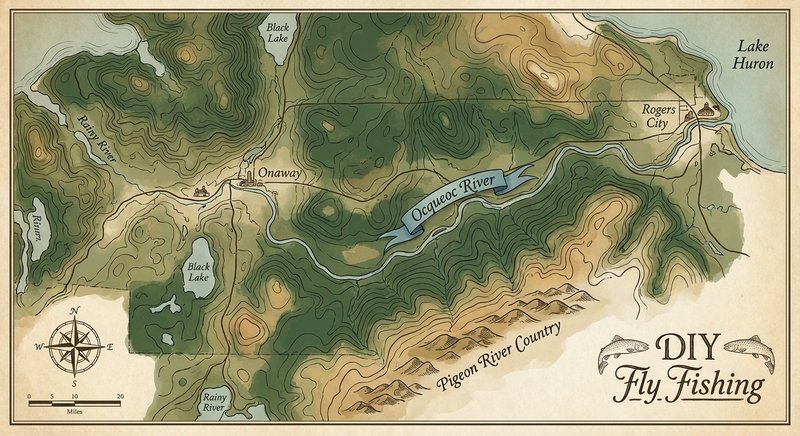
Ocqueoc River
Fly fishing in Michigan · Intermediate · Best seasons: Spring, Fall
Target Species
Brook Trout, Steelhead, Brown Trout
About This Water
Features Michigan's largest waterfall. Brook trout and steelhead in the lower sections.
Fishing Recommendations
The Ocqueoc River (pronounced AH-key-ock) is one of the hidden gems of Michigan’s Northeastern Lower Peninsula. Located in Presque Isle County, it is unique for being the only river in the Lower Peninsula with a major waterfall—Ocqueoc Falls. While it lacks the massive crowds of the famous West Side rivers, it offers a rugged, intimate, and highly rewarding fly fishing experience for those who appreciate wild fish and scenic solitude.
🎣 Location Overview
The Ocqueoc is a relatively short, cold-water river that drains into Lake Huron’s Hammond Bay. It is characterized by its diversity: the upper reaches are classic, narrow brook trout water with plenty of "sweepers" (fallen trees), while the lower sections below the falls open up into broader runs and gravel beds suitable for migratory fish.
What makes the Ocqueoc special is its wild character. Unlike the manicured "Holy Waters" of the Au Sable, the Ocqueoc is brushy, woody, and requires technical casting. The presence of the falls creates a natural staging point for migratory species, offering a spectacle rarely seen in this part of the state.
🐟 Target Species & Behavior
Steelhead (Adfluvial Rainbow Trout)
The Lake Huron steelhead are known for being "bright" and incredibly hard-fighting.
- Behavior: They enter the river to spawn, holding in deep pools and behind structure during their move upstream. Once they reach the gravel flats below the falls, they become more territorial.
- Holdings: Look for the "seams" where fast water meets slow water and the deep "dark water" holes just downstream of the falls.
Brook Trout (Resident)
The "jewels" of the North. The upper Ocqueoc and its tributaries (like the Little Ocqueoc) hold healthy populations of wild brookies.
- Behavior: Highly opportunistic but very spooky. They hide under overhanging banks and inside log jams.
- Feeding: They focus on terrestrial insects in the summer and small nymphs/larvae year-round.
Brown Trout (Resident & Lake-Run)
- Behavior: Resident browns are structure-oriented and often nocturnal. However, in the fall, larger Lake Huron browns may enter the lower river to spawn.
- Holdings: They prefer the deepest, woodiest cover available.
📅 Best Times to Fish
Spring (Late March – May)
This is the prime window for Steelhead. As the ice breaks on Lake Huron and the river temp hits 40°F, the run begins.
- Peak: Usually mid-April.
- Conditions: Look for a "rising and clearing" river after a rain.
Fall (September – November)
The fall season brings a mixed bag. Chinook and Pink Salmon arrive first (Sept/Oct), followed by the Fall Steelhead and Brown Trout.
- Peak: October is the sweet spot.
- Conditions: Cool, crisp mornings. The salmon spawn provides an "egg bite" that triggers aggressive feeding from resident trout.
Time of Day
- Trout: Low light is your friend. Dawn and dusk are essential for the bigger, wary browns.
- Steelhead: Bright midday sun often pushes them into deeper cover. Overcast days are best for all-day action.
🪰 Recommended Flies & Techniques
Steelhead Techniques
- Indicator Nymphing: The most effective method here. Use a 9ft 7wt or 8wt rod.
- Patterns:
- Eggs: Nuke Eggs, Glo-Bugs (Oregon Cheese or Pink), and Estaz Eggs.
- Nymphs: Size 8-12 Prince Nymphs, Stonefly creepers, and Hares Ears.
- Swinging: If the water is clear, swinging small streamers or "Spey" style flies on a light sink tip can be exhilarating.
Trout Techniques
- Dry Fly: For Brookies, use a 3wt or 4wt rod.
- Patterns: Elk Hair Caddis, Adams (Parachute), and during summer, Foam Ants or Beetles.
- Streamers: For Brown Trout, think "meat."
- Patterns: Black or Olive Woolly Buggers, Sculpin patterns, and the "Muddler Minnow."
- Presentation: Small, accurate casts are more important than long distance. Use a "Bow-and-Arrow" cast in the tight brush of the upper river.
💡 Pro Tips & Local Knowledge
- Focus on the Falls: The area immediately below Ocqueoc Falls is a magnet for fish. While it gets the most foot traffic, many anglers don't venture more than 200 yards downstream. If you hike a half-mile down, you’ll find untouched pockets.
- The "Little Ocqueoc": Don't overlook the confluence of the Little Ocqueoc. This area stays colder in the summer and can be a sanctuary for Brook Trout.
- Stealth is Key: The water is often crystal clear. Wear drab clothing (camo or earth tones) and avoid splashing. If you see the fish, they have likely already seen you.
- The Lake Huron Factor: Unlike Lake Michigan, Lake Huron's forage base (smelt and alewives) fluctuates. If the lake fishing is tough, the river run might be smaller but the fish will be hungrier.
⚠️ Important Information
Access
- Ocqueoc Falls State Forest Plaza: This is the primary access point with parking, restrooms, and easy trail access to the river.
- Road Crossings: There are several bridges along M-68 and Ocqueoc Falls Highway. Always respect private property signs between bridge easements.
Regulations
- Michigan DNR: The Ocqueoc is generally classified as a Type 4 stream below the falls (open all year for certain species, but check the current MI Fishing Guide for specific date ranges on keeping fish).
- License: You must have a valid Michigan All-Species Fishing License.
- Steelhead Limit: Be aware of the daily possession limit (usually 3 fish 15" or larger, but check local postings).
Safety
- Slippery Rocks: The limestone shelf at the falls is incredibly slick. Felt-soled boots or studs are highly recommended.
- Wildlife: This is "Up North" Michigan. Be aware of black bears in the area, though they generally avoid humans.
Guide’s Final Word: The Ocqueoc isn't a river for the numbers-obsessed angler; it’s a river for the seeker. It rewards patience, stealth, and a love for Michigan's wild, rugged beauty. Tight lines!
Bug Hatches & Matching Flies
| Hatch | Type | Peak months | Time of day | Hook sizes | Matching flies |
|---|---|---|---|---|---|
| Blue Winged Olive Baetis | mayfly | April, May, September, October | Midday | #18-22 | BWO Parachute #18-22, RS2 #20-22, Pheasant Tail #18-20 |
| Hendrickson Ephemerella subvaria | mayfly | April, May | Afternoon | #12-14 | Red Quill #12-14, Hendrickson Nymph #12-14, Hendrickson Emerger #14 |
| Grannom Caddis Brachycentrus | caddis | April, May | Midday/Afternoon | #14-16 | Elk Hair Caddis (Olive) #14-16, Deep Sparkle Pupa #14-16, Holy Grail #14-16 |
| Sulphur Ephemerella invaria | mayfly | May, June | Evening | #14-16 | Sulphur Parachute #14-16, Sulphur Spinner #14-16, Pheasant Tail #16 |
| Brown Drake Ephemera simulans | mayfly | June | Evening/Dusk | #10-12 | Brown Drake Cripple #10-12, Brown Drake Spinner #10-12, Brown Drake Nymph #10-12 |
| Hex Hexagenia limbata | mayfly | June, July | Late Night | #4-8 | Hexagenia Spinner #4-6, Roberts Yellow Drake #6-8, Hex Wiggle Nymph #6-8 |
| Spotted Sedge Hydropsyche | caddis | June, July, August | Evening | #14-18 | Tan Elk Hair Caddis #14-18, LaFontaine Sparkle Pupa #16, Peeking Caddis #14-16 |
| Slate Drake Isonychia bicolor | mayfly | July, August, September | Afternoon/Evening | #10-12 | Iso Parachute #10-12, Zug Bug #10-12, Isonychia Nymph #10-12 |
| Trico Tricorythodes | mayfly | July, August, September | Early Morning | #22-26 | Trico Spinner #22-26, Trico Drowned Spinner #24, Griffith's Gnat #22-24 |
| Terrestrials Formicidae / Coleoptera | terrestrial | July, August, September | All Day | #12-18 | Chernobyl Ant #12-14, Black Foam Beetle #14-18, Cinnamon Ant #16-18 |