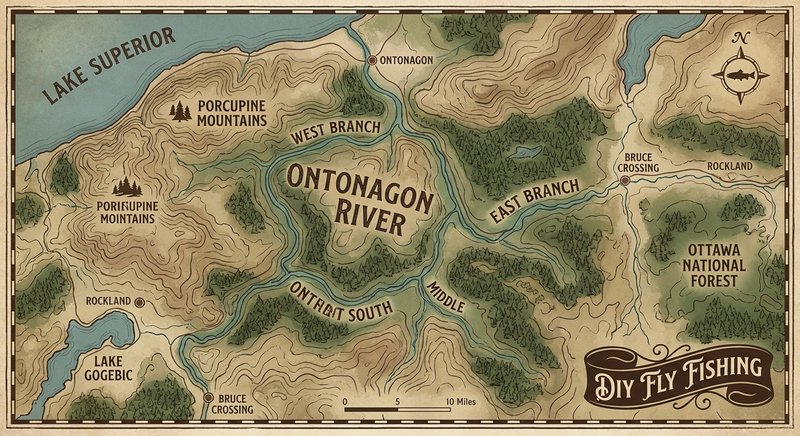
Ontonagon River
Fly fishing in Michigan · Advanced · Best seasons: Spring, Fall
Target Species
Steelhead, Salmon, Brook Trout
About This Water
Western Upper Peninsula river with steelhead, salmon, and resident trout. Remote wilderness fishing.
Fishing Recommendations
Welcome to the wild and rugged heart of Michigan’s Upper Peninsula. As your guide, I can tell you that the Ontonagon River is not for the faint of heart. It is one of the largest river systems in the U.P., draining a massive area of the Ottawa National Forest into Lake Superior.
Fishing here is a "frontier" experience. You aren't dealing with manicured banks and crowds; you’re dealing with tea-colored (tannic) water, slippery rocks, and some of the hardest-fighting lake-run fish in the Midwest.
🎣 Location Overview
The Ontonagon is defined by its four main branches (East, Middle, West, and South) that eventually converge into the main stem.
- The Main Stem: Deep, slow, and often murky, acting as the highway for migratory fish.
- The Branches: This is where the magic happens. These sections offer classic freestone characteristics—riffles, deep pools, and log jams.
- Why it’s special: It is a truly remote fishery. Unlike the more famous rivers of the Lower Peninsula, you can often find solitude here. The water is heavily stained by tannins (looking like dark tea), which allows anglers to get a bit closer to fish than in crystal-clear streams, but it requires high-contrast fly patterns.
🐟 Target Species & Behavior
Steelhead (Adipose-clipped and Wild)
These are the stars of the show. Ontonagon steelhead are known for their acrobatics.
- Behavior: In the spring, they push up to gravel stretches to spawn. In the fall, they follow salmon to feast on eggs.
- Holding Water: Look for "seams" where fast water meets slow water, and deep "tail-outs" at the end of runs.
Salmon (Chinook and Coho)
The fall run brings heavy-bodied King (Chinook) and Silver (Coho) salmon.
- Behavior: They are aggressive when they first enter from the lake but become territorial as they move toward spawning gravel.
- Feeding: They aren't actively feeding to grow, but they strike out of aggression or instinct.
Brook Trout (The Natives)
The upper reaches and colder tributaries hold beautiful, wild Brookies.
- Behavior: They love cover. If there is a fallen log or an overhanging bank, a Brookie is under it.
- Feeding: Opportunistic. They love terrestrial insects in late summer and small nymphs year-round.
📅 Best Times to Fish
Spring (Late March – May)
- Focus: Steelhead.
- Window: The "Ice Out" is the trigger. As soon as the snowmelt begins and water temps hit the 40°F mark, fish start moving. Mid-April is usually the "sweet spot" for the peak run.
Fall (September – November)
- Focus: Salmon followed by "Fall Run" Steelhead.
- Window: September brings the Salmon. By mid-October, the Salmon are spawning, and the Steelhead are right behind them eating eggs. This is arguably the best time for a trophy fish.
Best Time of Day
- In the tea-colored water, light penetration is low. Unlike clear rivers, you don't necessarily need to be there at the crack of dawn. 10:00 AM to 3:00 PM often provides the best visibility for the fish to see your fly.
🪰 Recommended Flies & Techniques
Steelhead & Salmon
- Technique: Indicator Nymphing or "Chuck-and-Duck" (due to the depth and flow).
- Flies:
- Eggs: Glo-Bugs or Estaz Eggs in "Oregon Cheese," "Pink Hot Spot," or "Chartreuse." (High visibility is key in dark water).
- Nymphs: Size 8-12 Hexagenia nymphs, Stoneflies (black or gold), and Prince Nymphs.
- Streamers: Black or Purple Egg-Sucking Leeches. The contrast of purple against tea-colored water is a local secret.
Brook Trout
- Technique: Dry-dropper or small streamers.
- Flies:
- Dries: Royal Wulff, Elk Hair Caddis, or Foam Ants (August).
- Streamers: Small Olive Wooly Buggers or Muddler Minnows.
💡 Pro Tips & Local Knowledge
- Contrast is King: In the dark, tannic water, don't use subtle colors. Use Fluorescent Orange, Chartreuse, and Solid Black. If the fish can't see it, they won't eat it.
- The "Middle Branch" Secret: The Middle Branch near Agate Falls is spectacular for scenery, but focus your fishing below the barriers where the lake-run fish congregate.
- Watch the Flow: The Ontonagon rises and falls rapidly with rain or snowmelt. Always check the USGS gauges. If the water looks like "chocolate milk," go get a pasty (local meat pie) and wait a day for it to settle to "root beer" color.
- Heavy Tippet: These fish live in "woody" environments. Don't play around with 6x tippet. For Steelhead, use 10lb or 12lb fluorocarbon. You need to be able to horse them away from submerged logs.
⚠️ Important Information
Access
- Much of the river is within the Ottawa National Forest, providing excellent public access. However, there are pockets of private land, especially near the mouth in the town of Ontonagon.
- Key access points include bridges on M-28, US-45, and various Forest Service roads. A high-clearance vehicle is recommended for forest roads.
Regulations
- License: A Michigan All-Species Fishing License is required for Steelhead and Salmon.
- Type 3 & Type 4 Waters: The Ontonagon has specific designations. Some sections are open year-round, while others follow the general trout season. Always check the current Michigan DNR Fishing Guide before casting.
- Great Lakes Splake/Trout Limits: Be aware of the specific bag limits for Lake Superior migratory fish.
Special Considerations
- Safety: The rocks here are notoriously slippery (Upper Peninsula "grease"). Wading boots with studs and a wading staff are mandatory.
- Wildlife: This is bear and wolf country. Carry bear spray if you are deep in the forest, and always let someone know your GPS coordinates.
- Cell Service: Expect zero bars once you leave the main highway. Download your maps offline.
Tight lines! The Ontonagon is a challenging river, but landing a chrome Steelhead in the middle of a silent U.P. forest is a memory you'll never forget.
Bug Hatches & Matching Flies
| Hatch | Type | Peak months | Time of day | Hook sizes | Matching flies |
|---|---|---|---|---|---|
| Blue-Winged Olive (BWO) Baetis / Acerpenna | mayfly | April, May, September, October | Mid-day | #18-22 | RS2 #18-20, Parachute BWO #18-22, BWO CDC Emerger #18-20 |
| Hendrickson Ephemerella subvaria | mayfly | May | Afternoon | #12-14 | Red Quill #12-14, Hendrickson Emerger #12-14, Pheasant Tail Nymph #12-14 |
| Grannom Caddis Brachycentrus | caddis | May | Morning/Afternoon | #14-16 | Elk Hair Caddis (Green body) #14-16, Pupa-loosa #14-16, Holy Grail #14-16 |
| Sulphur Ephemerella invaria / rotunda | mayfly | June | Evening | #14-18 | Sulphur Parachute #14-18, Sulphur Snowshoe Emerger #16-18, Sulphur Spinner #14-16 |
| Brown Drake Ephemera simulans | mayfly | June | Evening/Night | #10-12 | Brown Drake Cripple #10-12, Brown Drake Spinner #10-12, Hare's Ear Nymph #10-12 |
| Hex Hexagenia limbata | mayfly | June, July | Night | #6-8 | Hex Paradox #6-8, Wiggle Hex Nymph #6-8, Roberts Yellow Drake #8 |
| Golden Stonefly Acroneuria lycorias | stonefly | June, July | Afternoon/Evening | #8-12 | Pats Rubber Legs (Gold) #8-10, Chubby Chernobyl #8-12, Golden Stone Nymph #10-12 |
| Isonychia / Slate Drake Isonychia bicolor | mayfly | July, August, September | Afternoon/Evening | #10-12 | Iso Parachute #10-12, Zug Bug #10-12, Prince Nymph #10-14 |
| Terrestrials Formicidae / Gryllidae | terrestrial | July, August, September | All Day | #12-18 | Cinnamon Ant #16-18, Foam Beetle #14-16, Dave's Hopper #12-14 |