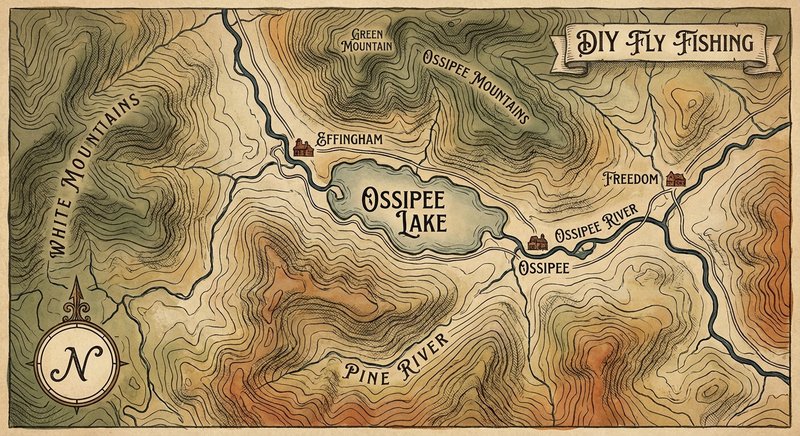
Ossipee Lake
Fly fishing in New Hampshire · Intermediate · Best seasons: Spring, Summer, Fall
Target Species
Smallmouth Bass, Landlocked Salmon, Pickerel
About This Water
Carroll County lake with bass and salmon. Near Mount Washington valley.
Fishing Recommendations
Welcome to one of the most versatile fisheries in the Lakes Region of New Hampshire. Ossipee Lake is a unique gem because it offers a "choose your own adventure" experience. Whether you want to hunt aggressive Landlocked Salmon in the cold winds of spring or pop for Smallmouth Bass in the lily pads of the bays, Ossipee delivers.
Here is your comprehensive guide to fly fishing Ossipee Lake.
🎣 Location Overview
Ossipee Lake is the state’s sixth-largest lake, but it fishes smaller than it looks because it is broken into a main basin and several connected "bays" (Broad Bay, Leavitt Bay, and Berry Bay).
What makes Ossipee special is its structure. Unlike many deep, bowl-shaped glacial lakes, Ossipee features expansive sandy flats, dramatic drop-offs, and significant river influences from the Bearcamp and Pine Rivers. The water is generally clear but has a slight "tea stain" compared to Winnipesaukee, which helps fly anglers get a bit closer to wary fish.
🐟 Target Species & Behavior
Smallmouth Bass
The "Smallies" here are known for their golden hue and incredible fight.
- Behavior: In spring, they move to the sandy/rocky shallows to spawn. In summer, they retreat to the "shelves" where the flats drop from 10 feet into 30 feet.
- Feeding: They focus heavily on crayfish and the lake’s abundant population of landlocked smelt.
Landlocked Salmon
These are the "silver bullets" of the north.
- Behavior: They are temperature-dependent. When the water is below 60°F, they are in the top 10 feet of the water column. As it warms, they go deep.
- Feeding: Smelt, smelt, and more smelt. If you find the bait clouds on your electronics, the salmon are nearby.
Chain Pickerel
Often overlooked but a blast on a fly rod.
- Behavior: These are ambush predators. They sit motionless in the "cabbage" (weed beds) and lily pads found primarily in the bays.
- Feeding: Anything that moves. They are highly aggressive and will chase a fly right to the boat.
📅 Best Times to Fish
- Spring (Ice-out through June): Prime Time. This is the only time Landlocked Salmon are easily accessible to fly anglers on the surface. It is also when Smallmouth Bass are in the shallows.
- Summer (July - August): Best for Smallmouth at dawn/dusk and Pickerel in the weeds all day. Salmon are generally too deep (40+ feet) for traditional fly gear during this time.
- Fall (September - October): The "Second Season." As water temperatures drop, salmon move back toward the river mouths (Bearcamp River), and bass feed aggressively on the flats to bulk up for winter.
Pro Timing: Overcast, slightly breezy days are best. The "Ossipee Chop" breaks up the surface, making salmon and bass less spooky.
🪰 Recommended Flies & Techniques
For Landlocked Salmon
- Flies: Classic New England streamers like the Grey Ghost, Black Ghost, or Joe’s Smelt (Sizes 4–8, long shank).
- Technique: Trolling a fly is the local tradition, but "searching" with a fast-sink tip line and a rhythmic strip-strip-pause retrieve near the river mouths is deadly.
For Smallmouth Bass
- Topwater: BoogleBugs or foam poppers in chartreuse or white.
- Sub-surface: Clouser Minnows (Blue/White to mimic smelt) and Hellgrammite patterns.
- Technique: Target rocky points and submerged wood. Use a versatile 6-weight rod with a weight-forward floating line.
For Pickerel
- Flies: Dahlberg Divers or large Bunny Leeches in bright orange, red, or chartreuse.
- Technique: Cast directly into the pockets of lily pads. Use a wire tippet or 30lb fluorocarbon bite guard, or they will snip your fly instantly.
💡 Pro Tips & Local Knowledge
- The "Channels": The narrow channels connecting the main lake to Broad and Leavitt Bays act as natural funnels. Fish the edges of the current here; bass often sit in the eddies waiting for bait to be pushed through.
- The Bearcamp Delta: The area where the Bearcamp River enters the lake is a massive sand delta. In the spring, this is a magnet for salmon. In the summer, the drop-off at the edge of this delta holds the biggest Smallmouth in the lake.
- The "Wind Side": Always fish the side of the lake the wind is blowing toward. The wind pushes the smelt (baitfish) against the shore, and the predators follow the buffet.
- Match the Smelt: Ossipee smelt are slender and silvery with a purple/blue sheen. Ensure your streamers have a bit of flash or UV material to mimic this.
⚠️ Important Information
- Access: The primary public boat launch is on Route 25 (Pine River boat ramp). There is also access via some of the marinas in the bays for a small fee.
- Regulations:
- NH Fishing License is required. You can buy them online via NH Fish & Game.
- Lead Ban: New Hampshire has strict laws regarding lead tackle. No lead sinkers or jigs weighing 1 ounce or less are permitted to protect the local loon population.
- Salmon Limits: There are specific length requirements for Landlocked Salmon (usually 15 inches minimum). Always check the current year’s NH Freshwater Fishing Digest for updates.
- Safety: Ossipee is notorious for kicking up a "square wave" chop when the wind comes out of the Northwest. If you are in a kayak or a small boat, keep a close eye on the weather.
Guide’s Final Word: If I had one day on Ossipee, I’d bring a 6-weight rod, a box of white Clouser Minnows, and spend my time hitting the rocky transitions between the main lake and Broad Bay. You never know if your next tug will be a 4lb Smallmouth or a 20-inch Salmon!
Bug Hatches & Matching Flies
| Hatch | Type | Peak months | Time of day | Hook sizes | Matching flies |
|---|---|---|---|---|---|
| Chironomids Chironomidae | midge | April, May, September | All day | #18-24 | Zebra Midge #18-22, Griffith's Gnat #20-24 |
| Hendrickson Ephemerella subvaria | mayfly | May | Afternoon | #12-14 | Red Quill #12-14, Hendrickson Emerger #12-14 |
| The Hex Hexagenia limbata | mayfly | June, July | Dusk/Night | #4-8 | Hexagenia Dry #6-8, Hex Nymph #4-8 |
| Light Cahill Stenacron candadense | mayfly | June, July | Evening | #12-16 | Light Cahill Dry #12-16, Gold Ribbed Hare's Ear #14-16 |
| Spotted Sedge Hydropsyche | caddis | May, June, July | Evening | #14-18 | Elk Hair Caddis #14-16, LaFontaine's Deep Sparkle Pupa #14-18 |
| White Miller Ephoron leukon | mayfly | August | Late Evening | #12-14 | White Wulff #12-14, White Miller Parachute #12-14 |
| Carpenter Ants Camponotus | terrestrial | May, June, August | All day | #10-16 | Black Foam Ant #12-16, Chernobyl Ant #10-12 |
| Golden Stonefly Acroneuria carolinensis | stonefly | June, July | Morning/Evening | #8-12 | Kaufmann's Stone #8-12, Golden Stimulator #10-12 |