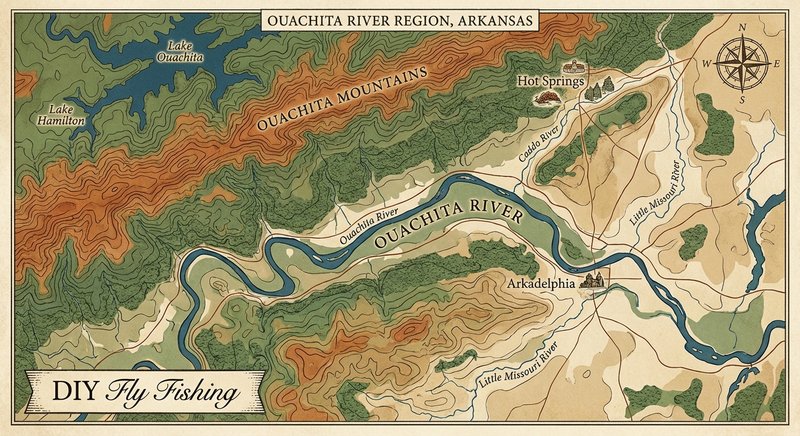
Ouachita River
Fly fishing in Arkansas · Intermediate · Best seasons: Spring, Summer, Fall
Target Species
Smallmouth Bass, Largemouth Bass, Catfish
About This Water
Scenic mountain river with smallmouth bass. Flows through Ouachita National Forest.
Fishing Recommendations
The Ouachita River (pronounced WASH-i-tah) is one of the crown jewels of the Natural State. Originating in the Ouachita Mountains of western Arkansas, it offers a diverse fly fishing experience that transitions from a rugged, rocky mountain stream to a wide, powerful river. For the fly angler, the "Upper Ouachita" (above Lake Ouachita) is legendary for its wild Smallmouth Bass, while the stretches below the dams offer excellent variety for Largemouth and even surprisingly sporty opportunities for Catfish.
🎣 Location Overview
The Ouachita River is defined by its ancient geology. Unlike the limestone-heavy Ozarks to the north, the Ouachita Mountains are composed of shale and chert, giving the river a distinct character.
- The Upper River: From Pine Ridge down to the headwaters of Lake Ouachita, the river is characterized by "pool and drop" mechanics. You’ll find long, turquoise-tinted pools separated by Class I and II rapids and fields of "willow justice" (dense water willows).
- The Mid-Section: Below Remmel Dam (Lake Catherine), the river becomes a tailwater. While known for seasonal trout, it quickly warms into a premier warm-water fishery as it flows toward Malvern and Arkadelphia.
- Why it's special: It offers a true wilderness feel. It is less crowded than the famous trout tailwaters of the White River system, providing a sense of solitude amidst stunning bluffs and dense pine forests.
🐟 Target Species & Behavior
Smallmouth Bass ("Brownies")
The undisputed king of the Upper Ouachita. These fish are lean, mean, and incredibly strong due to living in constant current.
- Behavior: They hold in "seams" where fast water meets slow water, behind large boulders, and deep within the water willow beds.
- Feeding: They focus heavily on crayfish and hellgrammites. In the summer, they look to the surface for dragonflies and terrestrial insects.
Largemouth Bass
Found more frequently in the slower, deeper "long pools" and the lower stretches of the river near wood cover.
- Behavior: They are ambush predators. Look for them near downed timber, submerged logs, and backwater sloughs where the current slackens.
- Feeding: They are less selective than Smallmouth, targeting larger forage like shad, sunfish, and frogs.
Catfish (Channel and Flathead)
While often overlooked by fly anglers, the Ouachita holds massive populations.
- Behavior: During the day, they lurk in the deepest "bluff holes." In the low light of evening, they move into the shallows and riffle headers to hunt.
- Feeding: On a fly rod, you aren't bait fishing. You are targeting their predatory instinct. They will crush heavy, dark streamers or crayfish patterns stripped slowly along the bottom of deep pools.
📅 Best Times to Fish
- Spring (April – June): This is the prime window. As water temperatures hit 60°F, Smallmouth become highly aggressive pre-spawn. Conditions: Keep an eye on water levels; spring rains can blow out the river quickly.
- Summer (July – August): The "Wet Wading" season. The water is lower and clearer.
- Prime Window: First light (5:00 AM – 9:00 AM) and "the witching hour" (sunset). Topwater action is at its peak during these times.
- Fall (September – early November): My personal favorite. The water cools, the bugs return, and the fish feed heavily to bulk up for winter. The scenery with the changing hardwood colors is world-class.
🪰 Recommended Flies & Techniques
Topwater (The most exciting way to fish the Ouachita)
- BoogleBug Poppers (Size 4-8): These are Arkansas staples. They are durable and have the perfect "pop."
- Stealth Bomber (Chartreuse or Black): Great for a more subtle "chug" and dive.
- Technique: Cast tight to the willow edges. Let the rings disappear before moving it. A "twitch-twitch-pause" rhythm is usually deadly.
Subsurface (The most productive)
- Clouser Minnow: Chartreuse/White or Olive/White. This mimics the native shiners and shad.
- Near Nuff Crayfish: If you aren't hitting the bottom, you're missing the Smallmouth. Fish this on a sink-tip line in the deeper holes.
- Gamechanger (Small): Excellent for Largemouth near wood cover.
- Hellgrammite Patterns: Dark brown or black woolly buggers with rubber legs work wonders in the riffles.
Presentation Tips
- The "Willow Swing": Cast your fly upstream of a patch of water willows and let the current swing it right along the edge of the vegetation.
- Strip-Set: Remember, these are bass, not trout. Do not "trout set" (lifting the rod). Point the rod at the fish and pull the line hard to set the hook in their bony mouths.
💡 Pro Tips & Local Knowledge
- The "Dragover" Stretch: The float from Dragover to Rocky Shoals is the most famous for a reason. It’s manageable for canoes/kayaks and holds some of the best Smallmouth water in the state.
- Watch the Gauge: For the Upper Ouachita, check the USGS gauge at Sims, AR.
- Under 3.5 ft: Too low, you'll be dragging your boat.
- 4.0 – 5.5 ft: Perfect fishing levels.
- Over 7 ft: Dangerous for novice paddlers; water will be murky.
- The "Catfish Secret": If you want to target Catfish, use a 7-weight or 8-weight rod with a heavy sink-tip line. Fish a large, black beaded leech or crayfish pattern in the "dead water" at the very bottom of a bluff hole. Move it painfully slow.
- Stealth is Key: In the clear summer water, the fish can see you from a distance. Long casts and drab-colored clothing will increase your hookup rate significantly.
⚠️ Important Information
- Access Point Gems:
- Pine Ridge: High up, very small water.
- Sims: Great launch point.
- Rocky Shoals: Popular takeout and great wade-fishing access.
- Regulations:
- You must have a valid Arkansas Fishing License.
- The Upper Ouachita is a Smallmouth Bass Management Zone. Check current AGFC (Arkansas Game and Fish Commission) regulations for length and creel limits—though most fly anglers practice 100% catch and release here.
- Safety: The Ouachita Mountains are remote. Cell service is non-existent in the river canyons. Always tell someone your float plan and wear a PFD; the rapids, while mostly mild, can pin a boat against "strainers" (downed trees) easily.
Guide’s Final Word: The Ouachita is a "soul" river. It’s not just about the numbers; it’s about the smell of the pines, the sight of a Bald Eagle, and the explosive strike of a Smallmouth in crystal clear water. Respect the river, and she'll treat you well.
Bug Hatches & Matching Flies
| Hatch | Type | Peak months | Time of day | Hook sizes | Matching flies |
|---|---|---|---|---|---|
| Blue Winged Olive Baetis spp. | mayfly | February, March, October, November | Late Morning/Afternoon | #18-22 | RS2 #18-22, Parachute Adams #18-22, Pheasant Tail Nymph #18-20 |
| Zebra Midge Chironomidae | midge | January, February, December | All Day | #18-24 | Zebra Midge (Black/Silver) #18-22, Griffith's Gnat #20-22, Palomino Midge #20-22 |
| Mother's Day Caddis Brachycentrus | caddis | April, May | Late Afternoon/Evening | #14-18 | Elk Hair Caddis #14-16, Holy Grail Caddis #14-16, Peacock Caddis #16-18 |
| White Fly Ephoron leukon | mayfly | August, September | Dusk/Evening | #10-14 | White Wulff #10-12, Ephoron Spinner #12-14, White Miller #12-14 |
| Sulphur Ephemerella invaria | mayfly | May, June | Evening | #14-16 | Sulphur Parachute #14-16, CDC Sulphur Emerger #14-16, Gold Ribbed Hare's Ear #14-16 |
| Light Cahill Stenacron canadense | mayfly | June, July | Evening | #12-14 | Light Cahill #12-14, Cream Variant #14, Pheasant Tail (Flashback) #14 |
| Grasshoppers Orthoptera | terrestrial | July, August, September | All Day | #8-12 | Dave's Hopper #8-12, Yug's Foam Hopper #10-12, Joe's Hopper #10-12 |
| Trico Tricorythodes | mayfly | July, August, September | Early Morning | #20-24 | Trico Spinner #20-24, Trico Female Dun #22-24, Black Zebra Midge #22-24 |