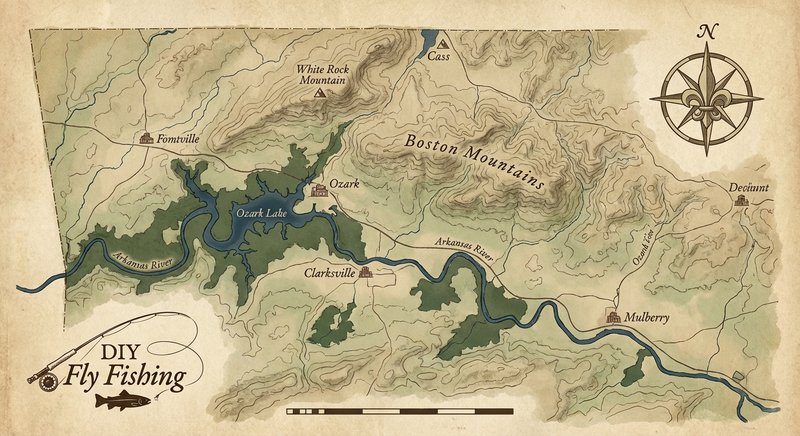
Ozark Lake
Fly fishing in Arkansas · Beginner · Best seasons: Spring, Summer, Fall
Target Species
Largemouth Bass, Spotted Bass, Crappie
About This Water
Arkansas River pool with good bass fishing. Near historic Ozark.
Fishing Recommendations
Welcome to the Arkansas River Valley. As a guide in this region, I can tell you that Ozark Lake (technically Pool 12 of the Arkansas River) is a hidden gem for the warm-water fly angler. Unlike the crystal-clear, deep mountain reservoirs of the Ozarks, this is a "river-lake" characterized by current, stained water, and incredible structure.
Here is your comprehensive guide to fly fishing Ozark Lake.
🎣 Location Overview
Ozark Lake is a 10,000-acre reservoir created by the Ozark-Jeta Taylor Lock and Dam. It stretches roughly 30 miles along the Arkansas River. What makes this water special is its diversity of habitat. You have the main river channel with heavy current and rock jetties (wing dams), vast backwater "sloughs" filled with lily pads and cypress knees, and deep creek arms like the Mulberry River confluence.
The water is typically stained (2–4 feet of visibility), which is actually an advantage for fly anglers—the fish aren't as "spooky," and they tend to hold tighter to shallow cover where a fly rod excels.
🐟 Target Species & Behavior
Largemouth Bass
These are the kings of the backwaters. They behave like classic ambush predators here. Look for them in the "dead loops" and sloughs away from the main river current. They hold tight to submerged stumps, lily pad edges, and water willow.
- Diet: Gizzard shad, sunfish, and crawfish.
Spotted Bass (Kentucky Bass)
In Ozark Lake, the "Spots" prefer the main river channel and the mouths of the larger creeks. They are more current-tolerant than Largemouths. You’ll find them stacked against rip-rap banks and the downstream side of wing dams.
- Behavior: They are aggressive and often school up to chase shad in the summer and fall.
Crappie
While usually a gear-angler's target, they are a blast on a 4-weight fly rod. They congregate in massive numbers around "brush piles" and submerged timber in the deeper sloughs.
- Behavior: They are suspended hunters. They look up to feed, making them perfect targets for a slowly stripped or "hovering" fly.
📅 Best Times to Fish
- Spring (March–May): This is the prime window. As water temps hit 55°F, bass move into the shallows of the backwaters to spawn. This is your best chance at a trophy Largemouth on a fly.
- Summer (June–August): Focus on the first two hours of daylight and the last hour before dark. During the heat of the day, fish the main river current where oxygen levels are higher.
- Fall (September–November): As temperatures drop, shad migrate into the creek arms. Look for "surface boils" where bass are corralling baitfish. This is the best time for fast-paced streamer action.
- The "Flow" Factor: Always check the Arkansas River flow rates. If the river is "blown out" (high, muddy red water), fishing is tough. If the flow is steady or dropping, the fishing is world-class.
🪰 Recommended Flies & Techniques
For Bass (Largemouth & Spotted)
- Topwater: BoogleBugs (size 4) or Umpqua Feather Merchants' Divers. Use a "pop-and-stop" retrieve near wood cover.
- Streamers: Clouser Minnows (Chartreuse/White or Grey/White) to mimic shad. For stained water, use a Black/Blue Woolly Bugger or a Gamechanger.
- Crawfish: Whitlock’s Near Nuff Craw. Fish this on a sink-tip line along the rip-rap jetties.
For Crappie
- Patterns: Micro-jig flies, Carty’s Crappie Candy, or small White Woolly Buggers (size 8–10).
- Technique: Use a slow, rhythmic strip. If they are deep, use a "strike indicator" (bobber) and hang the fly 4–6 feet down, twitching it over submerged brush.
Equipment Note
A 7-weight or 8-weight rod is standard for bass here. You need the "backbone" to pull a 5-pound bass out of heavy lily pads or timber. A weight-forward floating line works 80% of the time, but a sink-tip line is vital for fishing the river jetties in the summer.
💡 Pro Tips & Local Knowledge
- The "Wing Dam" Secret: On the main river, you’ll see rock jetties (wing dams) sticking out. The "scour hole" at the very tip of these jetties often holds the biggest Spotted Bass. Position your boat downstream and cast upstream into the eddy.
- The Mulberry River Mouth: Where the Mulberry River flows into Ozark Lake is a legendary spot. The mixing of the cooler, clearer Mulberry water with the river water creates a predatory feeding zone.
- Watch the Barges: When a large barge passes through, it creates a massive "surge" or "tide." This often stirs up baitfish and can trigger a 10-minute feeding frenzy. Be ready to cast as the surge hits the bank!
⚠️ Important Information
- Access: The Ozark Lake State Park offers great ramp access. The Clear Creek and Webb City areas are also excellent launch points for both powerboats and kayaks.
- Regulations: An Arkansas Fishing License is required. Check the Arkansas Game and Fish Commission (AGFC) website for current length and creel limits, as they can change annually.
- Safety: The Arkansas River is a commercial navigation channel. Barges have the right of way and cannot stop quickly. Always give them a wide berth and stay clear of the main navigation channel when anchored.
- Water Levels: Download the USACE Little Rock District app to monitor "Pool 12" levels and CFS (cubic feet per second) release from the dam.
Tight lines! If you find the right slough on a spring morning, you'll see why we call this the "Natural State."
Bug Hatches & Matching Flies
| Hatch | Type | Peak months | Time of day | Hook sizes | Matching flies |
|---|---|---|---|---|---|
| Midges Chironomidae | midge | January, February, March, December | All Day | #18-24 | Zebra Midge #18-22, Griffith's Gnat #20-24, WD-40 #20-22 |
| Blue Winged Olive Baetis | mayfly | February, March, October, November | Late Morning/Afternoon | #16-20 | RS2 #18-20, Parachute Adams #16-20, Pheasant Tail #16-18 |
| Mother's Day Caddis Brachycentrus | caddis | April, May | Evening | #14-16 | Elk Hair Caddis #14-16, Holy Grail #14-16, Green Caddis Larva #14-16 |
| Sulphurs Ephemerella invaria | mayfly | May, June, July | Evening | #14-18 | Sulphur Parachute #16-18, Sulphur Snowshoe Emerger #16-18 |
| Light Cahill Stenacron | mayfly | June, July | Late Afternoon/Dusk | #12-14 | Light Cahill #12-14, Gold Ribbed Hare's Ear #12-14 |
| Tricos Tricorythodes | mayfly | August, September | Early Morning | #22-26 | Trico Spinner #22-24, Trico Dun #22-24 |
| Scuds Gammarus | terrestrial | March, April, May | All Day | #14-18 | Ray Charles #14-18, Sowbug #14-16 |
| Terrestrials Formicidae / Orthoptera | terrestrial | July, August, September | Afternoon | #8-16 | Dave's Hopper #8-12, Chernobyl Ant #10-14, Black Foam Beetle #14-16 |