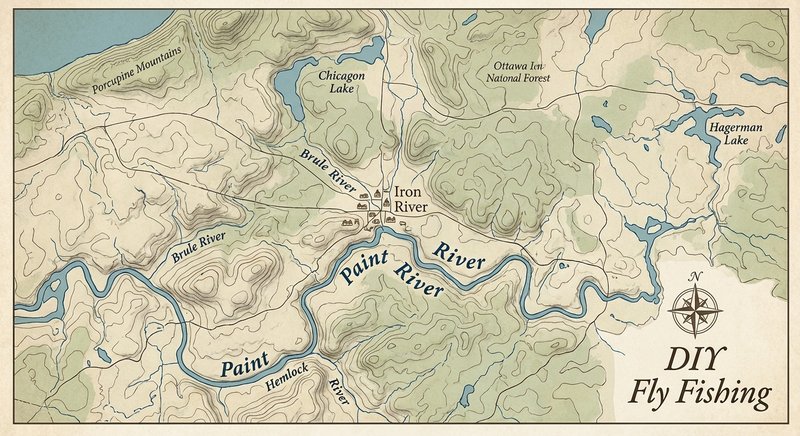
Paint River
Fly fishing in Michigan · Advanced · Best seasons: Summer, Fall
Target Species
Smallmouth Bass, Brook Trout, Brown Trout
About This Water
Upper Peninsula river with challenging whitewater sections. Excellent smallmouth and trout.
Fishing Recommendations
The Paint River in Michigan’s Iron County is one of the Upper Peninsula’s (U.P.) crown jewels. It is a diverse and rugged river system that offers a "Jekyll and Hyde" fishing experience: the upper branches are intimate cold-water trout havens, while the main stem transforms into one of the finest Smallmouth Bass fisheries in the Midwest.
🎣 Location Overview
The Paint River is defined by its wild, Northwoods character. Flowing through dense forests of hemlock, cedar, and pine, the water carries a heavy "tannic" stain—a tea-colored hue resulting from organic matter in the surrounding bogs.
What makes the Paint special is its variety. The North, South, and East Branches are classic cold-water streams where wild Brookies and Browns hide under undercut banks. As these branches converge near Crystal Falls and head toward the Brule and Menominee Rivers, the river widens, warms slightly, and becomes a playground for aggressive, trophy-sized Smallmouth Bass. Anglers love the Paint for its solitude; it is far less crowded than the famous rivers of the Lower Peninsula.
🐟 Target Species & Behavior
Smallmouth Bass (The Main Event)
The Smallmouth in the Paint are known for their dark coloration (due to the tannic water) and incredible fighting strength.
- Behavior: They are ambush predators. In the summer, they hold in the "heavy water" near the heads of pools, behind large boulders, and along wood-choked shorelines.
- Feeding: They gorge on rusty crayfish, emerald shiners, and hexagenia mayflies during the hatch.
Brook & Brown Trout
Found primarily in the Upper Branches and the colder tributaries.
- Behavior: Brook trout are opportunistic but spooky in the clear-but-stained water. Brown trout are more nocturnal and territorial, holding in deep logs and under overhanging alders.
- Feeding: They rely heavily on terrestrial insects (ants, beetles) in late summer and small sculpins or leeches.
📅 Best Times to Fish
Summer (June – August)
- Prime Window: This is the peak for Smallmouth Bass. The Hexagenia limbata (Hex) hatch occurs in late June through early July, offering a rare opportunity to catch trophy Smallmouth on massive dry flies at dusk.
- Time of Day: For trout, fish the early morning or late evening to avoid the heat. For bass, "bank banging" with streamers works all day, but topwater action peaks in low light.
Fall (September – October)
- Prime Window: Late September is magical. The Smallmouth start to school up and feed aggressively before winter.
- Conditions: As water temperatures drop, trout activity increases in the main stem as they move toward spawning tributaries. The fall colors in the U.P. provide a world-class backdrop.
- Time of Day: Mid-day becomes more productive as the sun warms the water.
🪰 Recommended Flies & Techniques
For Smallmouth Bass
- Topwater: Murdoch’s Wiggle Minnow (Orange/Gold), Boogle Bugs, or large foam poppers. The "splat" of the fly hitting the water often triggers a strike.
- Streamers: Kelly Galloup’s Dungeon (Olive or Black), Clouser Minnows (Chartreuse/White), and crayfish patterns like the Near Nuff Crayfish.
- Technique: Use a 6 or 7-weight rod with a sink-tip line to get streamers down into the pockets behind boulders.
For Brook & Brown Trout
- Dry Flies: Royal Wulff, Elk Hair Caddis, and Amy’s Ant. The stained water makes high-visibility flies essential.
- Nymphs: Prince Nymphs and Pheasant Tails (size 12-16).
- Technique: Tight-line nymphing through the deeper runs or "dapping" dry flies under low-hanging branches in the North Branch.
💡 Pro Tips & Local Knowledge
- The "Big Three" Branches: If you want trout, head to the North Branch. It has the most consistent cold water. For Smallmouth, the stretch from the Crystal Falls Dam down to the confluence with the Brule is legendary.
- Read the Tannic Water: Because the water is dark, fish cannot see you as easily as they can in clear spring creeks, but they are very sensitive to vibration. Wade quietly.
- The Crayfish Factor: The Paint is loaded with rusty crayfish. If the fishing is slow, switch to a burnt-orange or ginger-colored streamer and "crawl" it along the bottom.
- Float vs. Wade: The main stem is best fished from a raft or drift boat, as the "boulder gardens" can be treacherous to wade. The branches are much more wade-friendly.
⚠️ Important Information
Access
- Main Stem: Good access at the power dam in Crystal Falls and various bridges (e.g., US-2, MI-69).
- Branches: Access is more difficult and often involves forest service roads. A high-clearance vehicle and a good GPS (like OnX Maps) are highly recommended.
Regulations & Permits
- License: A standard Michigan Fishing License is required.
- Season: Trout season generally opens the last Saturday in April and closes September 30th on most Type 1 stretches. Smallmouth are catch-and-release year-round, with a possession season typically starting in late May.
- Check the current Michigan DNR Fishing Guide for specific stretch designations (Type 1-4).
Special Considerations
- Cell Service: Expect zero bars once you leave the main roads. Tell someone where you are going.
- Bugs: The U.P. is famous for black flies and mosquitoes in June and July. Bring heavy-duty repellent and a head net.
- Wildlife: This is black bear and wolf country. While they generally avoid humans, keep a clean camp if you are overnighting.
Bug Hatches & Matching Flies
| Hatch | Type | Peak months | Time of day | Hook sizes | Matching flies |
|---|---|---|---|---|---|
| Hendrickson Ephemerella subvaria | mayfly | May | Afternoon | #12-14 | Red Quill #12-14, Hendrickson Emerger #14, Pheasant Tail #12-14 |
| Grannom Caddis Brachycentrus | caddis | May | Morning/Afternoon | #14-16 | Elk Hair Caddis (Dark) #14-16, Peacock Caddis #16, Deep Sparkle Pupa #14-16 |
| Sulphur Ephemerella invaria | mayfly | June | Evening | #14-18 | Sulphur Parachute #16-18, CDC Comparadun #14-16, Gold Ribbed Hare's Ear #14-16 |
| Brown Drake Ephemera simulans | mayfly | June | Evening/Dusk | #10-12 | Brown Drake Cripple #10-12, Brown Drake Spinner #10-12, Harrop's Hair Wing Drake #12 |
| Giant Michigan Mayfly (Hex) Hexagenia limbata | mayfly | June, July | Night | #4-8 | Hexagenia Spinner #6-8, Robert's Yellow Drake #8, Hex Nymph #6-8 |
| Slate Drake Isonychia bicolor | mayfly | July, August, September | Afternoon/Evening | #10-14 | Iso Parachute #12-14, Zug Bug #10-12, Prince Nymph #12-14 |
| White Miller Ephoron leukon | mayfly | August | Evening | #12-14 | White Wulff #12-14, Snowshoe Dun #14, Light Cahill #14 |
| Blue-Winged Olive Baetis species | mayfly | May, September, October | Afternoon | #18-22 | BWO Sparkle Dun #18-20, RS2 #20-22, WD-40 #20 |
| Terrestrials Formicidae/Orthoptera | terrestrial | July, August | All Day | #8-16 | Joe's Hopper #8-12, Black Foam Ant #14-16, Chernobyl Ant #8-10 |