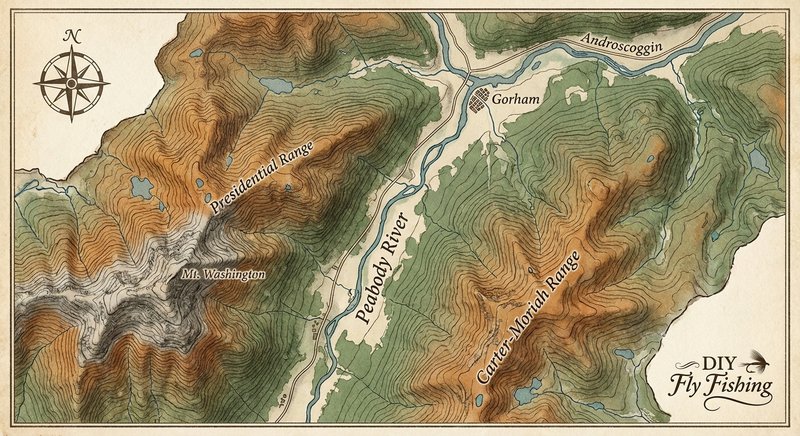
Peabody River
Fly fishing in New Hampshire · Beginner · Best seasons: Summer, Fall
Target Species
Brook Trout
About This Water
Mount Washington area stream with brook trout. Scenic Pinkham Notch.
Fishing Recommendations
As an expert guide who has spent years navigating the granite-choked streams of the White Mountains, I can tell you that the Peabody River is a quintessential New Hampshire mountain stream. It is a rugged, high-gradient freestone river that drains the eastern slopes of Mount Washington. If you are looking for technical, "blue-line" style fishing with the backdrop of the highest peaks in the Northeast, this is your water.
🎣 Location Overview
The Peabody River is a classic cold-water fishery characterized by boulder gardens, plunging waterfalls, and deep, crystal-clear pools. It begins near Pinkham Notch and flows north toward Gorham, where it meets the Androscoggin River.
What makes the Peabody special is its resilience. Because it is fed by the high-altitude snowpack and springs of the Presidential Range, it stays significantly cooler than other regional rivers during the heat of summer. It is a "pocket water" paradise—anglers love it because it rewards stealth and accurate casting rather than long-distance bombs.
🐟 Target Species & Behavior
The primary draw here is the Wild Brook Trout. While you may find some stocked fish near the bridges or lower reaches, the upper sections are home to vibrant, wild "salters" (though landlocked here) with fiery orange bellies and white-edged fins.
- Behavior: These fish are opportunistic but wary. In the fast current, they don't have long to decide whether to eat. They hold in the "cushion" in front of boulders, in the soft seams next to heavy whitewater, and in the tail-outs of pools during low light.
- Feeding: Their diet consists mainly of small stoneflies, caddis, and terrestrial insects (ants/beetles) that fall from the dense overhanging canopy.
📅 Best Times to Fish
While the river is open according to state seasons, your specified windows are the "Sweet Spots."
- Summer (Late June – August): This is prime time. When other rivers in New Hampshire get too warm for ethical trout fishing (above 68°F), the Peabody remains a cold sanctuary.
- Time of Day: Early morning (6:00 AM – 10:00 AM) and "the magic hour" before sunset.
- Fall (September – October): This is the most beautiful time to be on the water. The Brook Trout begin to spawn and move into their brilliant spawning colors.
- Prime Window: Mid-day becomes better as the water cools. Look for aggressive strikes as fish become territorial.
- Conditions: Fish after a light rain when the water has a slight "tea" stain, but avoid it during heavy runoff, as the river becomes a dangerous torrent very quickly.
🪰 Recommended Flies & Techniques
The Peabody is not a place for delicate 7x tippet and size 24 midges. You need flies that float high and are easy to see in broken water.
Top Fly Patterns
- Dry Flies:
- Royal Wulff or Royal Coachman (Size 12-14): The classic attractor.
- Elk Hair Caddis (Tan/Olive, Size 14-16): Imitates the prolific caddis life.
- Stimulators (Orange or Yellow, Size 10-12): Great for the "Dry-Dropper" rig.
- Chernobyl Ant or Foam Beetles: Essential for the late summer "terrestrial" bite.
- Nymphs:
- Pheasant Tail (Bead-head, Size 14-18): A universal producer.
- Prince Nymph (Size 12-14): The flash works well in the dark shadows of the boulders.
- Streamers:
- Black or Olive Woolly Bugger (Size 8-10): Swing these through the deeper pools for the larger "resident" brookies.
Techniques
- High-Sticking: Due to the complex currents, keep as much fly line off the water as possible. Use a short leader (7.5 ft) to maintain control in the pockets.
- Dry-Dropper: This is the most effective way to fish the Peabody. Hang a weighted nymph 18-24 inches below a buoyant dry fly.
- Stealth: The water is clear. Approach pools from downstream (fishing "up") and stay low to avoid casting a shadow over the fish.
💡 Pro Tips & Local Knowledge
- The "Dolly Copp" Stretch: The area around the Dolly Copp Campground is legendary. It offers excellent access and a variety of water types, from flat glides to heavy rapids.
- Look for the "Backwater": Sometimes the biggest brookies in the stream aren't in the main current; they are in the tiny, quiet pockets behind massive boulders that most people walk right past.
- The "One-Cast" Rule: In these small pockets, your first cast is your best chance. If you slap the water or drag your line, the fish will spook and hide for an hour.
- Gear Recommendation: Use a 2-weight or 3-weight rod, 7 to 8 feet in length. A 9-foot rod is often too long for the overhanging brush.
⚠️ Important Information
- Access: Route 16 parallels much of the river. There are numerous pull-offs between Gorham and the Pinkham Notch Visitor Center. The Great Gulf Wilderness trailhead also provides access to the upper, more remote reaches.
- Regulations: Always check the current NH Fish & Game Wild Trout regulations. Many sections of the Peabody are open to general regulations, but being a steward of wild fish, Catch and Release is strongly encouraged to preserve the population.
- Wading Safety: The Peabody is notoriously slippery. The rocks are "greasy" and often unstable. Felt soles (where legal) or studded rubber boots and a wading staff are highly recommended.
- Wildlife: This is moose and bear country. Be aware of your surroundings, especially when hiking in the dense brush along the banks.
Guide’s Final Word: The Peabody isn't about trophy-sized fish—a 10-inch Brookie here is a king. It’s about the purity of the environment, the crisp mountain air, and the jewel-like beauty of a wild trout in your hand. Tight lines!
Bug Hatches & Matching Flies
| Hatch | Type | Peak months | Time of day | Hook sizes | Matching flies |
|---|---|---|---|---|---|
| Blue-Winged Olive Baetis / Acerpenna | mayfly | May, September, October | Midday | #18-22 | BWO Sparkle Dun #18-20, Pheasant Tail Nymph #18-22 |
| Hendrickson Ephemerella subvaria | mayfly | May | Afternoon | #12-14 | Hendrickson Pink Lady #12-14, Red Quill #14 |
| Early Black Stonefly Taeniopteryx / Capniidae | stonefly | April, May | Late Morning | #14-18 | Early Black Stone #16, Zebra Midge #18-20 |
| March Brown Maccaffertium vicarium | mayfly | June | Afternoon | #10-14 | March Brown Dry #12, Gold Ribbed Hare's Ear #10-12 |
| Golden Stonefly Acroneuria | stonefly | June, July | Evening/Night | #6-10 | Kaufmann's Stone #8-10, Stimulator (Yellow) #8-12 |
| Spotted Sedge Hydropsyche | caddis | June, July, August | Evening | #14-16 | Elk Hair Caddis #14-16, LaFontaine's Deep Sparkle Pupa #14-16 |
| Light Cahill Stenacron / Stenonema | mayfly | June, July | Evening | #14-16 | Light Cahill #14-16 |
| Black Ants Formicidae | terrestrial | July, August | All Day | #16-20 | Black Foam Ant #16-18, Cinnamon Ant #18 |
| Slate Drake Isonychia bicolor | mayfly | August, September | Late Afternoon | #10-14 | Isonychia Nymph #10-12, Parachute Adams #12-14 |