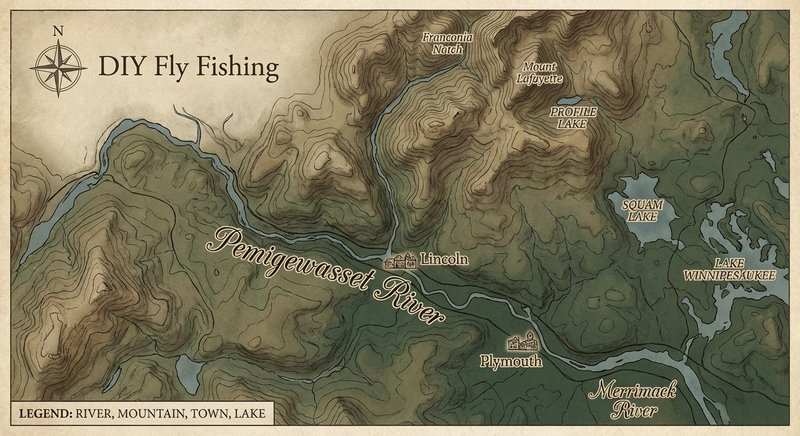
Pemigewasset River
Fly fishing in New Hampshire · Beginner · Best seasons: Spring, Summer, Fall
Target Species
Brook Trout, Brown Trout, Rainbow Trout
About This Water
White Mountain river with trout and bass. Scenic Franconia Notch area.
Fishing Recommendations
The Pemigewasset River, affectionately known by locals as "The Pemi," is the lifeblood of the White Mountains in New Hampshire. Stretching from the Profile Lake in Franconia Notch down to its confluence with the Winnipesaukee River, it offers some of the most diverse and scenic trout fishing in New England.
As your guide, here is the comprehensive breakdown for fishing this granite-studded gem.
🎣 Location Overview
The Pemi is a classic freestone river characterized by crystal-clear water, massive granite boulders, and steep gradients in its upper reaches. It transitions from a tumbling mountain stream in Franconia Notch State Park to a medium-sized river as it flows through Thornton, Campton, and Plymouth.
What makes it special is the sheer accessibility paired with mountain scenery. Because it follows the I-93 corridor, you can find world-class pocket water just minutes from the highway. The river is oxygen-rich, making it a "trout factory," though it is highly dependent on snowmelt and rainfall.
🐟 Target Species & Behavior
- Brook Trout: In the headwaters (above North Woodstock), you’ll find wild, native "salters" (though landlocked here). They are small, vibrant, and incredibly opportunistic. In the main stem, the state stocks larger brookies that frequent the slower eddies.
- Rainbow Trout: These are the "workhorses" of the Pemi. They love the fast, oxygenated water. Look for them in the "heavy water"—the "riffle-above-the-pool" or the "bubble line" where the current brings food directly to them.
- Brown Trout: The Pemi holds some surprisingly large, holdover browns. Unlike the rainbows, browns prefer "overhead cover." They hold under undercut banks, beneath downed timber, or at the very bottom of deep, dark pools during the day, coming out to hunt at dusk.
📅 Best Times to Fish
- Spring (Late May – June): This is the "Prime Time." Once the heavy snowmelt (freshet) subsides and water temps hit 50°F, the fish become extremely active. This coincides with the major insect hatches.
- Summer (July – August): The lower sections can get warm. During mid-summer, head north. Focus on the "Upper Pemi" inside Franconia Notch where the water stays cool. Fish early mornings (5 AM – 9 AM) and late evenings.
- Fall (September – October): My personal favorite. The Brown Trout become aggressive as they prepare to spawn, and the Brook Trout take on incredible spawning colors. The water levels are usually lower, making the river very easy to wade and read.
🪰 Recommended Flies & Techniques
Nymphing (The High-Yield Method)
Because the Pemi is a freestone river with a rocky bottom, the fish do 90% of their feeding underwater.
- Patterns: Pat’s Rubber Legs (Size 8-12) in coffee/black, Pheasant Tail Nymphs (14-18), and Prince Nymphs.
- Technique: Use a "High-stick" or European Nymphing approach in the pocket water. The currents are complex; keeping your fly line off the water prevents drag and gets the fly down to the "zone."
Dry Fly (The Exciting Method)
- Patterns: Elk Hair Caddis (14-16) is the gold standard here. For the Upper Pemi, a Royal Wulff or Stimulator (12-14) works wonders as an attractor.
- Technique: Look for the "bubble line." If your fly isn't floating at the exact speed of the bubbles, the trout will ignore it.
Streamers (For the Trophy Hunters)
- Patterns: Black or Olive Woolly Buggers, and the Grey Ghost (a classic NH pattern).
- Technique: Swing streamers through deep pools or "strip" them aggressively near downed logs to trigger a reaction strike from a big Brown.
💡 Pro Tips & Local Knowledge
- The "Greasy" Rocks: The granite in the Pemi is notoriously slick. Studded wading boots are not optional—they are a safety requirement. A wading staff is also highly recommended.
- Focus on the Pockets: Many anglers walk right past the small pockets behind boulders to get to the big pools. In the Pemi, a 2-foot wide pocket of calm water behind a rock often holds the best fish in the river.
- Check the Gauges: Before heading out, check the USGS gauge at Woodstock. If it's over 800 cfs, wading can be dangerous. The "sweet spot" for wade fishing is generally between 200 and 500 cfs.
- The "Mother’s Day" Caddis: Around mid-May, the river sees a massive hatch of Grannom Caddis. If you catch this window, the fishing is legendary.
⚠️ Important Information
- Access: Great access points are found at the Whale’s Tale Water Park (behind it), Blair Bridge in Campton, and various pull-offs along Route 3.
- Regulations: NH Fish & Game manages the Pemi. You need a standard NH Fishing License. Note that some tributaries may have different rules, but the main stem is generally open to bait, lures, and flies unless otherwise posted.
- Safety: The Pemi is a mountain river. It can rise rapidly during a heavy thunderstorm. Always keep an eye on the water level at the shoreline.
- Catch & Release: While the state stocks the river for harvest, I recommend releasing any wild-looking Brook Trout to preserve the heritage of these mountain waters.
Guide’s Final Word: The Pemi isn't just a river; it's a classroom. It will teach you how to read water and manage drag. Respect the current, watch the hatches, and you'll have a day you won't soon forget. Tight lines!
Bug Hatches & Matching Flies
| Hatch | Type | Peak months | Time of day | Hook sizes | Matching flies |
|---|---|---|---|---|---|
| Blue Winged Olive Baetis | mayfly | April, May, September, October | Late Morning/Afternoon | #18-22 | RS2 #20-22, Parachute BWO #18-20, BWO CDC Emerger #20-22 |
| Hendrickson Ephemerella subvaria | mayfly | May | Afternoon | #12-14 | Red Quill #12-14, Hendrickson Nymph #12-14, Snowshoe Rabbit Emerger #14 |
| Grannom Caddis Brachycentrus | caddis | May | All Day | #14-16 | Peacock Caddis #14-16, LaFontaine Deep Sparkle Pupa #14-16, Elk Hair Caddis (Olive) #14-16 |
| March Brown Maccaffertium vicarium | mayfly | May, June | Afternoon | #10-12 | March Brown Dry #10-12, Gold Ribbed Hare's Ear #10-12, March Brown Wet #12 |
| Sulphur Ephemerella invaria | mayfly | June | Evening | #14-18 | Sulphur Parachute #14-18, Pheasant Tail #16-18, Sulphur CDC Spinner #16-18 |
| Yellow Sally Isoperla | stonefly | June, July | Evening | #14-16 | Yellow Sally Dry #14-16, Golden Stone Nymph #14-16, Stimulator (Yellow) #14-16 |
| Light Cahill Stenacron canadense | mayfly | June, July | Evening | #12-14 | Light Cahill Dry #12-14, Light Cahill Wet #14, Cream Variant #12 |
| Slate Drake Isonychia bicolor | mayfly | July, August, September | Late Afternoon | #10-12 | Prince Nymph #10-12, Zug Bug #10-12, Dun Variant #10-12 |
| Cinnamon Caddis Hydropsyche | caddis | July, August | Evening | #16-18 | Tan Elk Hair Caddis #16-18, Soft Hackle Hare's Ear #16, Hydropsyche Larva #16-18 |
| Giant Black Stonefly Pteronarcys dorsata | stonefly | May, June | Night/Early Morning | #4-8 | Pat's Rubber Legs #6-8, Kaufmann Stone #4-8, Chernobyl Ant #8-10 |