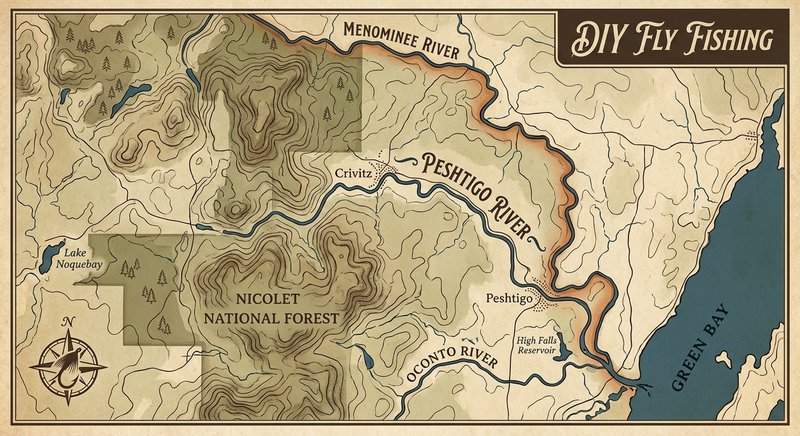
Peshtigo River
Fly fishing in Wisconsin · Beginner · Best seasons: Spring, Summer, Fall
Target Species
Brook Trout, Brown Trout, Smallmouth Bass
About This Water
Northeast Wisconsin river with trout and smallmouth bass. Beautiful northwoods setting.
Fishing Recommendations
Welcome to the "Roaring Rapids" of the Northwoods. As your guide, I can tell you that the Peshtigo River is one of the most diverse and rugged river systems in the Midwest. Flowing through the wild terrain of Marinette and Forest Counties, it offers a "Dr. Jekyll and Mr. Hyde" experience: the upper reaches are a cold-water trout paradise, while the middle and lower sections are world-class smallmouth bass territory.
Here is your comprehensive guide to fly fishing the Peshtigo.
🎣 Location Overview
The Peshtigo River is a classic freestone-style river characterized by dark, tannic "root beer" colored water and a bed of ancient granite boulders. It is famous for its high gradient, featuring some of the most challenging whitewater in Wisconsin.
Anglers love the Peshtigo because it feels wild. Much of the best water is tucked away in the Nicolet National Forest or surrounded by Marinette County forest land. The river is divided into distinct zones:
- The Upper River: Above Caldron Falls, it is a smaller, intimate trout stream.
- The Middle Section: Between the flowages (High Falls and Caldron Falls), you’ll find incredible trout water and the famous "Fly Fishing Only" stretch.
- The Lower River: Below Johnson Falls, the river warms and transforms into a premier Smallmouth Bass fishery with heavy rapids and deep pools.
🐟 Target Species & Behavior
Brook Trout
Found primarily in the upper reaches and the cold-water tributaries. They are opportunistic but wary. Look for them in the "pocket water" behind boulders and in the undercut banks of the quieter stretches. They feed heavily on caddis larvae and small terrestrials.
Brown Trout
The "Kings" of the Peshtigo. They inhabit the deeper runs and the shaded banks of the middle river. Browns here can grow to impressive sizes (18"+) by feeding on crayfish and smaller baitfish. They are notoriously light-shy; you’ll find them most active during low-light periods or when the water is slightly turbid after a rain.
Smallmouth Bass
Pound for pound, the hardest fighting fish in the river. They hold in the "seams" where fast water meets slow water, and in the eddies behind large granite outcrops. They are aggressive predators, keyed into crayfish, dace, and stoneflies.
📅 Best Times to Fish
- Spring (May - June): This is the "Golden Age" for trout. The Hendrickson and Sulfur hatches bring the big browns to the surface. Water levels are usually high, so heavy nymphing is often required early in the season.
- Summer (July - August): The best time for Smallmouth Bass. They are most active when the water warms. For trout, focus on early mornings and late evenings. This is "Hopper-Dropper" season on the upper river.
- Fall (September - October): A spectacular time to be on the water. Brown trout become aggressive as they prepare to spawn (please stay off active redds). Smallmouth bass feed heavily to bulk up for winter. The fall colors in Marinette County are a bonus.
🪰 Recommended Flies & Techniques
For Trout (Upper/Middle River)
- Dry Flies: Hendrickson (Size 12-14), Light Cahill (14-16), Elk Hair Caddis (14-18), and Stimulators (8-12) for the pocket water.
- Nymphs: Bead-head Prince Nymphs, Pheasant Tails, and Rubber-legged Stoneflies. The Peshtigo has a massive population of Golden Stoneflies.
- Streamers: Woolly Buggers (Black or Olive) and Muddler Minnows. Swing these through deep pools and under log jams.
For Smallmouth Bass (Middle/Lower River)
- Topwater: Hard-body poppers or Boogle Bugs in yellow, orange, or black.
- Sub-surface: Clouser Minnows (Chartreuse/White), Near Nuff Crayfish, and Gamechangers.
- Technique: Use a 6-weight or 7-weight rod. Cast towards the banks or into the eddies behind large boulders and use erratic strips to mimic a wounded baitfish or fleeing crayfish.
💡 Pro Tips & Local Knowledge
- The "Fly Fishing Only" Stretch: There is a legendary 5-mile stretch of the Peshtigo below Johnson Falls Flowage that is designated as Category 5 (Fly Fishing Only, Catch and Release). This area holds some of the highest trout densities and beautiful pocket water.
- The Tannic Tint: Because the water is dark (stained by hemlock and cedar tannins), use flies with a bit of "flash" or high-contrast colors (fluorescent orange beads or white wings) to help the fish track the fly.
- Wading Safety: This river is notoriously slippery. The granite boulders are rounded and covered in "snot" (algae). Studded wading boots and a wading staff are non-negotiable here, especially in the swifter currents.
- The Evening Rise: On the Peshtigo, the best dry fly action often happens in the final 30 minutes of daylight. Don't leave the water until it's too dark to tie a knot.
⚠️ Important Information
Access Information
- Goodman Park & McClintock Park: Excellent access points for the upper river with beautiful footbridges and well-maintained trails.
- Johnson Falls: The primary access for the trophy trout water.
- Peshtigo River State Forest: Provides numerous walk-in access points.
Regulations & Permits
- License: A valid Wisconsin Fishing License and an Inland Trout Stamp are required.
- Variable Regs: The Peshtigo has complex regulations that change by bridge and dam. Some sections are "Catch and Release Only," while others have specific bag limits. Always consult the current WDNR Trout Tool or pamphlet before your first cast.
- Dam Releases: Be aware that the dams (Caldron Falls, High Falls, Johnson Falls) can release water at any time. If you notice the water level rising or becoming muddy, exit the river immediately.
The Peshtigo isn't a river that gives up its secrets easily, but for the angler willing to hike through the pines and navigate the boulders, it offers some of the finest fly fishing in the Northwoods. Tight lines!
Bug Hatches & Matching Flies
| Hatch | Type | Peak months | Time of day | Hook sizes | Matching flies |
|---|---|---|---|---|---|
| Blue-Winged Olive (BWO) Baetis spp. | mayfly | April, May, September, October | Midday | #18-22 | RS2 #20-22, Parachute BWO #18-22, Pheasant Tail #18-20 |
| Hendrickson Ephemerella subvaria | mayfly | May | Afternoon | #12-14 | Red Quill #12-14, Hendrickson Emerger #12-14, Hare's Ear #12-14 |
| Grannom Caddis Brachycentrus | caddis | May | All day | #14-16 | Elk Hair Caddis (Olive) #14-16, LaFontaine's Deep Sparkle Pupa #14-16, Peacock Caddis #16 |
| Sulphur Ephemerella invaria/dorothea | mayfly | June | Evening | #14-18 | Sulphur Parachute #14-18, CDC Sulphur Emerger #16-18, Yellow Pheasant Tail #16 |
| Brown Drake Ephemera simulans | mayfly | June | Late Evening/Dusk | #10-12 | Brown Drake Spinner #10-12, Extended Body Drake #10, Brown Drake Nymph #10-12 |
| Golden Stonefly Acroneuria spp. | stonefly | June, July | Morning/Evening | #6-12 | Pat's Rubber Legs #6-10, Stimulator (Yellow) #8-12, Golden Stone Nymph #8-12 |
| Slate Drake Isonychia bicolor | mayfly | July, August, September | Afternoon | #10-14 | Iso Parachute #12-14, Zug Bug #10-14, Prince Nymph #12-14 |
| Trico Tricorythodes spp. | mayfly | July, August | Early Morning | #20-24 | Trico Spinner #22-24, Trico Dun #20-22, Zebra Midge #20-22 |