Pigeon River
Fly fishing in Michigan · Intermediate · Best seasons: Spring, Summer, Fall
Target Species
Brook Trout, Brown Trout
About This Water
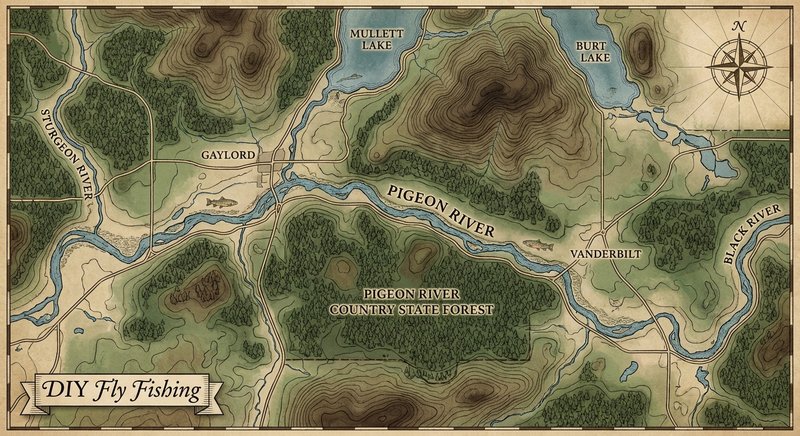
Flows through the Pigeon River Country State Forest. Excellent brook and brown trout fishing in remote setting.
Fishing Recommendations
As an expert guide who has spent years navigating the "Big Wild" of Northern Michigan, I can tell you that the Pigeon River is one of the crown jewels of the Midwest. Located in the heart of the 100,000-acre Pigeon River Country State Forest, it offers a truly remote, backcountry experience that is rare in the Lower Peninsula.
Here is your comprehensive guide to fly fishing the Pigeon River.
🎣 Location Overview
The Pigeon River is a classic freestone-style Michigan stream, characterized by its cold, clear water, sandy bottom, and an abundance of woody debris (logs and "sweepers"). What makes the Pigeon special is its solitude. Unlike its famous neighbors—the Au Sable or the Manistee—the Pigeon feels wild.
The river flows north toward Burt Lake, carving through cedar swamps and hardwood forests. It is part of the "Big Five" (along with the Sturgeon, Black, Au Sable, and Manistee), but it is arguably the most rugged. It is a "Blue Ribbon" trout stream that requires a bit of hiking and a lot of stealth, rewarding anglers with some of the most beautiful native Brook Trout and wild Brown Trout in the state.
🐟 Target Species & Behavior
- Brook Trout: These are the gems of the upper river. They are native, aggressive, and opportunistic feeders. They hold in the cold headwaters and smaller tributaries, typically tucked tightly under overhanging alders or in the shadows of submerged logs.
- Brown Trout: As the river gains volume in the middle and lower sections, the Brown Trout become the dominant predator. These fish are wary and highly structure-oriented. They love the deep undercut banks and the "tangled messes" of downed cedar trees.
- Behavior: Pigeon River trout are easily spooked. Because the water is often crystal clear and the river isn't overly wide, these fish have a high "startle response." They feed heavily on aquatic insects but will not hesitate to smash a well-placed terrestrial or streamer if the presentation is subtle.
📅 Best Times to Fish
- Spring (Late April – May): This is the start of the "classic" season. The Hendrickson hatch in late April and early May is the first major event. Fishing is best during the warmer afternoons.
- Summer (June – August):
- June is the pinnacle. You’ll see Sulphurs, Isonychia, and the legendary Hexagenia limbata (though the Hex hatch is more localized on the lower sections of the Pigeon than on the Manistee).
- July and August are "Terrestrial Time." Look for mid-day action with hoppers, beetles, and ants.
- Fall (September – October): This is the time for trophy Browns. As they prepare to spawn, they become aggressive and territorial. Streamer fishing during a drizzly October day can produce the biggest fish of the year.
- Prime Windows: Early morning for Trico hatches or spinner falls; late evening for the heavy caddis and Mayfly activity.
🪰 Recommended Flies & Techniques
Top Fly Patterns
- Dry Flies:
- Standard: Parachute Adams (Size 14-18), Roberts Yellow Drake, Royal Wulff.
- Hatch Specific: Hendrickson Dark Variant, Sulphur Dun, Borchers Special.
- Terrestrials: Foam Hoppers, Cinnamon Ants, and Dave’s Hopper.
- Nymphs:
- Pheasant Tail (Size 14-16), Gold-Ribbed Hare’s Ear, and Prince Nymphs.
- Pro Tip: Use a "Dry-Dropper" rig to cover both bases in shallower runs.
- Streamers:
- Woolly Bugger (Black or Olive), Muddler Minnow (mimics sculpins), and Sparkle Minnows.
Effective Techniques
- The "Short Game": You aren't making 50-foot casts here. Focus on 15-20 foot accurate casts.
- Stealth Wading: Move slowly upstream. The Pigeon has a lot of silt and sand; if you stomp around, the "plume" of sediment will alert fish downstream of your presence.
- Dapping/Tight-Lining: In the brushiest sections, you may find yourself "dapping" a fly over a log jam rather than performing a traditional cast.
💡 Pro Tips & Local Knowledge
- Look for the Wood: On the Pigeon, "Wood is Good." If a spot looks impossible to cast into because of a fallen cedar, that is exactly where the biggest Brown Trout is sitting.
- The Elk Factor: The Pigeon River Country is home to one of the largest free-roaming Elk herds east of the Mississippi. Keep your eyes peeled; hearing an elk bugle while you're landing a Brookie is a quintessential Pigeon River experience.
- Focus on Sturgeon Valley Road: The stretches near Sturgeon Valley Road and the various State Forest campgrounds (Pigeon River, Round Lake) offer excellent access and classic water.
- The "Pigeon Poke": Use a roll cast or a side-arm cast to stay under the canopy of overhanging trees. Overhand casting will often result in "tree trout" (getting stuck in the branches).
⚠️ Important Information
- Access: Much of the river is within the State Forest, providing excellent public access. However, some parcels are private. Always use a tool like OnX Maps to ensure you are on public land.
- Regulations: The Pigeon has different regulations (Type 1, Type 4, etc.) depending on the stretch.
- Check the current Michigan DNR Trout Guide for specific bag limits and lure restrictions. Much of the river is gear-restricted (Artificial Lures Only).
- Cell Service: Expect zero cell service. Download your maps for offline use and let someone know your "float plan."
- Wading Safety: The river isn't deep, but the "logs and muck" can be treacherous. A wading staff is highly recommended to poke through the silt and find solid footing.
- Bears: This is black bear country. While they are generally shy, keep a clean camp if you are staying in the forest.
The Pigeon River isn't about high fish counts; it's about the quality of the experience and the beauty of the surroundings. Slow down, stay quiet, and enjoy the wildness. Tight lines!
Bug Hatches & Matching Flies
| Hatch | Type | Peak months | Time of day | Hook sizes | Matching flies |
|---|---|---|---|---|---|
| Blue-Winged Olive Baetis spp. | mayfly | April, May, September, October | Mid-day/Afternoon | #18-22 | BWO Sparkle Dun #18-20, Pheasant Tail #18-22, RS2 #20-22 |
| Hendrickson Ephemerella subvaria | mayfly | May | Afternoon | #12-14 | Hendrickson Dark Dun #12-14, Red Quill #12-14, Gold Ribbed Hare's Ear #12-14 |
| Grannom Caddis Brachycentrus | caddis | April, May | Morning/Afternoon | #14-16 | Elk Hair Caddis (Olive) #14-16, Holy Grail #14-16, Peacock Caddis Larva #14-16 |
| Sulphur Ephemerella invaria/dorothea | mayfly | June | Evening | #16-18 | Sulphur Parachute #16-18, Sulphur Spinner #16-18, Frenchie #16-18 |
| Brown Drake Ephemera simulans | mayfly | June | Dusk | #10-12 | Brown Drake Cripple #10-12, Brown Drake Spinner #10-12 |
| Hex (Giant Michigan Mayfly) Hexagenia limbata | mayfly | June, July | Night | #6-8 | Hex Parasol #6-8, Hex Wiggle Nymph #6-10, Robert's Yellow Drake #6-8 |
| Isonychia (Slate Drake) Isonychia bicolor | mayfly | July, August, September | Afternoon/Evening | #10-12 | Iso Parachute #10-12, Zug Bug #10-12, Isonychia Nymph #10-12 |
| Trico Tricorythodes | mayfly | July, August, September | Early Morning | #22-26 | Trico Spinner #22-24, Drowned Trico #22-24 |
| Grasshoppers Orthoptera | terrestrial | August, September | Afternoon | #8-12 | Dave's Hopper #10-12, Parachute Hopper #10-14 |
| Cinnamon Caddis Hydropsyche | caddis | June, July, August | Evening | #14-18 | X-Caddis (Tan) #14-16, LaFontaine's Deep Sparkle Pupa #14-18 |